Teachers enter the profession with different skills and strengths. It’s time to differentiate how we help them grow.
People typically enter the teaching profession because they want to connect with and inspire students to grow and develop. Teachers are drawn to this career because they like working with students and they like their content area (Loewus, 2021). Yet teaching is complex work. Meeting the diverse interests and needs of 25-30 students at the same time is challenging. The changes that came with the COVID-19 pandemic brought this complexity into the spotlight, and teachers are being more open about what they need to stay in such a demanding and rewarding profession.
A focus on compliance with top-down mandates has caused many teachers to feel like their needs and those of their students are overlooked or ignored. Higher salaries are needed, but without a change in how teachers are supported, the trend to leave the profession will continue (Marshall et al., 2022). And even among teachers who stay, it will be difficult, if not impossible, for them to spark a curiosity or love for learning in their students if they have lost theirs.
A different approach
So how can leaders encourage teacher development at a time when so many teachers are discouraged? It is possible. Consider these comments from teachers at an urban school at the end of 2021-22, the second full COVID school year:
- “I have really grown this year as an educator, and the good news is so have my students. I think that is due to all of the feedback and focused learning we have done.”
- “The high expectations and clear feedback have made an impact on my classroom practice. I can’t imagine leaving now; I am just getting some traction.”
- “I appreciated that my concerns about my students were never dismissed.”
When asked what made them feel this way, these teachers described a school where the entire staff had input on the school’s improvement goals. Together, the staff identified a narrow focus for improvement and had multiple opportunities to learn, use, and reflect on this practice. Professional development helped them develop a shared understanding, and they collaborated to determine what the improvement strategies would look and sound like when implemented in their classrooms.
Teachers felt supported as they implemented what they were learning. They received lots of feedback via a weekly schoolwide blog, individual conversations and notes from their principal, coaching cycles, and examination of student work in professional learning communities. When they hit snags in their classrooms, they could get support from their team, their coach, and the principal. Their learning felt relevant, and they saw how these practices had a direct impact on their students.
This approach works because it begins with understanding the complexity of making learning meaningful for a teaching staff with diverse backgrounds and experience. Teachers aren’t all starting at the same place or coming from the same vantage point. Skill levels can vary dramatically based on not only the teacher’s years of experience, but also their willingness to try new techniques. Learning doesn’t happen in the same way, or at the same time, for everyone. It requires differentiation.
Differentiating instruction based on student needs is not a new concept to educators. Since the days of the one-room schoolhouse, educators have been challenged to teach students of different ages and abilities. We know differentiation is good for students, but it is also essential to teacher learning.
Creating the conditions for differentiated teacher learning
Differentiating learning for teachers in schools starts with acknowledging and addressing schools as complex systems. Schools are made of multiple interconnected parts. This interconnection results in a ripple effect in which one thing is touched, and other parts of the system are affected. The more attention we pay to the links between the parts, the more likely it is that improvements to the system will be sustainable.
The analogy of a garden helps to illustrate this concept. The interdependence between soil, seeds, and layout determines growth. Gardens flourish when gardeners give deliberate attention to the relationship between these elements. The same is true in schools. Helping everyone in the system grow and develop requires connecting all parts of the system. Professional learning for teachers must be tightly connected to the overall improvement efforts of the school. Having a clear focus; providing individual, small group, and whole-group learning; and rethinking supervision makes this happen.
Establish learning goals
Establishing clear and focused goals for the school is a critical first step to differentiating teacher learning. While this may seem counterintuitive, focusing on a small number of key high-yield strategies helps teachers with their individual growth in two very important ways.
First, having a clear focus on what is essential helps schools avoid competing initiatives that vie for teachers’ time and attention. Going after too many things at once results in frantic activity that leads nowhere. When everyone in the system shares a deep understanding about the purpose and nature of the work, the result is coherence, rather than chaos (Fullan & Quinn, 2016). Having clear goals helps remove the noise emanating from competing agendas in many schools. It forces leaders to make decisions about what is most important at the current moment in time. Being clear about the end game (goals) and how to get there (strategies) allows schools to say no to some initiatives and sets the stage for focused feedback. Armed with a skinny school improvement plan, all staff can work collectively toward mutually defined goals.
The second reason focusing on just a few goals matters is because it promotes collective teacher efficacy. This is the belief that together we can make a difference on outcomes for students (Goddard, Hoy, & Woolfolk Hoy, 2004). Learning flourishes in an environment where both adults and students believe they have what it takes to be successful. The combination of consensus about goals, teachers’ knowledge about one another’s work, and a cohesive staff promotes teachers’ collective efficacy (Donohoo, 2017). When schools have a clear idea of where they are headed, they can align resources to make sure teachers have what they need to be successful. Collective capacity occurs because everyone is rowing in the same direction.
For example, a school might have a goal to improve problem solving. One team in the school might determine that they need to set a goal of having students explain and justify their thinking when solving problems. An individual teacher on that team may determine that they also need to work on using rubrics so students can monitor and self-assess their work when problem solving. Focused goals create interdependence and allow for differentiation based on student and teacher need.
Layer professional learning
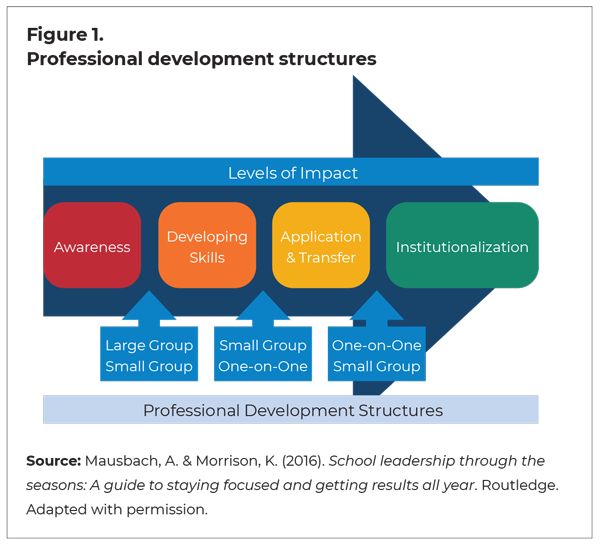
The goal for professional learning is to improve outcomes for students. Teachers need to transfer and apply learning to real-life situations in their classrooms. For this to happen, leaders need to pay attention to how teacher learning is organized (Joyce & Showers, 1980).
As learners move from awareness to institutionalization of new practices, the kinds of structures they need for learning shift (see Figure 1). Because learning isn’t linear, support needs to come in layers, which means teachers need opportunities to learn in large groups, in small groups, and one-on-one simultaneously. The key is to blanket teachers with the support they need to learn and grow, including providing multiple opportunities to learn in multiple ways.
Providing multiple opportunities for learning requires deliberate planning. Identifying staff outcomes and developing a long-range plan to get there helps make this happen. Staff outcomes should come from the strategies and action steps found in the school improvement plan. For example, a school improvement plan for improving achievement might include a goal to use formative assessments. One of the action steps could be to implement questions, cues, and prompts. And one of the outcomes for staff could be that they effectively use these questioning techniques to guide instruction. Developing a list of staff learning outcomes based on a collaboratively developed school improvement plan connects professional learning to classroom practice and enhances both ownership and understanding. Creating a list of outcomes makes the work ahead clearly visible.
A long-range plan enables leaders to identify topics for large- and small-group learning every week of the school year. Having this in hand at the beginning of the school year helps ensure that valuable learning time isn’t wasted. This plan can guide any one-on-one learning that occurs through coaching cycles and principal feedback.
Collaborative work that uses evidence, analysis, and action planning empowers teachers to determine where they need to grow and puts them on a pathway toward collective efficacy.
The long-range plan should be fluid. As teams gather evidence of strategy implementation, observe in classrooms, and analyze student work, they will need to adjust the overall plan to address the teams’ and individual teachers’ needs. For example, in a school that is focusing on learning intentions and success criteria, a team might identify that they need to revisit earlier learning on teacher clarity, while another team works on making sure students can articulate their learning. An individual teacher may need support in getting students’ attention during whole-group instruction so learning intentions and success criteria can have impact. Professional learning remains focused but gets adjusted based on evidence.
Without a tentative long-range (one-year) plan for professional growth, the learning of teachers can fall prey to the dreaded “activity” trap, treating professional development as a series of events that are loosely related, lack relevance, and have little hope of impacting teaching and learning.
Approach supervision differently
Teacher learners must be open to new ideas, be willing to admit when they don’t know how to help a struggling student, and have the courage to address lackluster data. Creating environments where teachers feel free to take risks and wrestle with the thorny challenges inherent in classrooms requires a different level of support than what many current evaluation systems tend to offer.
Traditional models treat supervision as an event, something done “to” rather than “with” a teacher. Walk-throughs, if used, often provide generic feedback using a checklist developed by the principal and a summative evaluation based on impractical rubrics. These practices erode openness and vulnerability. A better approach accounts for the individual needs of teachers and teams while helping build trust and improve student outcomes. This requires leaders to differentiate their support and feedback, so teachers can learn in context and apply their learning to their students’ daily needs.
Differentiated supervision means adapting to what teachers need and students deserve (Mooney & Mausbach, 2008). This approach embraces the idea that knowing, understanding, and responding to each teacher’s unique needs enables teachers to develop and grow. Multiple opportunities to learn must be provided and promoted using focused, actionable feedback. Consistent feedback based on what is happening in the classroom provides teachers specific information and opportunities to dialogue about both their needs and their students. Feedback is strength-based, highlighting the unique talents and challenges of individual teachers. One-on-one conversations allow teachers to find and share their thinking, successes, and struggles so feedback is tailored to their situation.
To address the challenge of improving an entire system while simultaneously addressing the individual needs of a diverse teaching staff, supervisors can think of their school improvement work as existing along two axes (Mausbach & Morrison, 2022). The vertical axis relates to the intended focus for improvement (building or classroom), and the horizontal is defined by the purpose of feedback (formative or summative). Figure 2 shows the relationship between these two axes and the types of learning processes and feedback involved in each quadrant.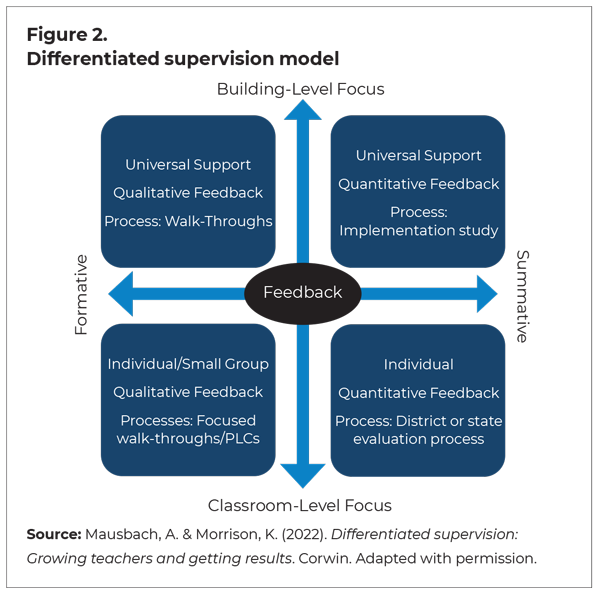
Differentiation within this model occurs in two distinct ways. First, the entire model is designed so that a leader can differentiate supervision practices based on whether they want to move and support the whole school or focus on individual teams and teachers. The second way differentiation is addressed is through generous amounts of qualitative feedback to individual teachers, which is where the majority of teacher learning will occur. All the elements work together to provide an individual teacher what they need when they need it.
A hallmark of learning is when the learner can apply what they have learned to new and unique situations. This involves synthesizing new information and comparing it to their existing understandings. Teachers need a system of support that helps them wrestle with and apply their new learning. Supervision must be more than a series of steps that lead to a final evaluation for this type of learning to occur. It must be about creating a culture where examining practice, working together to figure out issues, and constantly improving is the norm. When supervision is approached in this manner, it is a powerful driver for learning and growth.
Generic or all-encompassing feedback limits reflection and self-regulation. Narrative feedback, tailored to the individual, helps reinforce effective practices, refine ineffective ones, and promote reflection on what to do differently next time.
Making it happen
Differentiating teacher learning requires attention to the following practices.
Creating an infrastructure of support
The first step in making this work happen is to build an infrastructure of support. Infrastructure refers to the physical and organizational structures needed for the operation of an enterprise. An infrastructure is pivotal because it holds up the rest of the work. Much like a trellis in a garden provides support and direction for plants to grow, so does the way a leader organizes the work of the adults. Without upfront planning on what these structures will be, the hope of effective teacher learning dies on the vine.
Some important elements of an effective infrastructure need to occur before implementation of new learning or initiatives. These include feedback cycles placed on the principal’s weekly schedule and collaborative teams that will lead and support school improvement work. Plans for collaboration should address not only when to meet, but also outcomes and processes for analyzing student work. Putting these structures in place allows for individualization as teachers receive feedback every week via their collaborative team and face-to-face feedback at a minimum of every three weeks. Like a trellis in a garden, a well-designed infrastructure provides both structure and flexibility so when some teachers need more support a leader can respond.
Paying attention to the work in collaborative teams
The work in collaborative teams directly influences individual development. Collaborative work serves as the lens for helping determine how to support individual teachers. Individual skill and knowledge development are complemented by group learning. Group work, when done right, serves as the platform for deep learning, allowing individuals to collaboratively wrestle with the complexities of helping all students learn and in turn improve individual performance. This is why collaborative learning based on teachers’ everyday work has a lasting effect on classroom practice (Darling-Hammond, 1998; Little, 1990). When teachers engage together in an ongoing process of analyzing student work, instructional concerns can surface immediately, leading the team to spend more time on a concept or take a deeper look.
Teacher — and ultimately student — learning is enhanced when teacher teams spend time analyzing student evidence to determine what impact their actions have had on the learner and identify what they need to do next. Collaborative work that uses evidence, analysis, and action planning empowers teachers to determine where they need to grow and puts them on a pathway toward collective efficacy.
Relying on qualitative rather than quantitative feedback
Feedback is central to how we learn and grow. If we want to get better at something, we need information on how we are doing. Specific and descriptive feedback promotes self-awareness. It can serve as a voice in the person’s head, as they constantly think and reflect on how to advance or make changes if necessary.
Generic or all-encompassing feedback limits reflection and self-regulation. Narrative feedback, tailored to the individual, helps reinforce effective practices, refine ineffective ones, and promote reflection on what to do differently next time. It’s easier for a teacher to think about and act on feedback that invites dialogue and reflection. Effective qualitative feedback provides a descriptive analysis of the situation, materials, or student work. This type of feedback should be given in small relevant chunks over time in face-to-face discussions with the principal, teacher leaders, and peers.
Using look-fors as a learning tool
Look-fors are clear statements that describe an observable teaching or learning behavior, strategy, outcome, product, or procedure (Mooney & Mausbach, 2008). Collaboratively developed look-fors unify a school by helping create shared meaning and a common focus. Look -fors bridge the gap between learning and implementation because they help teachers understand the target. A look-fors stated as, “Students know the purpose of their learning and can articulate thinking strategies” is more attainable than a simple statement like “focus on rigor and relevance.”
Spending time discussing, identifying, and articulating what a strategy looks like in practice reveals what staff members know and what they still need to learn. The dialogue necessary to create and revisit look-fors helps leaders discern what aspects of the initiative teachers understood and where there may be misconceptions. This allows them to adjust professional learning to improve understanding and clear up misconceptions.
Embracing mistakes and the concept of ‘yet’
Learning something new can be uncomfortable and at times frustrating. Creating a culture where teachers feel open and willing to take risks requires trust and honesty. One way to develop this environment is to share mistakes. Starting meetings with, “This is what I did this week that didn’t go well. Can you help me identify why?” or “This strategy really missed the mark; I need to figure out a better way,” not only helps others learn, but models that mistakes are part of the learning process.
Since learning isn’t always a straightforward endeavor, it can be frustrating when results aren’t as expected. When this happens, “yet” needs to be the mantra. Statements such as “Results aren’t what we want yet” or “We haven’t tried ___ yet” can get individuals and teams back on track and ready to dig in again.
Honoring teachers’ uniqueness
Teachers, like all of us, want to work in a place where they feel seen and are able to grow and thrive. Differentiation at its essence is the act of recognizing the distinctions in and between things. If we ignore differences, individual teachers’ uniqueness can’t be valued and enhanced in a responsive and affirming way.
Valuing and supporting teachers in a way that accounts for diversity in their learning is the path forward — and it will model for them how to address differences among students. Differentiation requires focused goals, layered learning opportunities, and a different approach to supervision. These processes meet people where they are and provide footholds that help them grow in both understanding and their commitment to the profession.
References
Darling-Hammond, L. (1998). Teacher learning that supports student learning. Educational Leadership, 55 (5), 6-11.
Donohoo, J. (2017). Collective efficacy: How educators’ beliefs impact student learning. Corwin.
Fullan, M. & Quinn, J. (2016). Coherence: The right drivers in action for schools, districts, and systems. Corwin.
Goddard, R., Hoy, W., & Woolfolk Hoy, A. (2004). Collective efficacy beliefs: Theoretical developments, empirical evidence, and future directions. American Educational Research Association, 33 (3), 3-13.
Joyce, B. & Showers, B. (1980). Improving inservice training: The messages of research. Educational Leadership, 37 (5), 379-385.
Little, J.W. (1990). The persistence of privacy: Autonomy and initiative in teachers’ professional relations. Teachers College Record, 91 (4), 509-536.
Loewus, L. (2021, May 4). Why teachers leave — or don’t: A look at the numbers. Education Week.
Marshall, D.T., Pressley, T., Neugebauer, N.M., & Shannon, D.T. (2022). Why teachers are leaving and what we can do about it. Phi Delta Kappan, 104 (1), 6-11.
Mausbach, A. & Morrison, K. (2022). Differentiated supervision: Growing teachers and getting results. Corwin.
Mooney N. & Mausbach, A. (2008). Align the design: A blueprint for school improvement. ASCD.
This article appears in the May 2023 issue of Kappan, Vol. 104, No. 8, pp. 25-30.

ABOUT THE AUTHORS

Ann Mausbach
ANN MAUSBACH is an associate professor and director of the educational leadership program at Creighton University, Omaha, NE.
Kim Morrison Kazmierczak
KIM MORRISON KAZMIERCZAK is principal of Bloomer Elementary School, Omaha, NE.