By and large, the coverage produced by education reporters and news outlets has shined in recent weeks, with stories ranging from special education problems to secret DOE memos.
In the month since Mayor Bill de Blasio shut down New York City’s public schools and moved all instruction to remote learning, the city’s education journalists have certainly been busy.
Among those creating solid work on major topics and questions have been the staff at Chalkbeat NY, Eliza Shapiro of the New York Times, and Greg B. Smith and two other teammates at The City.
A look back at the coverage also reveals some holes in terms of topics that might have warranted more attention and some interesting perspectives, including from those at the front lines, and those who covered these extraordinary several weeks.
WHAT GOT COVERED
The number of areas addressed during these past several weeks have been numerous: de Blasio being urged to close public schools, access to technology, students with special needs, remote learning agreements establishing how teachers will serve students, and Department of Education employees testing positive for COVID-19 and passing away.
Some topics noticeably were not covered well, such as how teachers were coping with the transition to remote learning and if the DOE was helping them as it did its 1.1 million students. Also, public schools got nearly all the attention, despite nearly 100,000 students attending charter, private, and parochial schools in the city. But even with these gaps, what was covered was important and worthy of praise.
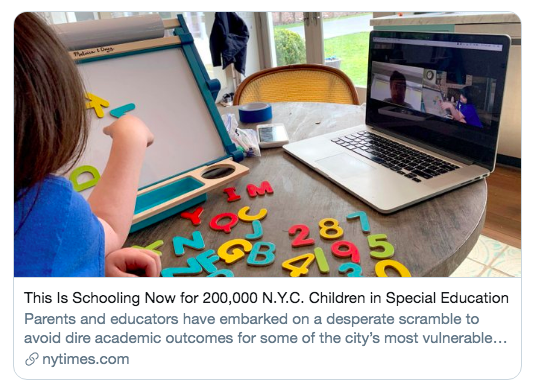
Above: One of NYT reporter Eliza Shapiro’s recent stories. You can read all of Shapiro’s recent coverage here.
WHO COVERED WHAT
A look at each outlet’s coverage shows several strong efforts:
The New York Times’ Eliza Shapiro, along with Elizabeth A. Harris, wrote a poignant article on the 200,000 children with special needs. She and Dana Goldstein collaborated on a detailed story that highlighted the battle between schools and unions over work rules for teachers conducting online learning. On her own, Shapiro wrote a memorable piece on the shutdown of NYC’s public schools. The Times’ Nikita Stewart wrote a powerful profile of a 10-year-old girl who couldn’t do remote learning because the homeless shelter she and her family are in has no internet access.
Not surprisingly, Chalkbeat NY produced the most abundant high-quality coverage of the crisis. An article by Alex Zimmerman first reported on the hint of schools closing on February 26. , Christina Veiga reported how Chancellor Richard Carranza was planning to put a nurse into every school. A few days later, the Chalkbeat team created a Live Update article displaying the rapid changes NYC was going through as pressures mounted for de Blasio to shut down schools. Since then, the Chalkbeat team has produced articles on alarming budget cuts, the deaths of many DOE staff, and what the summer will look like for students. [You can read all of Chalkbeat NY’s coronavirus coverage here.]
There are some honorable mentions as well, with Politico NY education reporters Madina Touré and Nick Niedzwiadek writing about the 6,000-student KIPP closing its doors and moving classes online before public schools did. This article is one of the rare non-public school pieces from these past several weeks.
Over at NY1 local cable news, Jillian Jorgensen displayed the challenges with remote learning, and a look at how schoolchildren are struggling to learn in homeless shelters, especially since most do not have internet access.
WNYC’s Jessica Gould produced a piece on how remote learning was a challenge for preschool kids.
The hidden gem was The City, a relatively new NYC-focused news outlet that provides content used by Chalkbeat and WNYC public radio. On March 13, reporters Greg B. Smith, Ese Olumhense, and Ben Fractenberg revealed the DOE sent an internal memo telling staff not to report anyone with COVID-19 symptoms to the city’s Department of Health and Mental Hygiene. On April 14, Smith reported the Department of Investigations was looking into this action.

Above: An example of COVID-19 coverage from The City. You can read all of its education coverage here.
REVIEWS AND REFLECTIONS
This is impressive work all around, according to David Bloomfield, professor of education leadership, law & policy at Brooklyn College and the CUNY Graduate Center. “I think the coverage has been fabulous for both the general media and the education media.”
Bloomfield also described how, in early March, talks of whether schools should be shut down may have played a role in the reports that were done. And he’s especially interested to see what will happen with the Department of Investigation’s review of the DOE’s memo. “That’s the big political story here. If the DOE was an accomplice in not announcing exposures, that’s scandalous.”
Not everyone is so impressed, however. Based on what she’s seen, Carlyn Cowen at the Chinese-American Planning Council of New York told The Grade that she’s not been seeing as much coverage focused on the most vulnerable populations in the city as she’d like. “A lot of what’s happening with the kids who are most on the margins is getting left out,” said Cowen. The standout has been The City, which Cowen says has been “doing amazing coverage.” “They’ve reached out to us a number of times, and they always ask, ‘What issues are we missing?’ I don’t generally see that.”
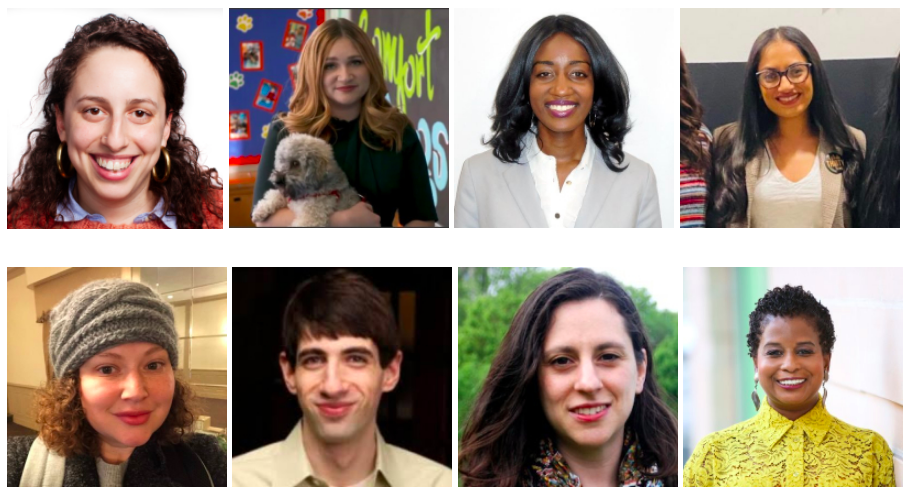
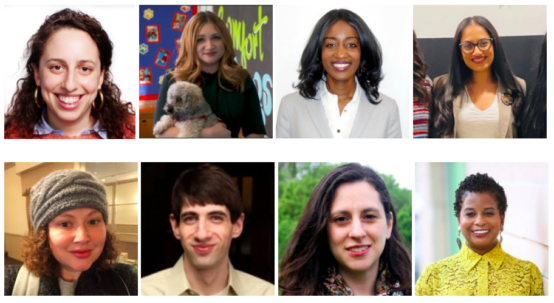
Above: Some of the reporters and editors who helped cover the NYC COVID-19 schools stories.
Amy Zimmer, the bureau chief for Chalkbeat NY, told us that she believes NYC’s education reporters should focus on more solutions-focused work since there’s a lot about remote learning that is and isn’t working. “There are so many questions about what will come next, and I think these forward-looking stories will be helpful, not only to help shape the dialogue, but also to calm some anxiety,” Zimmer explained via email.
This approach matters because it can “show families who are feeling unmoored by all of this uncertainty that thoughtful conversations are happening and that educators are really grappling with the fact that so many kids are inevitably falling behind.”
We reached out to several other education reporters who were involved with the coverage of the COVID crisis, either by email or social media. Most didn’t reply, but it is understandable. Education stories keep coming up with so many issues to discuss, and that is where their focus likely is. After all, education during COVID-19 has not been easy for anyone, and these education journalists are definitely on their toes, while doing admirable work at the same time.
Previous stories: Covering Chicago’s first week of remote learning
Keeping vulnerable kids front and center
ABOUT THE AUTHOR

Megan McGibney
McGibney is a freelance journalist, focusing on education, politics, and NYC life. She’s also an aspiring literary writer and mental illness advocate. Find her work at http://www.meganmcgibney.com. Follow her on social at @MeganMcGibney.