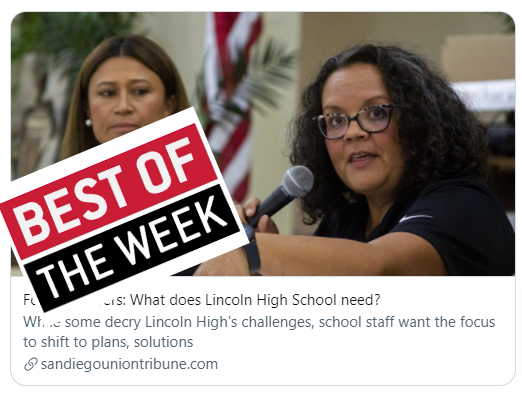
| 🏆 The best (non-COVID!) story of the week is from the San Diego Union-Tribune’s Kristen Taketa: What does Lincoln High School need? In it, Taketa looks at a school that has an image problem. It’s often seen as a “bad” school, but students and staff say there’s a lot of good stuff going on — beyond test scores. Its graduation rate has risen from 77% to 84% in just three years, and more students are getting into prestigious colleges. The school still has its struggles (some test scores are going down, after all, and principal turnover is high), but some school officials say raising alarm about its faults at the expense of celebrating its successes is hurting students. The story illustrates a different way for reporters to cover “failing schools,” one education journalists should keep in mind. “Instead of talking about the school, you should just come see it and find out,” says one student. “There’s some very smart and talented kids there; you have to get to know them.”
🏆 This week’s runner-up is Chicago fell behind on plans for students with disabilities during COVID-19. New data show the depth of the problem. by Samantha Smylie in Chalkbeat Chicago. Smylie tweeted that at the beginning of last school year, some special education advocates tipped her off that students with disabilities had lost communication with their IEP teams. So Smylie decided to investigate, submitting FOIA requests, doggedly following up with the notoriously nonresponsive Chicago Public Schools, and ultimately filing a lawsuit. The result is a solid, data-backed story spotlighting a vulnerable group of students left behind in the pandemic — a situation that has likely taken place in many other parts of the country. “During the 2019-20 school year — which saw an 11-day teacher strike and COVID-19 school closures — more than 10,050 re-evaluations, initial evaluations, and annual reviews were incomplete, a more than threefold increase over the previous school year,” Smylie wrote.
BONUS STORIES: Just 9% of Newark students met state math standards this spring, data show (Chalkbeat), The one certainty in Bay Area school reopenings: Uncertainty will continue (SF Chronicle), Behind D.C.’s scramble to get teens vaccinated before school starts (Washington Post).
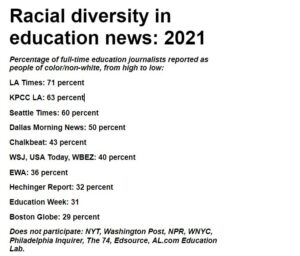
| Above: Among those who shared information, the Seattle Times, the LA Times, and KPCC reported the most racially diverse teams, while the Hechinger Report, Education Week, and the Boston Globe team had among the least diverse teams. |
|
COMMUNITY COVERAGE IN CLEVELAND
New from The Grade |
|
| Above: Cleveland Documenters Laylah Allen & Lawrence Caswell, and former Cleveland Plain Dealer education reporter Patrick O’Donnell.What to do when local news outlets stop covering schools the way they used to? In Cleveland, where the local paper is a shadow of what it used to be, a new program called The Documenters pays community members to take notes (and live tweet) school board meetings.
“It might not take the place of full-on journalism, but in some cases, Documenters work has helped a parent or changed a decision,” writes The Grade editor Amber C. Walker. The new piece was mentioned by NYU journalism professor Jay Rosen and Harvard’s Nieman Lab.

|
APOLOGIES, MANDATES, & PANIC COVERAGE
Thought-provoking commentary on the latest coverage.
|
|
|
ABOVE: The editor of Germany’s largest newspaper, BILD, recently apologized for “politics and media reporting that to this day, like poison, gives you the feeling that you are a mortal danger to our society.” Click the link to watch with English language subtitles.
PANIC REPORTING WARRANTS RECENT SCRUTINY: I’m glad to see media folks like Poynter’s Tom Jones and CNN’s Brian Stelter flagging inflammatory COVID coverage by mainstream news outlets. Former New Yorker writer James Surowiecki wrote a piece about “overwrought headlines, careless social-media writing … breeding unjustified fear and doubt.” But the problem is nothing new. For more than a year now, media coverage of COVID has persistently amplified risks, emphasized worst-case scenarios, and failed to give context. And the effect on school reopening has been dramatic. I hope that others like the Post’s Margaret Sullivan and NPR’s Kelly McBride will soon join in. And there’s been hardly a peep from the media watchdogs we depend on to keep coverage honest and on track.
MUDDLED REPORTING ON VACCINE OPPOSITION: On Thursday, the head of the AFT indicated some willingness to support a vaccine mandate for school staff. The New York Times and EdWeek reported it. But for the past week and half, there’s been surprisingly little in-depth reporting on the initial union opposition to vaccine mandates, which could dramatically affect student safety and school reopening. How was it not a big story? Politico, Bloomberg, ABC News, and NYMag ran stories and columns. AFT head Randi Weingarten was invited on MSNBC, and the NYT’s labor reporter tweeted out a long thread downplaying the meaning and impact of the union opposition. But there has been much less from education teams and outlets than would seem to be warranted — an unfortunate pattern when it comes to coverage of teachers unions in education.
Looking for more commentary about education coverage? Follow me at @alexanderrusso. |
|
|
PEOPLE, JOBS, KUDOS
Who’s going where & doing what?
|
|
| 🔥 Job moves: The move happened a while back, but former education reporter Tawnell Hobbs has officially joined the WSJ investigations team. You may recall the education beat veteran Ben Chapman was named her replacement. Former The 74 reporter Taylor Swaak says she’s joining the Chronicle of Higher Education later this month as a reporter, covering how tech innovations are changing the college experience. “So psyched to continue covering education for such a top-notch organization,” she tweeted. And NPR assistant editor Clare Lombardo has moved over to the outlet’s education team to help out with their back-to-school coverage, if only temporarily.🔥 Openings: WBUR is hiring a new education editor to replace Kathleen McNerney, who announced last week that she’s “stepping back from the workforce to be with my two young kids.” Mothers leaving the workforce has been a national phenomenon over the past 18 months. To my knowledge, McNerney is the first education journalist to do so.
🔥 Kudos: Chalkbeat editor Cara Fitzpatrick says, “Follow Jeff Solochek, btw, for all of the Florida education news. No one knows more.” Kudos also to EdWeek’s Stephen Sawchuk, who has successfully gotten into a print story words like “limn,” “bric-a-brac,” and “panopticon.” Very impressive. I would never let that happen.
|
EVENTS, RESOURCES
What just happened & what’s coming next?
|
|
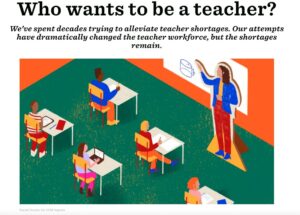
| Above: Check out these new series: Who wants to be a teacher? (APM Reports), Classroom Crisis (The 74), Bootstraps (EdSurge). ⏰ Resources: The weekly Burbio update on school starts, mask policies, and other treds remains a valuable resource. Last week, we shared resources on how not to re-traumatize sources when interviewing. And this week, we’re sharing tips from the Journalist’s Resource on how to prevent and address your own stress and trauma as a journalist. Also, the Center on Reinventing Public Education’s Robin Lake recommends a CRPE paper for those of you overwhelmed by all the reports on academic impacts/learning loss. Get the details here.
⏰ Podcasts: In addition to the series listed above from EdSurge and APM Reports, check out EdSource’s new weekly podcast, Education Beat. “We’ll help make sense of the most pressing issues facing California and beyond,” executive director Anne Vasquez tweeted.
⏰ Grants: Apply by Sept. 13 for grants from The Fund for Investigative Journalism. Winners will receive up to $10,000 to report on any topic.
THE KICKER
|
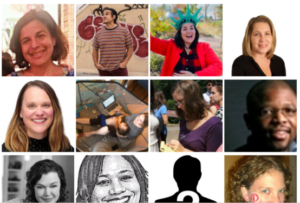
Last year, 11 current and former education reporter parents shared their back-to-school decisions, which included in-person, hybrid, remote, and — from an anonymous reporter — going private.
A year later, we’re asking the same question. Click here to read some early answers — then add your own. |
|
|
That’s all, folks. Thanks for reading!
Using Feedly or FlipBoard or any other kind of news reader? You can subscribe to The Grade’s “feed” by plugging in this web address: http://www.kappanonline.org/category/the-grade/feed/.
Read more about The Grade here. You can read all the back issues of The Grade’s newsletter, Best of the Week, here.
By Alexander Russo with additional writing from Michele Jacques and Colleen Connolly. |
|
|
|
|
|
|
|
|