A LOST YEAR
Best education journalism of the week
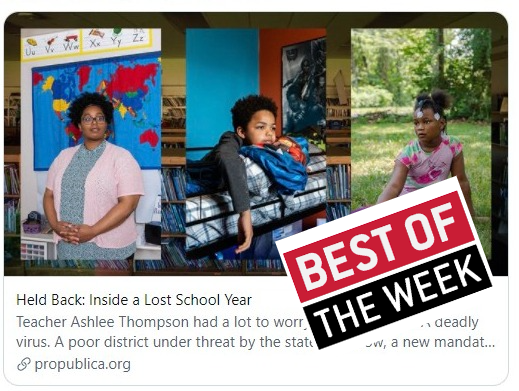
🏆 BEST: The best education journalism of the week is Inside a Lost School Year by ProPublica’s Annie Waldman, in which the reporter explores the impact of Michigan’s new literacy law on a school system crippled by spiraling budget cuts and facing the spectre of being dissolved by the state. With sensitivity and diligent reporting, Waldman follows a “miracle teacher,” struggling with her own health as well as the challenges of teaching remotely. EWA’s Emily Richmond calls it “a superbly detailed, heartbreaker story.” The New York Daily News’ Michael Elsen-Rooney describes it as “a primer on core challenges in U.S. public education.”
🏆 RUNNER-UP: The runner-up is Bethany Barnes’ Tampa Bay Tribune story, Tampa teens reported a teacher’s sexual comments. Then a student’s life was upended. It describes how one teacher’s history of innuendo and inappropriate sexual behavior was so familiar her behavior was taken as normal at a Tampa high school. But when one student called her out on it, the school responded by punishing the student and protecting the teacher. “Beautifully written and thoroughly reported as usual,” according to ProPublica’s Aliyya Swaby. “A jaw-dropping story,” notes ProPublica’s Pamela Colloff.
🏆 BONUS STORIES: Boys of color fell further behind at school amid COVID-19 (Chalkbeat Chicago), The making — and near breaking — of a Black male teacher (WHYY Philadelphia).
To get daily education headlines and hear about education journalism events, follow @thegrade_.
The big story of the week, according to us.
Story of the week: Summer school: Hundreds of thousands of students plan to attend summer programs to gain better academic footing. Districts have the money, but some don’t have enough teachers:
🔊 Record number of students enroll in summer school (NBC News)
🔊 Summer School Is Here (NYT)
🔊 School districts intensify summer programs to combat learning lost (PBS NewsHour)
🔊 Summer school is getting beefed up but some programs struggled to get teachers (CNN)
🔊 Philly’s summer school is off to a rocky start (Philadelphia Inquirer)
🔊 Summer classes begin with a record 45,000 students (Local 10)
🔊 Lacking teachers, Fairfax delays summer school for hundreds of students with disabilities (Washington Post)
🔊 NYC to pay for summer school taxis for homeless students and those with disabilities after facing criticism from advocates (Chalkbeat NY)
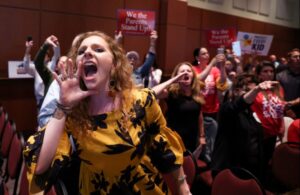
COVERING CRT
New from The Grade Above: Reuters image of the recent protest in Virginia’s Loudoun County.
The critical race theory debate is exciting and easy to cover (in the sense that people shouting at each other are easy to cover).
But it’s not an easy story to report and write in a way that’s accurate and helpful to readers.
“Historically, these kinds of school panics have relied on hasty journalism to feed their false rumors,” SUNY Binghamton professor Adam Laats told me.
In my latest column, journalists and experts suggest ways to tell the CRT story in a constructive way.
Some of their suggestions? Clarify whether CRT is or isn’t being used in your district. Explain why districts were revamping their instruction in the first place. Consider whether or not to use the term “CRT” in your piece.
Thanks to the Maynard Institute for including this week’s story in its excellent newsletter.
VACCINE MANDATES?
Thought-provoking commentary on the latest coverage.
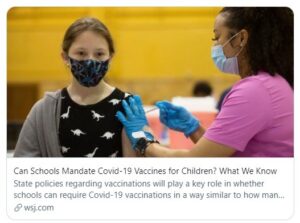
Above: As this June WSJ story indicates, there are lots of questions about schools, vaccine mandates, and kids that are going to be asked during the next few weeks.
📰 LOOMING STUDENT VACCINE MANDATE DEBATE: In a development that perhaps should have been anticipated, vaccine mandates for kids returning to school are now being discussed for the fall, even though there’s no vaccine for kids under 12 and the necessity of vaccinating teenagers is subject to intense debate. Three weeks ago, the WSJ asked whether schools can mandate vaccination, finding that schools and school districts “generally don’t have the authority to mandate student vaccines. But state legislatures or health officials acting under legislative authority can.” Meanwhile, Ohio legislators have banned vaccine mandates of various kinds. SFUSD is debating whether to create a mandate or not for staff. As far as I know, the teachers unions and Biden administration haven’t taken a position on the topic — yet. There’s an NEA resolution on the topic that’s up for debate.
📰 WHO LED, WHO LAGGED? New research from the CDC and Harvard’s business school finds substantial variations on how much school was offered and which kids participated. Enrollment dropped 3 percent, according to new data from the CDC and reported in The 74. Black and brown kids got less in-person instruction, noted EdWeek. Illinois schools lagged behind most other states in access to in-person learning during the pandemic, reported the Chicago Tribune. Maryland, Washington, and Minnesota also had lower rates of in-person schooling, according to the Minnesota Reformer. Schools with longer school days were less likely to go remote, according to a new study from Harvard.
📰 THE MODERATE CRITIQUE OF CRT: Think that the current concern about how kids are being taught about race is just a conservative thing? You’re wrong. Two years ago, The Atlantic’s George Packer lamented what he described as illiberalism at his kid’s progressive NYC school. And you can see some of the same concerns and arguments in this new David Frum essay headlined The Left’s War on Gifted Kids, which says that “across the U.S., blue-state educational authorities have turned hostile to academic testing in almost all of its forms.”
Did someone forward you this newsletter? You can sign up here.
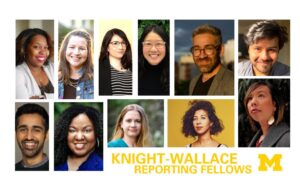
Above: The latest cohort of Knight-Wallace fellows, including the Hechinger Report’s Nichole Dobo.
🔥 Award winners: Hechinger Report’s Nichole Dobo is among the latest cohort of Knight-Wallace Reporting Fellows at the University of Michigan. New Haven Independent reporter Emily Hayes won two Connecticut SPJ journalism awards. It was a surprise to her. South Florida Sun Sentinel reporter Scott Travis is one of three finalists for Florida’s Journalist of the year by that state’s SPJ branch for his work investigating Broward County schools. The full list of finalists in all categories is here.
🔥 Comings & goings: The Washington Post’s Tracy Jan welcomed Emmanuel Felton on his first day as race and ethnicity reporter at the Post: “What a score for us. Welcome, Emmanuel!” Monica Velez has joined the Seattle Times from the Fresno Bee. After five years covering CPS, the Chicago Tribune’s Hannah Leone is on a list of reporters who are taking buyouts.
🔥 Jobs: St. Louis Public Radio is looking for an education reporter. The Wall Street Journal is hiring a national K-12 reporter.
🔥 EWA’s Emily Richmond credited NYT Opinion staff editor Eleanor Barkhorn for having helped get her latest piece into the section, which has run several education-related pieces lately. If Barkhorn’s name seems familiar, it’s because she was the founding editor of The Atlantic’s education page before going on to work at Vox. You can read my 2020 eulogy for the once-great page she built here.
🔥 Books: Former education writer Amanda Fairbanks has a new book out about a group of young men lost at sea near Montauk, Long Island. Congrats, Amanda!
Our apologies to Chalkbeat editor Mónica Rhor, whose name we misspelled in last week’s newsletter. We featured her personal reflections on how the pandemic highlighted education inequities.
What just happened & what’s coming next?
⏰ Appearances: Freelancer Kavitha Cardoza moderated a Carnegie Forum chat on elevating family and school partnerships. Watch it here. Former LA Times reporter Sonali Kohli participated in a panel on the future of LGBTQ+ journalists and storytellers.
⏰ RIP: WBEZ Chicago reporters that Chicago’s Harper High School — yes, the one featured in the 2013 This American Life series — is closing. The first part of the award-winning series, by Linda Lutton, Alex Kotlowitz and Ben Calhoun, can be heard here.
⏰ Upcoming: EdWeek’s CRT explainer has seen more than 2 million views, according to the nonprofit news outlet. It is hosting a July 13 virtual live discussion, Critical Race Theory: Understanding the Debate, with EdWeek reporters Stephen Sawchuk and Andrew Ujifusa.
Did someone forward you this newsletter? You can sign up here.
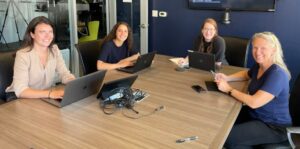
THE KICKER
Above: That’s the first in-person meeting of the Alabama Education Lab, whose members include Rebecca Griesbach, Savannah Tryens-Fernandes, Ruth Serven Smith, and Trish Crain.
That’s all, folks. Thanks for reading!
Using Feedly or FlipBoard or any other kind of news reader? You can subscribe to The Grade’s “feed” by plugging in this web address: http://www.kappanonline.org/category/the-grade/feed/
Read more about The Grade here. You can read all the back issues of The Grade’s newsletter, Best of the Week, here
By Alexander Russo with additional writing from Michele Jacques and Colleen Connolly.
ABOUT THE AUTHOR
Alexander Russo
Alexander Russo is founder and editor of The Grade, an award-winning effort to help improve media coverage of education issues. He’s also a Spencer Education Journalism Fellowship winner and a book author. You can reach him at @alexanderrusso.
Visit their website at: https://the-grade.org/