Research reveals the most effective ways to help young struggling readers through tutoring.
Tutoring has gained popularity as a strategy to improve the academic achievement of struggling students. Intensive, relationship-based tutoring is a highly effective academic support for many students, particularly in the early elementary years when school schedules and classroom routines are flexible (Groom-Thomas et al., 2023). For schools considering how to begin tutoring or where to prioritize resources, early literacy tutoring — which is both effective and feasible — is a good place to start.
Learning to read strongly predicts later life outcomes, including high school test scores (Sparks, Patton, & Murdoch, 2014) and high school graduation (Hernandez, 2011). Early elementary school is when students make the biggest leaps in their reading abilities (Hill et al., 2008). As two-thirds of 4th graders are not meeting proficiency on reading assessments (National Assessment of Educational Progress, 2022), schools have turned to early literacy tutoring to catch students up.
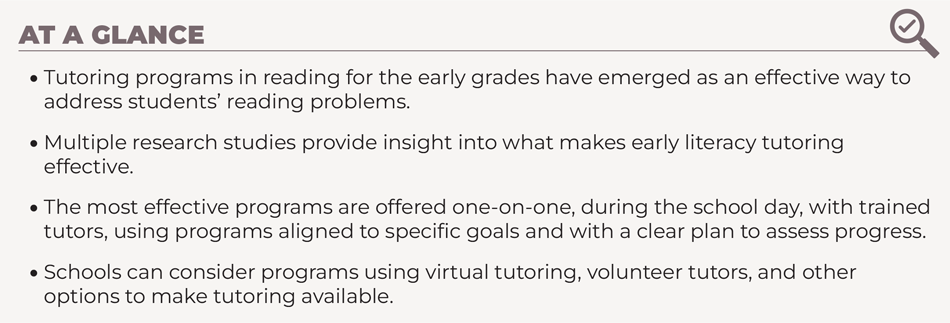
A range of tutoring approaches are available to accelerate young students’ literacy development. Effective programs typically share a few key components. They operate one-on-one, provide students with a consistent tutor, occur during the school day, use high-quality instructional materials, and have concrete methods for monitoring alignment and outcomes. With these elements in place, many programs can be successful.
What early literacy tutoring looks like
Traditionally, early literacy tutoring aimed to support small numbers of struggling readers. But learning loss from the COVID-19 pandemic and long-standing gaps in reading proficiency on national assessments have expanded the scope of early literacy tutoring as more students fall below commonly used test score cut-offs used to identify students in need of literacy intervention. For example, the cut-off score for students needing intensive support on Dynamic Indicators of Basic Early Literacy Skills (DIBELS) was at the 38th percentile in 2017-2019 (University of Oregon, 2020). By 2023, the percentage of students falling below the cut-off had grown, and that same score was at the 49th percentile (University of Oregon, 2022). Put another way, 30% more students need early literacy support now than they did before the pandemic.
Using news articles on tutoring in the U.S. and a network of tutoring stakeholders connected to the National Student Support Accelerator (NSSA) at Stanford University, we identified 187 tutoring providers offering reading support to K-3 students. NSSA reached out to those providers to obtain information about their operations, including grade levels covered, content areas, mode of delivery (i.e., in-person, virtual, or hybrid), locations served, and more.
We found that early literacy tutoring varies substantially on multiple dimensions, including student-to-tutor ratio, session frequency and length, mode of delivery, tutor background and professional support, and their focus for reading development. For example, Chapter One provides tutoring in 10-minute bursts up to five times a week, while Reading Partners provides 45-minute sessions with less frequency.
Most early literacy tutoring programs address multiple domains of reading development. In a meta-analysis of early literacy interventions (Gersten et al., 2020), more than 90% of programs addressed decoding while 87% included passage fluency instruction, and 70% covered encoding. In the same meta-analysis, 57% of the studies described reading programs that addressed phonological awareness, while 55% addressed comprehension. As phonics instruction has become more popular in U.S. schools, more tutoring programs have emphasized those skills.
Assessing the effects of early literacy tutoring
The benefits of early literacy tutoring are evident in an unusually large body of research literature. Meta-analyses combine estimates from those studies to give us a more robust estimate of the likely effect of an intervention across contexts. Three early literacy tutoring meta-analyses have similarly concluded that tutoring increases academic achievement by 0.41 standard deviations (Elbaum et al., 2000); 0.39 standard deviations (Gersten et al., 2020); and 0.24 standard deviations for small-group tutoring and 0.41 standard deviations for one-on-one tutoring (Neitzel et al., 2022). A meta-analysis of the effect of early literacy tutoring on English learners suggests an even larger effect size for these students, but only a few studies were included, making the results less definitive (Richards-Tutor et al., 2016).
The most effective early literacy tutoring is individualized and relationship-based with a consistent tutor, administered during the school day, and contains plans for fidelity and assessment aligned to the tutoring program.
While the positive effects of early literacy tutoring are clear, comparing across programs can be difficult because assessments used to study programs often vary. The federal government requires states to assess students in grades 3-8, but it does not require assessments in earlier grades. States, districts, and schools have sought out their own options and use these local tests to identify needs (Shields, Cook, & Greller, 2016) or to monitor effectiveness of classroom instruction and interventions so that they can adjust their practice (Chu, 2021).
In the 46 early literacy tutoring studies we looked at, researchers used more than 25 unique assessments. The Woodcock-Johnson (especially the Word Attack, Letter-Word Identification, and Passage Comprehension subtests) and DIBELS (with emphasis on Phoneme Segmentation Fluency and Nonsense Word Fluency subtests) were the most popular.
Even within a test, measuring effect sizes can be difficult because older students are often administered more challenging questions covering different subskills. For example, if DIBELS is administered across a school’s K-2 population, all kindergartners will be administered questions on letter names while only some 2nd graders will; all 2nd graders will be administered questions on reading comprehension, but no kindergartners will (University of Oregon, 2023).
Moreover, programs address many distinct skills, and programs that are equally good at what they do may show different results, depending on the assessment used. A fluency-based assessment will likely show positive results for an instructional program centered on fluency, but smaller effects in a program focused on comprehension. Ideally assessments will have subtests, covering different domains of reading, so researchers can assess the effects of programs on different domains.
Features of the most effective tutoring
What will work best in particular schools will vary, and comparing effectiveness across programs can be challenging. But research still holds insights into what practices tend to be the most successful.
One-on-one tutoring with a consistent tutor tends to produce larger gains than small-group tutoring broadly (Nickow, Oreopoulos, & Quan, 2024). The same is true for early literacy tutoring (Gersten et al., 2020; Neitzel et al., 2022). Exceptions may exist for English learners, as these students may benefit more from interactions with their peers (Richards-Tutor et al., 2016).
Research also provides evidence that teachers tend to produce larger gains than paraprofessionals or volunteers, though the differences vary by study and paraprofessionals and volunteers both consistently deliver positive effects (Gersten et al., 2020; Nickow, Oreopoulos, & Quan, 2024; Ritter et al., 2009; Slavin et al., 2011). Similarly, syntheses of research have found that the most effective programs are administered at least three times a week (Nickow, Oreopoulos, & Quan, 2024).
Some tutoring programs have recruited volunteers from the local community. This can reduce labor costs but often delivers smaller effect sizes in student growth.
Opt-in programs rarely engage high-need students effectively (Robinson et al., 2022). Instead, the most effective programs are conducted during the school day, instead of after school or on weekends (Nickow, Oreopoulos, & Quan, 2024). Even when tutoring is provided within the school day, scheduling can be a challenge. Students with high needs may be chronically absent, and scheduled services for English learners or students with disabilities may overlap with tutoring (Robinson et al., 2024). Highly effective programs consider these challenges at the outset and design tutoring to take place when all students are able to attend.
Furthermore, in our experience, the quality of the instructional materials matters. More effective programs are aligned with the science of reading and emphasize skills like phonemic awareness or vocabulary.
Most successful programs also include regular monitoring of student performance, enabling tutors to adjust their practice and enabling schools to monitor the effectiveness of the tutoring. Low-cost assessments like DIBELS, which costs $1 per student plus $200 to set up a new school account, are quite popular. Other products (like NWEA’s MAP Growth assessment) provide more ongoing support for practitioners or are more aligned to grade-level standards (like iReady).
Most successful programs also build plans to monitor fidelity (i.e., whether tutors are teaching the content they are supposed to teach). This monitoring can take many forms, such as tools for tutors to log their sessions, session recordings with automated analyses like talk-time or session length, regular observations by coaches, or a survey for student feedback.
Overall, research shows that the most effective early literacy tutoring is individualized and
relationship-based with a consistent tutor, administered during the school day, and contains plans for fidelity and assessment aligned to the tutoring program.
Case studies in effective tutoring practice
Within those constraints, effective early literacy tutoring can take many forms. The 187 tutoring providers that we identified vary in who is doing the tutoring, in their ratios of students to tutors, in their form of delivery, in their instructional materials, and in a wide range of other features. The cases below demonstrate some of this variety.
Tutoring with new or existing staff
Some early literacy tutoring programs leverage existing school staff, such as paraprofessionals, or partner with AmeriCorps or universities to obtain trained staff.
For example, the Minnesota Reading Corps uses AmeriCorps tutors to deliver one-on-one tutoring five days a week for 20 minutes a day to students in grades K-3 who score below benchmark on an initial assessment. In a study of this program (Markovitz et al., 2014), students receiving tutoring performed significantly better than their peers at the end of the program. Effects were largest for kindergarten students, who were able to produce more than twice as many correct letter sounds after only one semester.
Similarly, in a pilot study of Once (Bennett et al, 2024), an early literacy tutoring program using paraprofessionals to deliver one-on-one tutoring for 15 minutes a day five days a week, students receiving tutoring performed 0.05 standard deviations better than students in the control group. The estimate was larger for students who performed well below benchmark on their initial assessment.
In another study (Pace Miles and Fletcher, 2023), the New York City Department of Education contracted with preservice teachers at the City University of New York to deliver early literacy tutoring and fulfill their fieldwork requirements. Other programs using tutors paid through federal work-study continue to be popular and effective as they reduce cost. Effect sizes from these staff-led programs are often smaller than would be expected using teachers as tutors, but these programs are less costly, creating a trade-off for districts to weigh when choosing a program.
Tutoring with community members
Tutoring need not rely on school employees. Some tutoring programs have recruited volunteers from the local community. This can reduce labor costs but often delivers smaller effect sizes in student growth (Neitzel et al., 2022; Slavin et al., 2011). However, some volunteer programs that focus on tutor training and high-quality instructional materials have been more successful.
Reading Partners, for example, recruits volunteers in 12 metro areas to tutor students at their schools twice a week for 45 minutes. Their content emphasizes phonics at the beginning then levels up to comprehension strategies. A randomized control trial of Reading Partners tutoring for students in grades 2-5 pre-pandemic (when all tutoring was in person) showed an effect size of 0.10 standard deviations on reading comprehension, 0.09 standard deviations on reading fluency, and 0.11 standard deviations on sight word reading (Jacob et al., 2016). These effect sizes are smaller than for some early literacy programs, but they are worth noting because they are with older elementary students who typically make less growth per year in reading skills as they age (Hill et al., 2008; Nickow, Oreopoulos, & Quan, 2024). During the COVID-19 pandemic, the Reading Partners model shifted and now includes virtual tutoring at some schools in a model called Reading Partners Connects. An evaluation of that new model is ongoing (Erickson, Jacob, & Asher, 2023).
Other models with community members as tutors show promise but have not been formally evaluated using a well-powered randomized control trial. For example, a descriptive study of Oakland Unified School District’s early literacy tutoring program, which recruited tutors from the local community to partially staff the program, showed a moderate and statistically significant difference between tutored students and non-tutored students (Jochim, Daramoia, & Polikoff, 2023). All tutors in the Oakland study received intensive training and biweekly coaching sessions tied to the curriculum.
In-person, short-burst tutoring
New models of early literacy tutoring have emerged that try novel approaches to increase the reach or decrease the cost of effective tutoring.
Chapter One’s tutoring program, implemented in a large school district in Florida, provides tutoring to K-2 students in short five- to 10-minute one-on-one sessions up to five days a week. Sessions focus on phonics and sight word acquisition. Tutors, called early literacy interventionists, tutor students in-person during the school day either in the classroom or in adjacent rooms. The tutors follow a digital curriculum during the sessions, and students are scheduled to spend 15 minutes each day using Chapter One’s software independently outside their tutoring time. Tutors all possess college degrees, receive substantial training prior to tutoring, and participate in ongoing professional development.
Research can offer practitioners some guidance on what programs are most effective. Programming within the school day can reduce attendance concerns and increase effectiveness.
A recent randomized control trial showed that Chapter One tutoring increased students’ oral reading fluency by 0.23 standard deviations, and treatment students were twice as likely to reach the desired reading foundation skills level (Cortes et al., 2024). Chapter One is less costly than most early literacy tutoring programs, charging between $375 and $450 per student.
Virtual tutoring with students in school
Another attempt at reducing cost has come in the form of virtual tutoring, delivered while students are in school. Although more than 100 virtual tutoring providers are listed in the National Student Support Accelerator database, virtual tutoring for early literacy has been evaluated rarely. In one study (Robinson et.al., 2024), researchers showed that OnYourMark’s one-on-one virtual tutoring improved end-of-year literacy scores by 0.11 standard deviations for K-2 students. Effect sizes of one-on-one tutoring were largest for 1st graders (0.19 standard deviations) and students scoring below the median on initial assessments (0.14 standard deviations). Two-on-one tutoring provided by OnYourMark was correlated with improved early literacy test scores, but the relationship was not statistically significant.
Using research to make wise choices
The COVID-19 pandemic highlighted and widened existing disparities in American schools especially around early reading. Schools and districts have increasingly turned to early literacy tutoring to assist struggling readers. The emerging landscape of options is wide, with hundreds of different providers.
Research can offer practitioners some guidance on what programs are most effective. Programming within the school day can reduce attendance concerns and increase effectiveness. Furthermore, small student-to-tutor ratios (in one-on-one programs whenever feasible) can build meaningful relationships that support learning. Moreover, effective programs use high-quality materials and monitor fidelity of implementation through rigorous data collection. These programs also typically have a plan for evaluation, with an assessment selected in advance to measure the early literacy domain most relevant to the intervention.
Within those constraints, many successful programs have emerged. For communities with tight labor markets, virtual tutoring has offered an alternative to traditional in-person options. Similarly, for cost-constrained districts, existing paraprofessional staff can offer a viable solution. By implementing early literacy tutoring programs attuned to local conditions and rooted in the literature about what works, educators can help students improve their literacy skills and their later academic success.
References
Bennett, E., Lee, M., Loeb, S., & Robinson, C.D. (2024). Effects of high-impact tutoring on early literacy outcomes: A pilot study. National Student Support Accelerator.
Chu, D. (2021, October 28). The case for K-2 testing. Flypaper by the Fordham Institute.
Cortes, K.E., Kortecamp, K., Loeb, S., & Robinson, C.D. (2024). A scalable approach to high-impact tutoring for young readers: Results of a randomized controlled trial (EdWorking Paper No. 24-893). Annenberg Institute at Brown University.
Elbaum, B., Vaughn, S., Tejero Hughes, M., & Watson Moody, S. (2000). How effective are one-to-one tutoring programs in reading for elementary students at risk for reading failure? A meta-analysis of the intervention research. Journal of Educational Psychology, 92 (4), 605-619.
Erickson, A.H., Jacob, R., & Asher, C. (2023, September 12). An evaluation of the Reading Partners Tutoring Program. OSF Registries.
Gersten, R., Haymond, K., Newman-Gonchar, R., Dimino, J., & Jayanthi, M. (2020). Meta-analysis of the impact of reading interventions for students in the primary grades. Journal of Research on Educational Effectiveness, 13 (2), 401-427.
Groom-Thomas, L., Leung, C., Loeb, S., Pollard, C., Waymack, N., & White, S. (2023). Challenges and solutions: Scaling tutoring programs. Inter-American Development Bank.
Hernandez, D.J. (2011). Double jeopardy: How third-grade reading skills and poverty influence high school graduation. Annie E. Casey Foundation.
Hill, C.J., Bloom, H.S., Black, A.R., & Lipsey, M.W. (2008). Empirical benchmarks for interpreting effect sizes in research. Child Development Perspectives, 2 (3), 172-177.
Jacob, R., Armstrong, C., Bowden, A.B., & Pan, Y. (2016). Leveraging volunteers: An experimental evaluation of a tutoring program for struggling readers. Journal of Research on Educational Effectiveness, 9 (sup1), 67-92.
Jochim, A., Daramola, E.J., & Polikoff, M. (2023). Teachers and tutors together: Reimagining literacy instruction in Oakland. Center for Reinventing Public Education.
Markovitz, C.E., Hernandez, M.W., Hedberg, E.C., & Silberglitt, B. (2014). Impact evaluation of the Minnesota Reading Corps K-3 program. Corporation for National and Community Service.
National Assessment of Educational Progress. (2022). NAEP Reading, Grade 4. U.S. Department of Education.
Neitzel, A.J., Lake, C., Pellegrini, M., & Slavin, R.E. (2022). A synthesis of quantitative research on programs for struggling readers in elementary schools. Reading Research Quarterly, 57 (1), 149-179.
Nickow, A., Oreopoulos, P., & Quan, V. (2024). The promise of tutoring for preK-12 learning: A systematic review and meta-analysis of the experimental evidence. American Educational Research Journal, 61 (1), 74-107.
Pace Miles, K. & Fletcher, A. (2023). Improving vulnerable populations’ emergent reading outcomes by training preservice teachers in an evidence-based program. Journal of Research in Childhood Education, 37 (3), 442-462.
Richards-Tutor, C., Baker, D.L., Gersten, R., Baker, S.K., & Smith, J.M. (2016). The effectiveness of reading interventions for English learners: A research synthesis. Exceptional Children, 82 (2), 144-169.
This article appears in the September 2024 issue of Kappan, Vol. 106, No. 1, p. 32-36.

ABOUT THE AUTHORS

Sarah Novicoff
Sarah Novicoff is a graduate student in educational Policy at the Stanford University Graduate School of Education, Stanford, CA.

Susanna Loeb
Susanna Loeb (sloeb@stanford.edu) is a professor at the Stanford University Graduate School of Education and the founder and executive director of the National Student Support Accelerator, both in Stanford, CA.