By Mara Rose Williams
Editor’s note: As the Black Lives Matter movement forced a national reckoning on race in America… a group of reporters and editors at The Star began to grapple with the 140-year-old newspaper’s own historic role in perpetuating a system of white superiority. They decided that the most meaningful response The Star could offer would be to call itself to account for decades of coverage that depicted Black Kansas Citians as criminals or, more often, simply ignored their aspirations, achievements and struggles for dignity. [Republished with permission.]
It’s right there in Bonneye Massey’s deposition, among stacks of evidence collected by attorneys for the children suing Kansas City Public Schools.
Ladd Elementary, the all-Black school her son attended in the early 1960s, became so crowded that students could go only half a day. So the district had to bus some a few miles to the all-white Humboldt Elementary. But when they got there, Massey said, the Black students were marched to classrooms on the third floor, away from the white children.
“They were never considered Humboldt students,” Massey said in her court testimony. “Their records stayed at Ladd.” That way, she said, they would move on to the predominantly Black junior high in their neighborhood, not the largely white school other Humboldt students would attend.
Long after the U.S. Supreme Court said such actions were illegal, the district kept schools segregated. Officials continually shifted attendance boundaries and promoted a liberal transfer policy that isolated students by race.
The Star ran the headline big in 1954 when the U.S. Supreme Court ruled in Brown vs. Topeka Board of Education that school segregation could not stand. The editors and reporters at The Star, however, did little for the next two decades to hold local school officials accountable. Yet in the decades after that 1954 landmark court ruling,the city’s two main newspapers, The Star and its sister paper, The Kansas City Times, wrote about board actions and school integration as an order of the courts, but acted as if segregation were some nasty monster living only in the swampy South.
The editors and reporters at The Star did little for the next two decades to hold local school officials accountable.
They failed to take to task the school board whose decisions, despite the law of the land, kept Black and white children apart. And until testimony came out years later in the 1977 desegregation case against the district, the papers didn’t tell stories like Massey’s, ones that showed the impact on families whom desegregation was meant to help.
That omission rendered them invisible. And some argue, still today, it helped fuel the fear among white families that led many of them to flee the city for the suburbs or private school.
“When the school board had an obligation to take steps that would stop segregating, if not in fact integrating, it did just the opposite,” recalled Arthur Benson, a Kansas City civil rights attorney who represented the children in the desegregation case. As more Black families moved in, he said, the school board made 300 “micro boundary changes and transfers” to preserve segregation. And Troost Avenue was the dividing line.
When he and his team of attorneys went looking in The Star and Times for accounts of those actions, “there was no record of it anywhere in the newspaper archives.”
YEARS OF SEGREGATION
Over the last five months, The Star pored through hundreds of archived articles and court and school district documents to piece together what happened leading up to and after that precedent-setting lawsuit.
During the trial, federal officials called those boundary changes from 1954 to 1977 “clear violations of the law.”
They are but a sliver of the desegregation saga, an example of the news that went untold by The Star and Times during one of the most consequential course of events for children in the history of Kansas City. A story so fraught with disenfranchisement, Benson said, that in his recent retelling, he broke down in tears.
The papers told no stories about the Black families who poured into Kansas City in the 1950s and ’60s so their children could get a better education.
The papers told no stories about the Black families who poured into Kansas City in the 1950s and ’60s so their children could get a better education. In Missouri, Black children could attend only three high schools. In Kansas City, it was Lincoln.
Brown vs. Topeka Board of Education was supposed to change that. In 1955 the district was 22.3% Black. Within 10 years it was 40.5% Black.
By 1966, at 25 elementary schools more than 90% of the students were Black, and in 36 schools more than 90% were white. Some hit 100%.
The newspapers didn’t point out the violation of federal law, how isolated students were by race. Or how from 1961 to 1963 alone the board changed 24 attendance boundaries, some just a few blocks west or south, to keep the status quo.
School officials would argue, in several stories in The Star and Times, that it wasn’t the district’s fault, but rather it was housing patterns — no one called out the racist real estate practices — that segregated Black and white families.
Officials said boundary changes were needed to deal with crowding, The Star reported. But district records showed Black students were moved from one East Side school to another. White students were allowed to transfer out of integrated schools to all white schools.
“Swift changes in the racial makeup of schools cause panic and swifter neighborhood turnover,” The Star quoted Cleo H. Muller, then president of the Pershing St. Therese Neighborhood Council, telling the school board on July 1, 1963. The district was considering a proposal to relieve crowding at Central High by allowing Black students there to transfer to Paseo High.
“We don’t want Paseo, which is already well integrated, to increase its proportion of Negro students to become more than 50% and have white parents begin to transfer their children out,’’ the paper quoted Muller saying.
It did not report, though, that the board then reconfigured boundary changes, even after saying race was not a consideration.
Several days later that summer, hundreds of families and activists took to the streets in protest of those boundary shifts. The papers reported on the protests but skirted the issue that the board had furthered racial isolation.
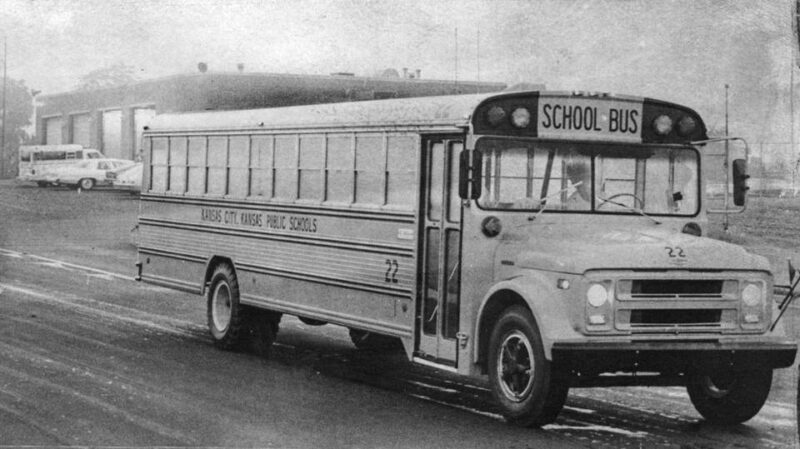
The papers reported on the protests but skirted the issue that the board had furthered racial isolation.
“Virtually every school the KCMSD built after 1954 opened either all-white or all-black, and until 1976, attendance zones did not cross Troost,” wrote Kevin Fox Gotham in “Race, Real Estate, and Uneven Development: The Kansas City Experience, 1900-2010.”
As late as 1977, with the district still mostly segregated, a Star article quoted parents at a school board meeting opposed to a district attempt to finally desegregate schools.
“I don’t want my child to be a guinea pig,” one parent said. That September, a story in The Times discussed the rush of white students enrolling at private schools. The Star said then that “several white parents are looking at the private schools as havens; cloistered environments where children can be sent to avoid desegregation.”
Yet there were no stories of the effects on Black families. No stories of how students were strategically pushed around the district like pieces on a chess board. No stories about how the decisions made in courtrooms and boardrooms affected their lives.
No stories either about the talented Black teachers in the predominantly Black schools, who took those positions because that’s where the jobs were. A December 1965 story in The Star said, “The Kansas City School District does not discriminate in hiring the Negro teacher.” What it didn’t say is that, for the most part, they were hired to teach only Black children.
BLACK TEACHERS
The papers did include school district promises to give Black teachers positions in integrated schools, after the U.S. education department insisted that be the case. But the papers didn’t write that most of those schools only ended up with one or two Black teachers. Court documents showed that in 1968, 407 of 503 Black teachers were assigned to schools where 97% of students were also Black.
There were no stories about the textbooks with broken spines, discarded from the schools attended by mostly white children and handed down to schools attended by mostly Black children.
Stories were filled with quotes from local, state and federal officials who were given space to talk about Black children as problems.
Eric Wesson, now editor of the Kansas City Call, a weekly Black newspaper, grew up in Kansas City. In the 1970s he went to Southeast High School, a majority Black school, for one year before a boundary change allowed him and “about a handful of other Black students” to attend the mostly white Southwest High School.
Wesson told The Star recently that one of the first things he noticed was “there weren’t no hand-me-down books. They were new.” At Southeast, “we had all used books. When the white schools got rid of them, then we got them. We knew because they were stamped with the other school’s name. Sometimes they didn’t even have all the pages. Some didn’t have covers. It was pretty bad. I didn’t get good material until I got to Southwest.”
No stories about the district watering down courses offered in some of the mostly Black schools. Among the evidence in the desegregation case was a 1967 letter to then-Superintendent James Hazlett from the U.S. Department of Health, Education and Welfare about the lack of foreign language courses at a junior highs with mostly Black students. “Other junior high schools got Latin, Spanish, French, German and Russian,” the letter said.
Benson recalled that in one instance, a science teacher was moved from Southeast to Southwest and replaced by a janitorial services teacher. “And so not only was the educational opportunities spiraling downward for African Americans, it was almost being broadcast to the community that this is what the school board is doing.
“And nobody in the news media called that out and said what you are doing is destroying educational opportunities for these people.”
Instead, stories were filled with quotes from local, state and federal officials who were given space to talk about Black children as problems.
An August 1963 story in The Times about how the district would solve overcrowding mentioned that nine classes from Ladd Elementary would move to Humboldt Elementary. No story explained what Bonneschool board statement “recognized that every large city is beset with increasing numbers of children, largely Negro, who are deprived in many ways. They lack motivation and resources, and make up a large percent of the dropout and youth problems.”
In The Star and Times, no stories questioned whether it was the white teachers who needed to change.
Comments like that about Black children, Gwendolyn Grant says, fed white teachers’ perception that they should expect less of them.
Grant, now executive director of the Kansas City Urban League, attended Lincoln and later Westport high school.
“Westport was predominantly white,” Grant recalled. “There were more extracurricular (activities). Our books, resources, everything was better. We had a literary society. All that stuff that got you in the mind of college. It wasn’t going on at Lincoln. But what they didn’t have were Black teachers. I had really great teachers at Lincoln. Tough teachers,” she said. She missed them.
At Westport, she said, “Part of the problem was most of the teachers were white with very little cultural competency, implicit bias, things that resulted in teachers forming an assumption that Black kids are inherently inferior.”
When Candace Cheatem started school at Meservey Elementary, most of her classmates were white. So were her teachers. So was her first friend.
“Many of the Caucasian teachers were not that pleased with teaching us,” said Cheatem, a 1975 Southeast High graduate who now works with the KCPS Parents As Teachers program. “They felt imposed upon. You could tell some of the teachers didn’t want us there. It was almost as if it was a reflection on them, you know, like they were saying, huh, now we are teaching Black kids.”
By the time Cheatem got to Southeast, “it had made its turn to mostly Black students by then,” she said. Cheatem recalled a conversation with a white school counselor about career possibilities.
“She said, ‘You would make a good maid.’ That was her vision of me.” When she told one of her Black teachers about it, “I remember she said, ‘Girl, God’s got a better plan for you.’”
Such stories did not appear in the papers.
THE ATTITUDE OF THE DAY
By the 1970s, the schools were falling apart and there was no money for repairs, Benson said.
“The school district was a complete wreck. The buildings were literally rotting away. Some doors had to be chained closed because they could no longer close on their own. There were holes in the ceilings and roofs and water would come in when it rained.” The papers didn’t address those problems until after the desegregation trial ended in 1985.
In June 1985, federal Judge Russell G. Clark issued an order that ended up costing nearly $2 billion, doubling the local property tax. The idea was to attempt desegregating the district by improving the school buildings — massive upgrades, new facilities — with a “build it and they will come” attitude. But white families did not accept the invitation. In fact they continued their flight to the suburbs. Others enrolled their children in private schools.
The coverage in The Star and Times was born from the attitudes of the day, said former Kansas City Mayor Sly James, who was the only Black student at Bishop Hogan Catholic High School. He said Kansas City had long been divided by redlining and racist covenants.
“My neighborhood was all Black, school was all white and that created a lot of social awkwardness,” James said. “I was exposed to two cultures. Most of my friends were only exposed to one.
“I think the racism of the time is why The Star, the Times didn’t do more,” James said. “To think that they would, would mean you believe they were anti-racist and I don’t think they were because newspapers are a reflection of the society in which they exist. And other media wasn’t doing a very good job either. The papers would nibble around the edges of the issue but never really dig in.”
There were no stories of the effects on Black families. No stories of how students were strategically pushed around the district like pieces on a chess board. No stories about how the decisions made in courtrooms and boardrooms affected their lives.
Newspaper coverage, however, did make it clear that the impetus for how the district was instructed to spend the court-ordered money was to lure white families back.
That frustrated the Black community because, “we didn’t need integrated schools, we needed better schools,” said Clinton Adams, a Kansas City lawyer and community activist. “They made it all about the white students when it should have been about the infliction perpetrated on Black children, the miseducation of the Black children in Kansas City. They had good intentions, but the remedy was wrong.”
And The Star, he said, “didn’t give us a voice in that. As far as we were concerned they were part of the oppression because they didn’t hear what we were trying to say.”
The desegregation lawsuit against the district was originally filed by two school board members, including Edward Scaggs, one of two Black members. His children — Greg, Keith and Helen — were named among the plaintiffs.
Greg Scaggs recently recalled the day in 1977 when he asked his dad why he filed that lawsuit.
“I remember him sitting me down and saying to me that it was because he wanted to make sure that his kids and other kids like us could go to any school in the area and get the same education that the white children in the suburbs were getting.”
Until 1982, when Edward Scaggs, then president of the board, stepped down, neither The Star nor Times interviewed the family.
“Republished with permission of the Kansas City Star, from Kansas City schools broke federal desegregation law for decades. The Star stayed quiet. By Mara Rose Williams. Published December 20, 2020.]; permission conveyed through Copyright Clearance Center, Inc.”
ABOUT THE AUTHOR

The Grade
Launched in 2015, The Grade is a journalist-run effort to encourage high-quality coverage of K-12 education issues.