🏆 Best Education Journalism of the Week 🏆 (08/29/2025)
Aug 29, 2025
In this week’s newsletter:
📌 States and districts show improvements — mostly.
📌 Journalists reflect on post-Katrina education coverage.
📌 All-star education reporter Talia Richman has her Baltimore Banner debut.
📌 “Your English teacher and your gym teacher are getting married.”
STATES SHOW IMPROVEMENT
The big education story of the week
The big education story of the week is that kids in several states seem to be improving in math and reading proficiency — despite low overall scores and stubborn achievement gaps.
Results from states like Virginia, Maryland and D.C show modest but real increases in statewide evaluations. Michigan third-grade English scores reached a new low even as other grades improved (Maryland Matters, Virginia Mercury, WJLA DC, Chalkbeat Detroit).
The news is also good in some large school districts. Detroit and Baltimore showed steady improvements, although both still lag behind their respective statewide averages. What does not seem to be contributing much to post-pandemic academic improvements? Tutoring (Chalkbeat Detroit, Baltimore Banner, Hechinger Report).
Other big education stories this week include enrollment declines in major school districts (Miami Herald, Los Angeles Times, Broward County), red-state school districts losing federal education funds (NYT, Washington Post), the spread of school cellphone bans (Denver Post, Seattle Times, Washington Post AL.com, The Atlantic, KLCC Oregon), and a devastating school shooting (Associated Press, Minneapolis Star Tribune).
RECOVERY, FOUR-DAY WEEKS, & KATRINA
Top education journalism of the week
🏆At Tampa Bay’s Victory High, newly sober students get a second chance provides a look at how a school not only helps teens out of addiction, but also the logistics of how it keeps the lights on. It is a thorough examination of one of just a dozen similar schools nationally “where students have to have done drugs to get in.” (Lane DeGregory / Tampa Bay Times)
🏆Pass or fail? Midwest families and districts are learning from the 4-day school week is an exhaustive look at why school districts in Iowa have or have not adopted a shorter weekly schedule. By examining academic and behavioral outcomes and interviewing a wide range of people the story provides an unusually well-rounded look at a new educational policy. (Nicole Grundmeier / Iowa Public Radio)
🏆Deep Transit Cuts in Philadelphia Set Commuters and Parents Scrambling is not strictly about education, but puts a human face on a major policy issue impacting parents and students. Making journalism about transportation funding engaging is not easy, but this story manages it. (Sonia A. Rao, Davaughnia Wilson and Vicky Díaz-Camacho / New York Times)
🏆20 years after Katrina, New Orleans schools are still ‘a work in progress’ is one of many retrospective pieces this week on how the Big Easy moved to a charter school system. This piece from a local journalist features a charter school skeptic turned advocate and does an unusually nice job of documenting both mistakes and opportunities (Aubri Juhasz / WWNO)
Other stories we liked include The long arc of John McDonogh Senior High School (The Lens), The Confederacy Is Great Again at This Texas School (The Free Press), and A ‘college for all’ push thrived in New Orleans after Katrina. It wasn’t for everyone (NPR).
Thanks for reading Alexander Russo’s The Grade, where we take a closer look at education news. Subscribe for free to receive new posts and support my work!Subscribe
REFLECTIONS ON COVERING POST-KATRINA NEW ORLEANS
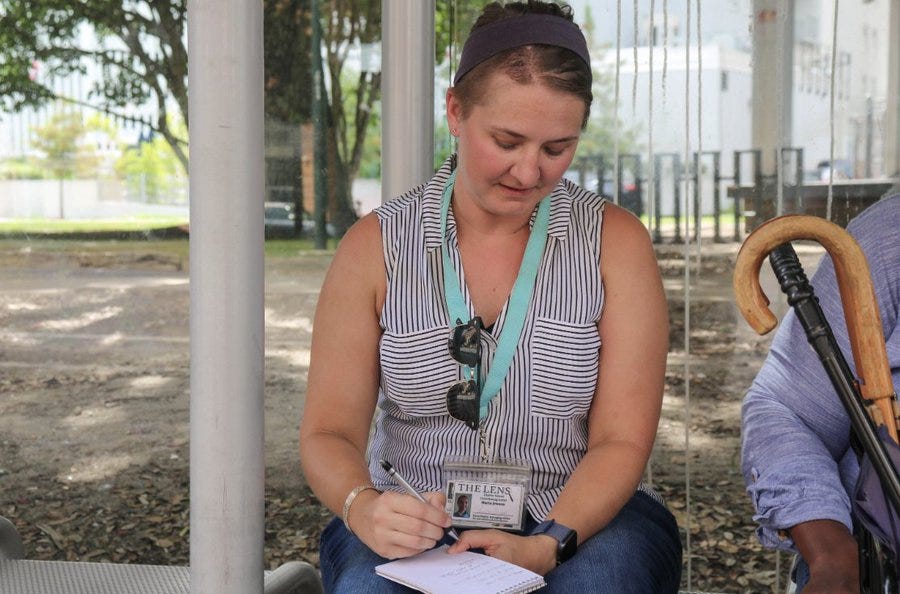
In her new essay for The Grade, Marta Jewson describes the challenges of bringing transparency to NOLA’s highly decentralized system of schools, the frustrations of national outlets’ overly simplistic coverage — and the problems of local editors clinging to an outdated focus on district-oriented stories.
Read it all here: Disaster, decentralization, & the slow climb back to school transparency.
Other coverage reflections:
“I think there was a lot of credulousness about the impact of the charter conversion and the influx of inexperienced Teach for America recruits,” says former NPR education reporter Anya Kamenetz. To do better next time, reporters need to “listen to people with roots in a place.”
Balancing locals’ needs with a national context was a major challenge, says former Times-Picayune reporter Danielle Dreilinger. Among local outlets, competition was a frequent frustration, according to Dreilinger, who’s now a national rewrite editor for Gannett. “Everyone jumping on the same story meant no coverage for everything important happening down the block.”
“There was a lot of good reporting, especially in the early years that I was here,” says education researcher Doug Harris. However, there was more coverage of the failures — and the coverage sometimes let stand false or misleading statements. “We would find one thing and the reporters found someone who disagreed but without any critique of our work or alternative data.”
“There have been [national journalists] who’ve come in and done beautiful stories,” says longtime local journalist Katy Reckdahl. “But I always just ache a little bit, because [what’s happening] is nuanced and complicated in a way that’s hard to [understand] within a week.”
Coming up: I can’t wait to share the great conversation I had with journalist Chandler Fritz about what it’s really like inside an ESA-funded Arizona microschool. His Harper’s Magazine cover story, if you still haven’t read it: The Homemade Scholar.
Thanks for reading Alexander Russo’s The Grade! This post is public so feel free to share it.
PEOPLE, PODCASTS, & QUOTABLE
📰Job changes: Former Dallas Morning News reporter Talia Richman has her first piece up at the Baltimore Banner, where she’s apparently going to be covering high-performing Montgomery County schools. Tara García Mathewson has left The Markup/CalMatters to begin her Spencer Journalism Fellowship.
Nicholas Gutteridge has joined the Texas Tribune as a reporting fellow covering everything from politics and education to crime and courts. Former US News education reporter (and contributor to The Grade) Lauren Camera is freelancing, advising Whiteboard, and teaching at American University.
📰Recognition: AP education reporter Bianca Vázquez Toness received SPJJ’s 2025 New America Award for issues affecting immigrant or ethnic communities in the US. Coverage from Chalkbeat New York’s Michael Elsen-Rooney got a nice mention in the Columbia Journalism Review newsletter.
📰Podcasts / Segments:
Sarah Carr was on NPR’s Weekend Edition talking about the ‘college for all’ movement that dominated post-Katrina school reform. New Orleans Public Radio’s Aubri Juhasz was featured on NPR’s All Things Considered (Hurricane Katrina brought a wave of young, new teachers to New Orleans) and WBUR’s nationally syndicated show Here & Now (How Hurricane Katrina impacted Louisiana’s lowest-performing schools). The Branch’s NOLA schools podcast Where the Schools Went has new episodes.
KMUW Wichita public radio reporter Suzanne Perez was on All Things Considered sharing her story about credit recovery programs. KVNF’s Laura Palmisano was on the same show with the story of one Colorado teacher who ended up helping students sell things at the farmer’s market. Hechinger’s Jill Barshay and AP’s Collin Binkley talked about the Trump administration and education on NPR’s 1A. CNN’s Fareed Zakaria had Jon Haidt on his show to talk about all the new school cellphone bans.
📰Data: New York spends nearly three times as much per pupil as Arizona for “essentially the same results,” according to 50CAN’s Marc Porter Magee. Newsweek has a map showing where homeschooling is soaring. NEPC’s Carol Burris notes that charters are closing. Of the 30 states that track voter registration by political party, Democrats lost ground to Republicans in every single one, notes the New York Times. You’d never know from media coverage that 43 percent of undergrads attend community college and 41 million have credits but no degree. Third Way has now joined DFER in calling for Democrats to engage on private school choice.
📰Quotable:
“US teachers are almost twice as likely to be Democrats as Republicans. But US parents are now much more likely to be conservative than progressive.”
“Mastodon was clunky, Meta banned news and politics, and Bluesky turned into a boring progressive echo chamber.”
“Not quite sure that a few good #NAEP results translate to ‘smarter,’ but it’s effective messaging for sure.”
KICKER

“There’s an education angle to this story!“
That’s all, folks. Thanks for reading!
Using Feedly or FlipBoard or any other kind of news reader? You can subscribe to The Grade’s “feed” by plugging in this web address: http://www.kappanonline.org/category/the-grade/feed/.
Read more about The Grade here.
By Alexander Russo