|
|
| A YEAR OF COVIDThe big education story of the week |
|
| MENTAL HEALTH, ELITE SCHOOLSThe best education journalism of the week |
|
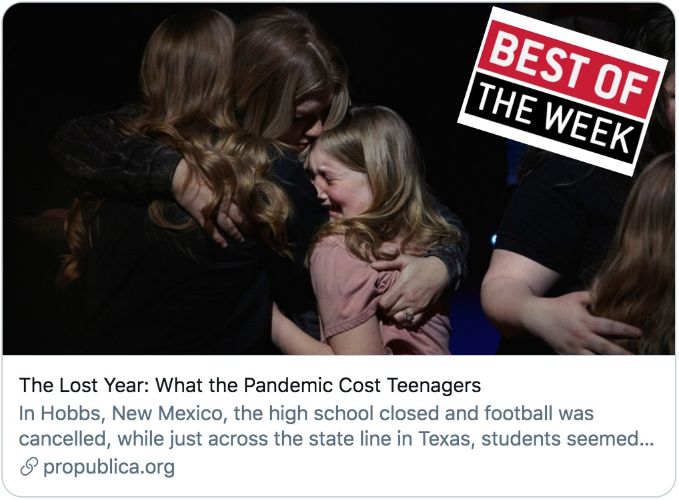
| 🏆 BEST: The best story this week is another stellar feature from Alec MacGillis in ProPublica: The Lost Year: What the Pandemic Cost Teenagers. In it, MacGillis contrasts the COVID responses in Hobbs, New Mexico, where schools and sports shut down, and Seminole and Denver City, Texas, where they did not. Though only a 30-minute drive apart, high schoolers in this part of the country lived worlds apart in the pandemic — and for some kids the consequences were severe. The benefits in terms of reduced COVID cases were minimal. The story won a lot of praise from other journalists, who called it devastating, gutting, and wrenching.See also: ‘Wake Up, Do School, Repeat’: A Year Of Pandemic Life Has Taken Its Toll On High School Seniors from GBH Boston’s yearlong series Covid and the Classroom.
🏆 RUNNER-UP: This week’s runner-up is Caitlin Flanagan’s Private Schools Have Become Truly Obscene in The Atlantic. Flanagan takes a harsh look at elite schools and their impact on society, especially when so many public schools are floundering. “Many schools for the richest American kids have gates and security guards; the message is you are precious to us,” she writes. “Many schools for the poorest kids have metal detectors and police officers; the message is you are a threat to us.” This story also won a lot of praise from fellow journalists, including a comment that Flanagan’s “prose is delicious, and her insight withering.”
🏆 BONUS: I also loved this story from the Washington Post, ‘An essential service’: Inside Biden’s struggle to meet his school reopening promises, which offers an inside look at the struggles the Biden team is experiencing on this promise.
To get daily education headlines and education news events, follow @thegrade_. |
|
| THE YEAR’S MOST MEMORABLE COVERAGENew from The Grade |
|
| Shutdowns. Remote learning. Crowded Halls. Protests.Over the past 12 months, education reporters have had to cover a year of grief and anger — for the most part, without going inside schools.
To mark a year’s efforts at chronicling the story, this week’s column features the 15 most memorable K-12 COVID stories of the year.
These stories dominated the conversation, changed minds, and altered the course of events — for better or worse.
Bonus: Here’s another list of COVID-era journalism, this one from EdWeek columnist and high school teacher Larry Ferlazzo. |
|
| MEDIA TIDBITSThought-provoking commentary on the latest coverage |
|
| Above: Chalkbeat launched a new initiative about source diversity after auditing their own coverage and finding an overrepresentation of white voices. “We used our findings to hold ourselves accountable, and we increased the share of Black and Hispanic/Latino voices…” Read this thread for more on their findings and next steps. Diversifying sources won’t solve all of education journalism’s diversity problems, but it can be a helpful first step. Read more about the importance of source diversity from The Grade’s Amber C. Walker, who’s currently working on a new piece about the progress that’s been made in revamping newsrooms since last summer.📰 RETHINKING REOPENING OPINIONS: We’ve seen tons of polling results and coverage about parents’ preferences for or against reopening schools, much of it based on the assumption that lower support for reopening from Black and brown communities results from long-standing mistrust of schools and disproportionate experiences with infection and death. But the availability of in-person school options can dramatically change those views, according to Ohio State’s Vladimir Kogan and Brown’s Jon Collins. According to Collins, “people in districts that had already opened for some form of in-person instruction at the time were about 20% points more likely to support reopening…”
📰 GIVING VOICE TO THE MIDDLE GROUND: I had the chance earlier this week to talk with journalist Amanda Ripley, who’s been thinking a lot about how extreme viewpoints are increasingly highlighted in our politics and in our journalism, drowning out middle voices and nuance. I was reminded of that conversation a few days later, reading a pro-reopening teacher’s lament about education coverage she’s seen in New York City: “All year, I’ve been wondering why journalists and reporters refuse to give voice to all the middle-ground teachers,” she wrote. Indeed, viewpoints among teachers are remarkably varied, though you might not necessarily know that from the coverage. I hope to write up the conversation with Ripley soon. She wrote about the prevalence of “cartoonish narratives” not too long ago, and has a new book coming out next month. |
|
 |
| PEOPLE, JOBSWho’s going where & doing what? |
|
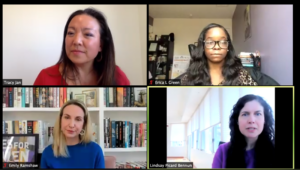
| Above: A Stanford panel on race and media last week featured two reporters with education beat experience: the Washington Post’s Tracy Jan (top left) and the New York Times’ Erica L. Green. A notable quote from Green: “I don’t cover Black students or students of color in general because I’m a person of color. I cover it because that is the story of education in this country.”🔥 Congrats to the Seattle Times’ Hannah Furfaro, who is among the finalists for NIHCM awards in journalism and research for her story in Spectrum News last year about the dangers of the antipsychotic Abilify and its use in children. Speaking of Seattle, the nonprofit news outlet Crosscut is hiring a staff education reporter.
🔥 Congrats also to the newly named spring 2021 class of Higher Education Media Fellows at the Institute for Citizens & Scholars! The fellows will receive $10,000 to support a reporting project. This semester’s cohort is Adam Bruns (Site Selection Magazine), Stephanie Daniel (KUNC), Derricke Dennis (ABC News New York), Cassandra Etienne (CivicStory), Tasmiha Khan (freelance), Kate McGee (Texas Tribune), Elle Moxely (KCUR), David Tobenkin (freelance), Alina Tugend (freelance), Charlotte West (freelance), and Chandra Thomas Whitfield (freelance).
🔥 Kudos to freelancer Rachel Cohen who has a big new opinion piece on COVID policy lessons in the New York Times(!). “We released thousands of prisoners and scrapped bail. We banned evictions and moved the homeless into their own rooms,” she wrote. “We did so much, so quickly, and we can do so much more.”
🔥 The education beat suffered a big loss this week, when it was announced that veteran education reporter Rebecca Klein was among the layoffs at HuffPost. There was an outpouring of support for her and praise for her work. “This industry is tough, but I hope to continue my reporting elsewhere,” Klein tweeted.
Did someone forward you this newsletter? You can sign up here. |
|
| EVENTS, DEADLINES, APPEARANCESWhat just happened & what’s coming next? |
|
| Above: The Boston Globe’s Naomi Martin (right) was on MSNBC to talk about the impact of COVID on education.⏰ Don’t miss CNN’s “back to school” segment tonight at 9 EST, featuring Jake Tapper, new Education Secretary Miguel Cardona, and NEA head Becky Pringle. Crossed fingers that Tapper won’t give these folks a free pass.
⏰ The San Francisco Chronicle’s Jill Tucker and Politico California’s Mackenzie Mays were on high school newspaper podcast The Paper Tiger to talk about the battle to reopen schools. KQED’s Joe Fitzgerald Rodriguez moderated a panel on SFUSD’s school reopening, and you can catch the replay here. And the NYT’s Nikole Hannah-Jones was quoted in the University of Colorado, Riverside’s student newspaper, The Highlander, encouraging young journalists to dig deeper: “We get into journalism to hold power to account,” she said.
⏰ Scholarships: The deadline for the CUNY education reporting scholarship has been extended to March 15. CUNY students, alumni, and community journalists can apply to receive a $2,500 reporting stipend and funds to cover registration fees and expenses to attend an education conference. Apply here.
⏰ Resource: Curious about how different state reopening thresholds compare? You might start by checking out this National Governors Association resource. But be careful. ProPublica had to issue a correction on this data in Alec MacGillis’ story this week. |
|
 THE KICKER THE KICKER |
|
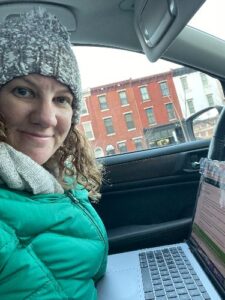
| “I don’t want to brag, but when I work from my ‘mobile office’ I write about 3x faster,” tweeted Philadelphia Inquirer education reporter Kristen Graham. “Had to drop my kid off somewhere, banged out a story in 30 mins while waiting for him.” |
|
| By Alexander Russo with additional writing from Michele Jacques and Colleen Connolly. |
|
| That’s all, folks. Thanks for reading. |
|
|
|
|
|
|