In this week’s newsletter: A new national report reveals a handful of districts’ hidden success. Rebuilding community after the LA wildfires destroyed Altadena’s Rosebud Elementary School. How ‘Nice White Parents’ ended up discrediting legitimate concerns. What happens when a non-journalist interviews a school lunch lady? ❤️ Happy Valentine’s Day!❤️
SIX PERCENT SUCCESS
The big education story of the week
The big education story of the week is the release of a new report called Economic Recovery Scorecard showing how poorly most states and districts have done in the five years since the pandemic — and how well a handful of states and districts have done relative to the rest (AP, NPR, The 74, Oregonian, The Hill).
“Schoolchildren in Massachusetts, Ohio and Pennsylvania are still about half a year behind typical pre-Covid reading levels,” notes the New York Times. “In Maine, Oregon and Vermont, it is close to a full year.”
Of particular note is the relative success of districts including Compton (CA), Frisco (Texas), Union City (NJ), and Rapides Parish (LA) (LAist, NJ Spotlight, EdSource, NYT, Houston Public Media, Chalkbeat, LA Times, K12 Dive, Boston Globe). Just six percent of districts recovered pre-pandemic reading and math levels.
It may be more convenient to cover (and read about) the uncertain fate of a handful of government bureaucrats and federal DEI and research programs, but news about the educational well-being of the nation’s students — and the success of a handful of districts — is inarguably more important.
Other big stories of the week include canceled IES contracts, suspended USDE staffers, and the Linda McMahon nomination hearing. Follow @thegrade_ for daily news coverage, Monday through Friday.
SCHOOL RECOVERY AT ROSEBUD ELEMENTARY
The best education journalism of the week
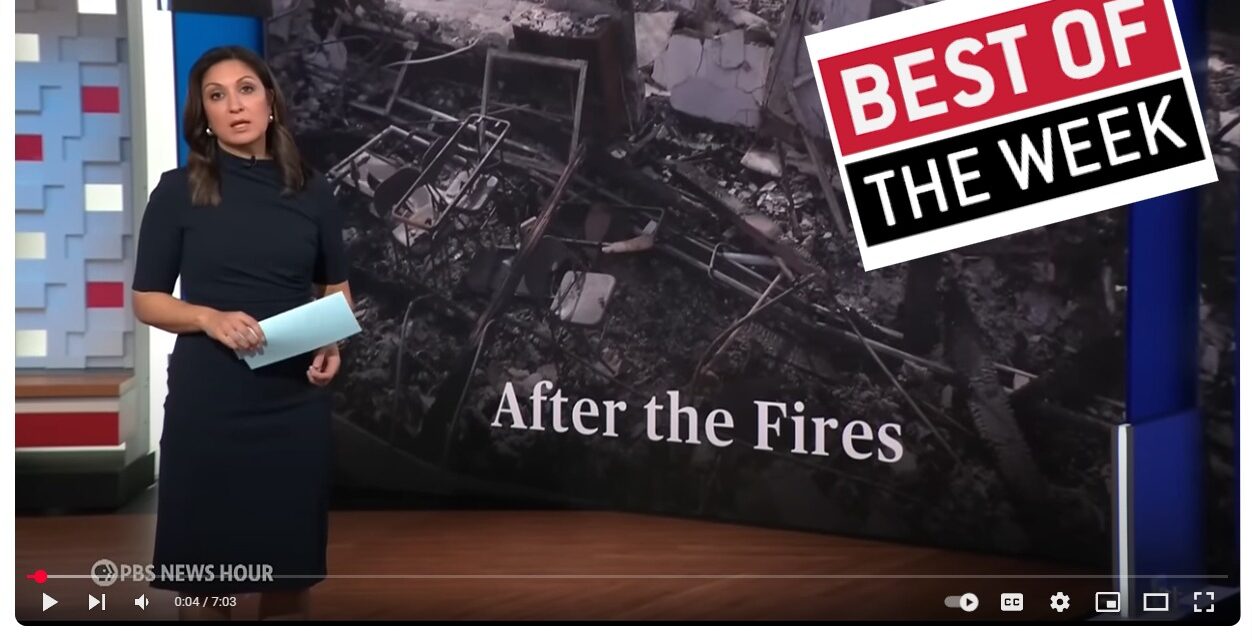
The best education journalism of the week is Students and teachers find ways to keep learning after wildfires destroy schools by William Brangham of PBS News Hour.
In this seven-minute segment, Brangham profiles Pasadena Rosebud Academy, a charter PK-8 school in Altadena, Ca., that burned down Jan. 7. Key to the narrative: the school’s imperative to offer students a sense of security and safety after one in three students were either displaced or lost everything. “They lost their dinosaurs or their favorite shoes and all of their things and their toys,” one teacher observes.
Officials at the tiny school — it enrolls just 175 students — do this by getting students back together for in-person learning as soon as possible, via a donated event space nearly an hour’s bus ride south. But it’s not an easy job. In early February, they relocate again.
In telling this story, Brangham does what few national journalists have done in the wake of L.A.’s wildfires: he circles back. The segment also conveys the importance of learning communities like Rosebud, featuring students, teachers and parents talking about what they lost and what remains. It’s a master class in restrained storytelling and commitment to a community.
Other education stories we liked include questions about discipline in a New Mexico school district (ProPublica/NM in Depth), an investigation into three LA schools cyberattacks (The 74), Colorado’s first agriculture-focused charter school (Colorado Sun) and how West Philadelphia High School increased enrollment after years of decline (Philadelphia Inquirer).

RECONSIDERING ‘NICE WHITE PARENTS’
Our latest columns and commentary
Way back in 2020, the blockbuster New York Times podcast Nice White Parents was all the rage, telling the story of how clueless white parents affected schools serving Black and brown kids.
However, a new commentary from Angie Schmitt reconsiders the series, noting that it fetishized racial integration and discredited white parents: How ‘Nice White Parents’ explains the past four years.
“It became kind of routine in left-leaning circles to just absolutely flame white parents who raised concerns about anything happening at their schools,” notes Schmitt — contributing to growing alienation among white parents from public schools and the Democratic party.
Also: Already serving 1 million kids & absorbing $4 billion in public funds, private school choice seems poised to expand in the Trump 2.0 era. But how to cover the trend in deeper, more interesting ways? FutureEd’s Liz Cohen has some helpful suggestions: Covering choice in the Trump 2.0 era.

Above: The Free Press (and education reporter Frannie Block) had a big week, with stories about lowered academic standards in American schools (above), a student suing a district for failing to teach him to read, and — perhaps the most TFP of the bunch — antisemitism in the Massachusetts Teachers Association.
PEOPLE, JOBS, & EVENTS
Who’s going where and what’s happening
📰 Appearances: The McMahon hearing in the US Senate. The New York Times’ Dana Goldstein was on WNYC Public Radio talking about DOGE, IES, and all the rest. Bellwether’s Andy Rotherham’s interview of former IES head Mark Schneider garnered an audience of 600. You can watch the replay. Former NPR education reporter Anya Kamenetz was on CNN talking about the possible abolishment of the USDE. Washington Post education reporter Laura Meckler was on the PBS News Hour talking about the USDE, cuts, etc. NM In Depth editors and reporters discuss education.
📰 Books: Eve L. Ewing’s new book, Original Sins, addresses schools’ history as a tool for cultural decimation — and their potential use as a tool for liberation. Read her interviews with Chicago reporter Jewél Jackson and with The Ink.
📰 Quotable:
🗣 “They did in 1 day what I couldn’t do in 6 years… I’m a little jealous.” – Former IES head Mark Schneider
🗣 “The mainstream media explanation is that [Trump’s aims are] just hypocrisy. A more nuanced view [is that reducing the USDE footprint] requires first uprooting the discriminatory practices and destructive dogmas.” – AEI’s Rick Hess
🗣 “Parents with kids under 18 swung 7 POINTS to Trump between 2020 and 2024. If Dems want to win, they need to acknowledge this.” – Erika Sanzi
🗣 “Public education means educating the public. It doesn’t mean corralling every kid into one building.” – AEI’s Robert Pondiscio
📰 New information: Nearly 3/4 of Americans are now dissatisfied with the quality of public education, according to Gallup. Also from Gallup: Democratic voters favor moderation. Teens’ phones were monitored across the country, revealing 90 minute usage during school hours, according to a new JAMA Pediatrics paper written up in The 74.
📰 Upcoming: Sold a Story returns next week with three new episodes, including one about an Ohio school district that has had remarkable results that might have been endangered by the state’s new literacy mandates. “We dig in on the state lists,” Emily Hanford tells us, examining “some critical questions about evidence in education that school districts and policymakers should be thinking about as they continue to try to improve reading instruction at scale.” Listen to APM Reports’ Hanford and Christopher Peak talk about the podcast on Minnesota Public Radio.
THE KICKER
We saved the best for last.

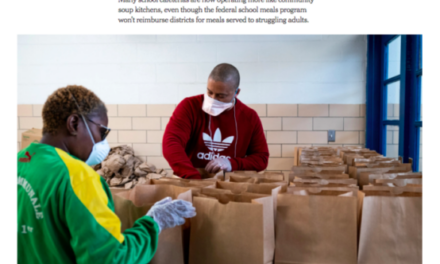
Above: Podcaster Theo Von’s conversation about “cafeteria life” with Cleveland Ohio school lunch lady Melissa Ansel has earned 1.6 million views in less than a year.
That’s all, folks. Thanks for reading!
Reply to this email to send us questions, comments or tips. Know someone else who should be reading Best of the Week? Send them this link to sign up.
Using Feedly or FlipBoard or any other kind of news reader? You can subscribe to The Grade’s “feed” by plugging in this web address: http://www.kappanonline.org/category/the-grade/feed/.
Read more about The Grade here. You can read all the back issues of The Grade’s newsletter, Best of the Week, here.
By Alexander Russo