In this week’s newsletter: Unanswered questions and contrasting responses in the aftermath of Uvalde. Journalists differ sharply on how to cover school gun violence. A slew of great education stories, including one about a Chicago high school that has recently welcomed nearly 70 Afghan refugees. Meet the only national rural higher education reporter.
UVALDE AFTERMATH
The big story of the week, according to us:
The big story of the week is the sad aftermath to the attack on Uvalde’s Robb Elementary School. More details have emerged about last week’s shooting that left 19 kids and two teachers dead, but the exact timeline of events and actions is still unclear. The teacher who supposedly left the door unlocked claims that’s not what happened. A school district police chief has reportedly stopped cooperating with state investigators. We still don’t know much about missed warning signs and attempted interventions. And the district has threatened to arrest reporters. In the meantime, schools, students, and politicians are debating how to prevent the next school shooting:
🔊 In many cases, school hardening has already happened. (Chalkbeat)
🔊 ‘We failed these children’: Agony is compounded by outrage (CNN)
🔊 After Texas shooting, schools around US boost security (AP)
🔊 There are hundreds of thousands of school shooting survivors (WSJ)
🔊 What school shootings do to the kids who survive them (Washington Post)
🔊 We’ve known how to prevent a school shooting for more than 20 years (FiveThirtyEight)
🔊 Experts cast doubt on high-tech efforts to stop school shooters (Washington Post)
🔊 Arming teachers is hard, even in gun-loving Texas (Politico)
🔊 Following Texas school shooting, Newtown reflects on a decade of hard lessons (Boston Globe)
🔊 After Texas shooting, NYC considers locking main doors at public schools (Gothamist)
🔊 RI schools to get thousands for safety updates (Providence Journal)
🔊 Students walk out for gun law reform (USA Today)
Other big stories of the week: Troubling trends in student achievement and school performance (Post and Courier, Miami Herald, GBH, EdSource) — along with pockets of progress and innovation (KPCC LA, Boston Globe, The Observer, The 74, Chalkbeat NY, NPR).
REFUGEE HIGH; INTERVENTION STORY
The best education journalism of the week, according to us:
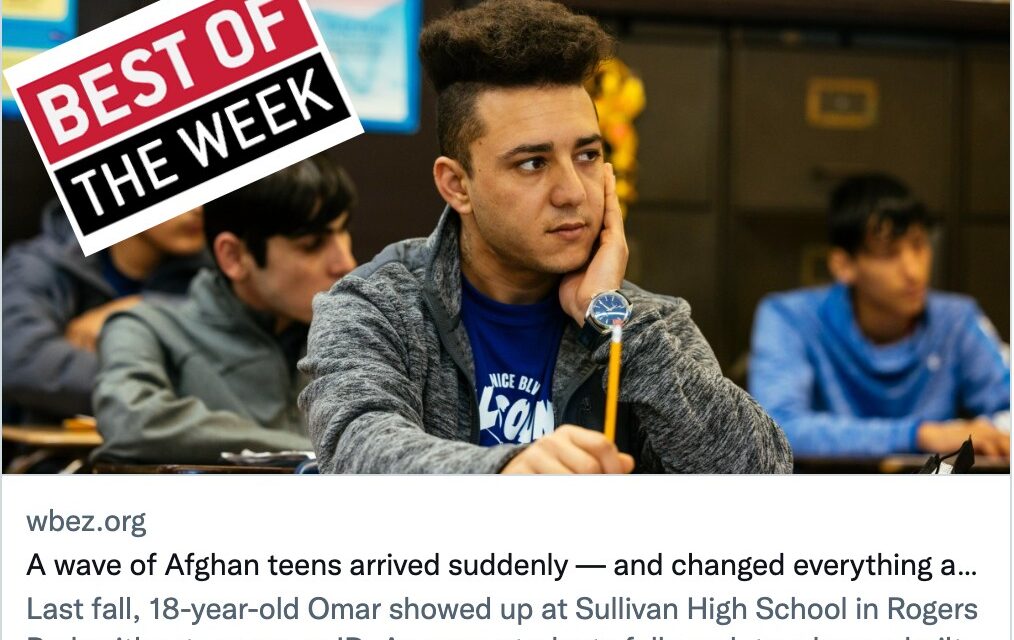
🏆 BEST: The best story of the week is A wave of Afghan teens arrived suddenly — and changed everything at a Chicago high school by Elly Fishman for WBEZ Chicago public radio. As you’ll see, it’s a classic student-centered, in-school education story, the kind that I always want to see more of. Fishman spends a day inside the diverse Roger C. Sullivan High School, where close to 70 students arrived during this last year from various parts of Afghanistan. They speak different languages. Some can’t read and write, in any language. All have experienced displacement and trauma. And sometimes this leads to behavioral problems — fights with other students, challenges around daily prayer, and cultural clashes. Fishman speaks not only with these students but also the school’s social worker, ESL teacher, and a student guide. This is a great story that shows what it’s been like for students arriving from Afghanistan — a story that seems largely forgotten. (It was actually published late last week, but I liked it too much not to feature it here.) Fishman’s book, “Refugee High,” is coming out in August.
🏆 RUNNER-UP: This week’s runner-up is When teens threaten violence, a community responds with compassion by Rhitu Chatterjee for NPR. This solutions-oriented story gets at one of the central questions around school shootings: what prompts a kid to commit such a heinous act, and is there anything that adults can do to prevent students from becoming so desperate and angry that violence seems like the only answer? In the segment, Chatterjee interviews a young Oregon man named Mishka who as a student had made threats of violence, including shooting up his school. We get to hear Mishka’s side of the story — physical attacks, the severe bullying, and his feelings of injustice — along with the safety interventionist who was involved. Mishka was moved to a smaller school where he received more individual attention and could connect with a trusted adult for advice and compassion. This story offers a doable solution and an ounce of hope in the wake of last week’s tragedy. But its real power is in the way Chatterjee tells it in a very human way, with great quotes from Mishka and the interventionist.
BONUS STORIES:
🏆 Behind the rapid rise of Colorado Hispanic graduation rates (Chalkbeat CO)
🏆 Florida embraced social-emotional learning after Parkland. Not any more. (Tampa Bay Times)
🏆 How Eric Adams’s Struggle With Dyslexia Is Shaping His Mayoralty (New York Times)
🏆 Dangerous Streets Outside City Schools Threaten Children (NYC Streetsblog)
🏆 Before Uvalde shooting, Mexican-Americans fought for decades to improve school system (El Paso Times)
🏆 L.A. school board races like no other in recent memory: less spending, little mudslinging (LA Times)
🏆 Hear from four TJ freshmen admitted under controversial circumstances (Washington Post)
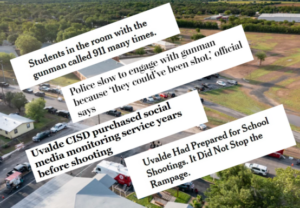
DIFFERING VIEWS ON SCHOOL SHOOTING COVERAGE
New commentary from The Grade
In a new commentary, regular contributor Greg Toppo calls for a radical reconsideration of the amount of coverage and prominence given to school gun violence. “The journalism out of Uvalde, Texas, has been amazing,” writes Toppo. “But a week later, I’m struggling with the odd feeling that we’re all suckers.” (School shootings belong on the back pages, not the front.)
In a new interview, Mother Jones journalist Mark Follman makes the case for covering school gun violence through a prevention-focused “threat assessment” lens. The key question journalists should be addressing, according to Follman, is how an 18-year-old with a history of deeply disturbing behaviors signaled his plans for an attack and gained access to powerful firearms without any effective response. (Warning signs in Uvalde)
Also: There have been numerous reporter reflections and features about the journalists covering the Uvalde story and the job they’re doing, including in the New Yorker, ProPublica, The Guardian, and CJR. And: Recent shootings have also revived the debate about whether media outlets should publish graphic images of victims or crime scenes in the Columbia Journalism Review, New York Times, Vanity Fair, and Philadelphia Magazine. I came out in favor of graphic images in 2018 but have since been convinced that the change is unlikely to have its intended effect.
For education media commentary and insights all day, every day, follow @alexanderrusso.
PEOPLE, JOBS, AWARDS
Who’s doing what, going where.
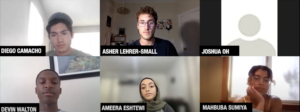
Above: The 74’s Asher Lehrer-Small (top center) and the outlet’s student advisory council met virtually to discuss gun safety and how the Uvalde school shooting has impacted their communities.
🔥 Job moves: Deputy director Erik Robelen is leaving EWA after eight years, and will announce his next move soon. Former Houston Public Media education reporter Laura Isensee announced that she’s joining Adonde Media as a senior editor. And longtime education reporter Kavitha Cardoza will fill in for EWA public editor Emily Richmond while Richmond is doing a year-long Spencer education journalism fellowship.
🔥 Recognition: Congrats to CalMatters reporters Jocelyn Wiener, Erica Yee, Anne Wernikoff, Ricardo Cano, and Elizabeth Aguilera for winning 1st and 3rd place in youth and education coverage in the California Journalism Awards. Their stories covered inequalities in education and the challenges special-needs kids have faced in the pandemic. And the New York Post’s Cayla Bamberger (formerly of the Connecticut Post) won a 2nd place award in education coverage at the Connecticut SPJ awards for her project on English language learners. Kudos also to Stephen Burd, whose tireless reporting for the Washington Monthly and other outlets helped expose Corinthian Colleges for defrauding students. Read his thread here.
🔥 New ventures: The Post and Courier Education Lab in South Carolina now has a Twitter! Help them get some more followers here. Though it’s no longer new, the Alabama Education Lab has completed its first full year in operation! And KPCC/LAist higher ed reporter Adolfo Guzman-Lopez has been taking a break from the beat to pursue a passion project, a podcast called “Imperfect Paradise” about California stories with “universal significance.”
🔥 Rural higher ed: This week I learned that Nick Fouriezos is currently the only full-time national education reporter covering rural higher ed issues in the country. Read his fascinating thread about misperceptions surrounding rural higher ed and a helpful list of outlets (including The Daily Yonder, Scalawag magazine, and Southerly magazine) and bylines (including Chalkbeat Colorado’s Jason Gonzales and Mississippi Today’s Molly Minta) to follow for high-quality rural education coverage. Be sure to follow him and subscribe to his newsletter, Mile Markers. Thanks to Emily Richmond for the tip!
EVENTS, RESOURCES, TRENDS
⏰ Podcasts: Episode 5 of School Colors’ second season dropped this week, exploring how a Queens, New York, school district went from being considered racially divided to exceptionally diverse. NPR’s Code Switch aired a segment on reconsidering school safety towards prevention rather than enforcement. The New York Times’ The Daily featured segments on the students lost in Uvalde and the delays in rescuing survivors on the day of the shooting. The Detroit Free Press featured Lily Altavena on a recent podcast segment about a town that hasn’t had its own high school in seven years. The Post Bulletin’s Jordan Shearer was on his paper’s in-house podcast talking about student behavior in Rochester schools.
⏰ School board election trends: Interest in running for school boards is up nationwide, according to Ballotpedia. Only 25% of school board races are unopposed this year, down from 35% last year and 40% in 2018. In April’s school board races, incumbents lost at nearly twice the historical average. And it isn’t just conservatives running. As NPR reported, progressives are also turning to school boards to counter right-wing anger at education issues.
⏰ Research: Sixteen out of 100 large and urban districts are considering shuttering schools next fall, according to CRPE. The National Center for Education Statistics released a report showing that the drop in public school enrollment between fall 2019 and fall 2020 was the largest decline in a year since 1942. The ACT reports that grade inflation was persistent and widespread even before the pandemic. The Pew Research Center reports that most teens prefer in-person learning over hybrid and virtual. And Human Rights Watch released an important report on how governments around the world have harmed children’s right to privacy with online learning tools in the pandemic.
THE KICKER
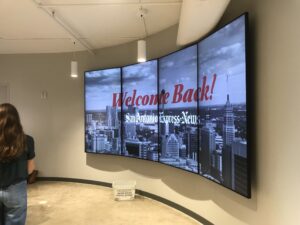
“Today was my first day at the Express News office!!,” Tweeted San Antonio Express education reporter Danya Pérez. “After two+ years of WFH I’m so sure my mental health will benefit from a little home/work separation.”
That’s all, folks. Thanks for reading!
Reply to this email to send us questions, comments or tips. Know someone else who should be reading Best of the Week? Send them this link to sign up.
Using Feedly or FlipBoard or any other kind of news reader? You can subscribe to The Grade’s “feed” by plugging in this web address: http://www.kappanonline.org/category/the-grade/feed/.
Read more about The Grade here. You can read all the back issues of The Grade’s newsletter, Best of the Week, here.
By Alexander Russo with additional writing from Colleen Connolly.
ABOUT THE AUTHOR
Alexander Russo
Alexander Russo is founder and editor of The Grade, an award-winning effort to help improve media coverage of education issues. He’s also a Spencer Education Journalism Fellowship winner and a book author. You can reach him at @alexanderrusso.
Visit their website at: https://the-grade.org/