
A Massachusetts district uses curriculum, teacher support, and data to fuel student academic growth.
The COVID-19 pandemic hit the Pentucket Regional School District hard. We’re a 2,200-student regional school system serving three small suburban communities north of Boston. Our district historically enjoyed high student achievement, but scores had been steadily declining for about a decade. We were starting to reverse those losses shortly before the pandemic, but the disruptions that began in March 2020 set those efforts back. We operated remotely in the spring of 2020, followed by a hybrid schedule for a few months in the fall of the 2020-21 school year. By mid-winter in 2021, almost all our students had returned to a full in-person schedule. Teaching and learning were still not quite the same that year, but our staff remained focused on student outcomes while also attending to student well-being.
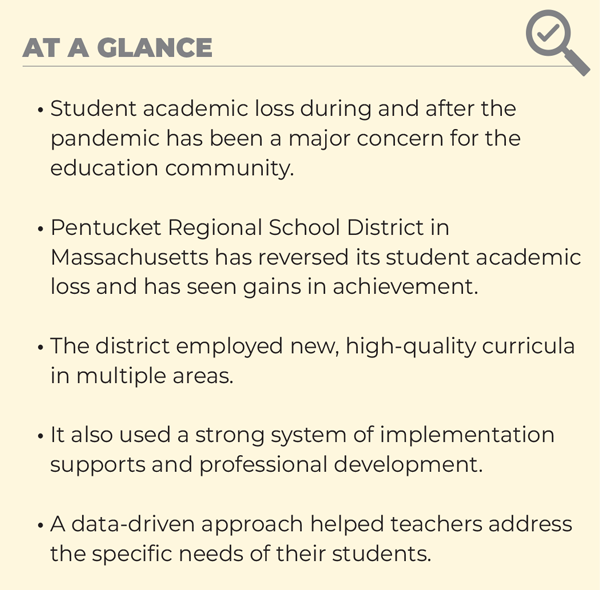
Now, we safely can say we have emerged stronger, thanks to a new curriculum and a data-driven approach to help teachers address the specific needs of individual students. Our teachers are focused and growing in their craft. Our families are engaged. Our community leaders are supportive. And, most important, our students are learning more than ever.
Catch-up growth
U.S. students lost academic ground during the pandemic. Recent National Assessment of Educational Progress scores show that recovery of that ground has been slow or
nonexistent. Education leaders, researchers, administrators, and teachers are searching for solutions to this urgent problem.
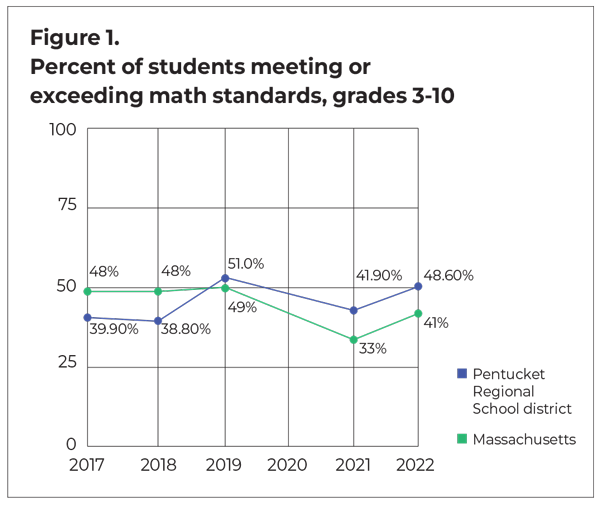
At Pentucket, we have shown that academic recovery and growth after the pandemic is possible. On the 2022 Massachusetts Comprehensive Assessment System (MCAS) state assessment (Massachusetts Department of Elementary and Secondary Education, 2022), the percentage of Pentucket students meeting or exceeding the math standards rose in all but one grade, an average gain of more than 7 percentage points per grade from the 2021 test, exceeding the performance in 2017 and 2018 and nearly returning to the 2019 pre-pandemic high (Figure 1).
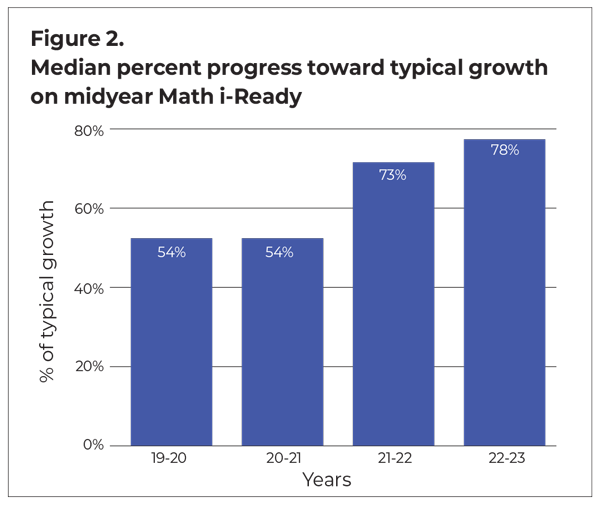
On the i-Ready midyear assessment, the median percent progress toward “typical growth” for our district had risen from 54% in 2019-20 to 79% in 2022-23 (Figure 2). Typical growth is defined as the average annual growth for a student at their grade and baseline placement level. The iReady assessment recommends aiming for 50% or greater progress toward typical growth at midyear. Our results showed that, in January 2023, when the midyear i-Ready assessment was administered, half of our students were meeting or exceeding 79% of their typical growth measure, as opposed to half of our students meeting or exceeding 54% of their typical growth measure in January 2020. Based on this data, our students had made greater progress toward meeting their annual typical growth measure in January 2023 than in January 2020.
Possibly even more telling is that on the spring 2023 i-Ready assessment, the median percent progress toward typical growth had risen to 135% in math.
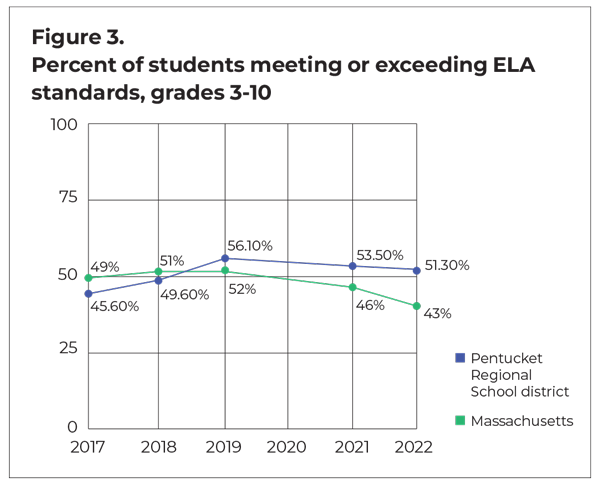
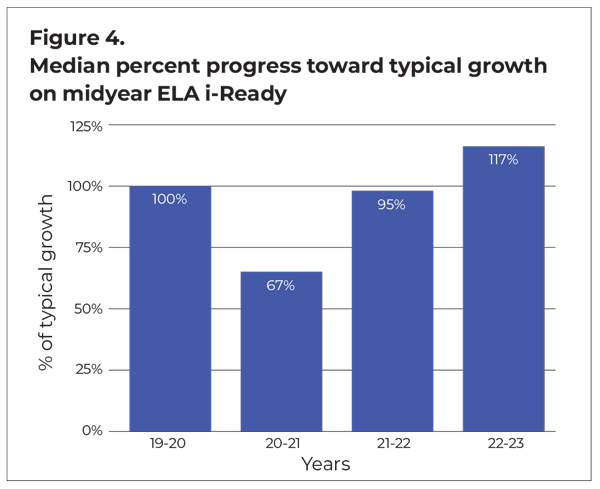
We experienced similar gains in English language arts (ELA). While we were 9-10 points below the state average in 2016-17 and 2017-18 in grades 3-10 on the MCAS state assessment, we were 7 points above it by 2021-22 (Figure 3). On the i-Ready midyear assessment, the median percent progress toward typical growth in ELA for our district had reached 117% in 2022-23, compared to just 67% two years earlier (Figure 4). With growth scores like this midyear, we knew the students were closing gaps so it was no surprise to learn the median percent progress toward typical growth in ELA had reached 150% in the spring of 2023. We applied the same approach to our foundational skill work with literacy where only 68% of our students in K-3 were meeting the benchmark expectations on the DIBELS 8 assessment at the end of the 2018-19 school year. By the end of the 2022-23 school year, that number was up to 81%, which significantly reduces the risk of future reading difficulties for students.
This is what catch-up growth looks like. We have largely recovered from pandemic-related declines and are now considerably above the state average. Even our lowest-performing school is catching up. We have never seen this type of growth before.
A focus on curriculum
Much of our success can be attributed to a relentless focus on three priorities:
- A coherent, standards-based, high-quality curriculum in core academic subjects.
- A commitment to using these instructional materials effectively.
- A passion for using data to guide decisions and improve performance.
Our success can be traced to a group of teachers at Donaghue Elementary School in Merrimac in 2015. Worried that their math curriculum was not aligned with new state standards, these teachers searched for something new. They discovered, downloaded, and began using EngageNY Math, the free version of the standards-aligned curriculum created by New York state and the precursor to Eureka Math and Eureka Math2. By fall 2017, all three elementary schools in the district elected to use the materials, citing richer math discussions, improvements in students’ modeling abilities, and support in trying multiple problem-solving strategies as benefits.
By the time our superintendent, Justin Bartholomew, and I arrived in 2018, a lot of promising work was underway. We built on the work by strengthening the curriculum across the district and in all subjects. We also supported teachers in using the materials and student data to improve instruction.
Seeking a consistent curriculum
We focused first on literacy, where our scores had been dropping. We had talented teachers, but literacy instruction was not consistent among the district’s schools and, in many cases, not even among classrooms in the same building. Many teachers were selecting or developing their own materials. With a regional school district, in which students come from three different towns and elementary schools, the inconsistency becomes especially problematic when the students come together in middle school.
Many teachers were using a workshop model with Lucy Calkins’ Units of Study but were frustrated by the limitations of this balanced literacy model, which taught students to guess at words using context clues rather than explicitly learning phonics. In 2017, Pentucket began using a phonics-based reading program. Two years later, we adopted a supplemental tool that specializes in teaching phonemic awareness skills. But we knew we needed more.
The evidence is clear: Helping students build knowledge is one of the keys to great comprehension (Cabell & Hwang, 2020; Liben & Pimentel, 2018; Petrilli, Davidson, & Carroll, 2022). We wanted students reading real books and other informative materials that allowed them to study topics deeply, not collections of random reading passages or basal readers in a scattershot approach. We also wanted students to see multiple perspectives represented in what they read. Our alumni — former students now in college or careers — told us that they needed literature and discussions that reflected the diverse world they were entering after graduation.
We formed a literacy planning team that engaged in professional learning opportunities focused on evidence-based practices. By the 2020-21 school year, some teachers were beginning to use Wit and Wisdom, a knowledge-building ELA curriculum for grades K-6. We fully implemented the curriculum the following year. This provided teachers with sets of engaging books on a variety of topics and a clear path to teach students how to read complex text.
Changing our instructional approach
Getting good instructional materials in all content areas was just a first step. We also made it a districtwide priority to help teachers use these curricula effectively. We wanted to make sure they were using the materials not as a script, but as a jumping-off point for deeper instruction.
A lot of our literacy focus has been on helping teachers develop a deeper understanding of the new, more challenging ELA standards adopted in Massachusetts and most other states. The new standards called for three big instructional shifts:
- Implementing daily instruction and practice with complex text.
- Using evidence from text with speaking, writing, and reading.
- Building knowledge through text and vocabulary.
Pentucket students read great books that dive deeply into topics like space, the deep sea, the Great Depression, the Civil Rights Movement, and the American Revolution. With this knowledge comes vocabulary development, an understanding of language structure and syntax, and improved reading comprehension, all while using authentic literature and learning how to write well.
Teachers no longer teach skills such as vocabulary and grammar as isolated exercises. Instead, they tie the skills instruction back to the books. They don’t teach writing by having students respond to random prompts. Instead, students write about what they’re reading, carefully drawing evidence from multiple text sources. Students practice decoding skills to build their automaticity in word recognition, but when students engage with text, the focus is not on automaticity, but on making meaning. This is not done through the same type of practice as decoding, which has been a fundamental shift for many teachers.
Comprehension strategy instruction by our teachers has been shifting to be less focused on a specific strategy of the week, like making inferences, but rather more focused on building background knowledge and teaching other aspects of language that we know affect comprehension, such as syntax, grammar, and sentence structure of grade-level text. A recently published meta-analysis of 52 articles (Peng et al., 2023) revealed that simply providing more comprehension strategy instruction and practice did not create better results for readers and the impact of comprehension strategies was positive only when knowledge-building was part of the instruction.
Similarly, in math, some teachers had to relearn the content so that they could help students understand the ideas underlying mathematics knowledge — and not just memorize algorithms and formulas. Of course, students still need to know at a glance that 10 x 10 = 100, but we also want them to understand why this is so. This way, they won’t hit a wall when they move beyond basic arithmetic to algebra and geometry.
Investing in our teachers
To support our educators, we have significantly strengthened our professional development. Many of our teachers read, and we collectively discussed, The Knowledge Gap by Natalie Wexler (2019), which discusses the importance of building knowledge through content-rich approaches.
Teachers now have 45 minutes of common planning time a day, plus some early release time for more in-depth study. In our curriculum-aligned professional development, we support our teachers in deeply understanding the lessons, being clear about the learning goals for each module, and then mapping out their instruction. This is consistent with a “backwards by design” approach. The student work is purposefully planned based on what we want the learning outcomes to be. The materials are great, and the publisher’s implementation guides are helpful, but there is no substitute for teachers reading the texts and doing the lessons themselves — before they start teaching them.
Even with the most thoughtful planning, teachers need advice on adjusting their lessons in real time — knowing when to zig and when to zag. So, we’ve also prioritized providing real-time support in classrooms through embedded coaching. We hired a full-time ELA coach/coordinator who spends one day a week in our smallest elementary school and two days in our larger elementary schools observing, modeling, and otherwise supporting. Her work has been essential to our progress. We have hired additional support staff for students struggling with reading, and principals are learning how to conduct constructive learning walks in their classrooms.
We used federal pandemic relief funds, made available through the Elementary and Secondary School Emergency Relief (ESSER) Fund, for some of these investments and have been planning ways to sustain the efforts after the funding ends in 2024. Beyond the safety spending that was needed, ESSER funds helped us provide additional literacy tutors; add a literacy coordinator/coach; upgrade technology infrastructure; and purchase high-quality instructional materials, such as Wit and Wisdom for our middle school students. This past spring, the voters in our three towns supported an operational tax override, which provides a permanent increase to our budget. It’s essential that our community understands that the changes we’ve made are not one-time fixes but essential investments in permanent, systemic, structural changes.
Using data in new and robust ways
Regularly analyzing and discussing student data is a core component of our expanded professional development. Teachers have access to detailed data dashboards, which include information from their regular in-class assessments, Dynamic Indicators of Basic Literacy Skills (DIBELS) assessment, and the districtwide i-Ready test we administer three times a year.
The dashboards are powerful ways to allow teachers to analyze performance from many different angles. Teachers are trained and frequently involved in the data analysis — with and without administrators overseeing it. We use data to understand whether students are making expected progress at various points during the year. Teachers see where the breakdown in learning is happening — whether it is the whole class, small groups, or individual students. For students who are lagging, teachers get immediate, targeted advice on the kinds of interventions to try next.
We also schedule formal, in-depth, grade-level discussions throughout the year in each school: 45 minutes in the fall to review baseline performance data, 90 minutes in the winter to focus on intervention strategies, and 60 minutes in the spring to review progress and celebrate success. This is true data-driven instruction at work. For example, here is a typical prompt from a math data meeting that comes from i-Ready data analysis tools that help our staff consider which skills need to be targeted for student instruction:
Those students with a low score in Number and Operations may struggle with understanding the relative size of decimals and fractions and have difficulty with comparing decimals and fractions. These students will benefit from review of foundational fraction and base-ten decimal representation to understand operations with these numbers. Those students with a low score in Algebra and Algebraic Thinking may have trouble identifying and expressing relationships between numbers; they will particularly benefit from instruction on the concepts and skills described below in the section Algebraic Thinking. All students in this profile likely need to develop fluency with basic multiplication and division facts. They also likely need reinforcement of essential vocabulary.
At all times, our emphasis is on using data to improve not punish. When we see an area of specific need, we’ll respond with programming to help. For example, coming out of the pandemic in summer 2021, we held an intensive two-week summer academy in math, the content area where our performance had declined the most. The impact was immediate as students closed the gaps in their content and skills.
Similarly, during the year, we have seen positive results from our intensive math and ELA labs in middle school. These are designed for students who are far behind and need extra time, as determined by a close analysis of their i-Ready and MCAS scores. Their regular math and ELA teachers provide more targeted instruction to 10-12 students for 60 minutes a day while the other students are in enrichment classes. In almost all circumstances, these students are only involved for a semester, sometimes only a quarter, allowing students to participate in enrichment courses during the rest of the year.
This is not homework help, nor is it a new track for struggling students. It’s meant to be a time for students below grade level to build missing skills (Fielding, Kerr, & Rosier, 2007). The focus is on strengthening the precursor skills they need before they can master grade-level content. Students can leave as soon as they have caught up. At most, they can stay for 16 weeks. For those who are still demonstrating difficulty, we engage in a problem-solving data-driven process to determine next steps to help support the student.
We have a similar catch-up program in elementary school called targeted teaching time. During targeted teaching time, which occurs each day in grades K-6, we set up schedules that “flood” a grade level with adult support in a way that ensures students who are the furthest behind get the most direct instruction. In K-3, we focus on intensive literacy intervention to ensure we address early foundational skills. We don’t just schedule daily small-group instruction for all students. Instead, the students who require the most direct and explicit instruction get what they need in a small group. Most other students spend the time in whole-class instruction, partner work, and with teacher check-ins to ensure they remain on task. This tiered model approach is yielding strong annual growth for all students, but especially for those who are far behind.
A coordinated system
The work we have done in Pentucket is far from a straight line of progress, and there was no single trick, tool, or curriculum that made the difference. It is hard work, but it is all rooted in a systems approach to change. We write about our work in our district Teaching and Learning blog at https://bconway56.wixsite.com/pentucketblog.
When discussing our work, I often use the words of W. Edwards Deming (1993): “A bad system will beat a good person every time.” That serves as a reminder that, to really reach every student, we need a coordinated approach that addresses all the factors we can control for. There is no easy fix, but it can be done.
References
Cabell, S.Q. & Hwang, H. (2020). Building content knowledge to boost comprehension in the primary grades. Reading Research Quarterly, 55 (S1), S99-S107.
Fielding, L., Kerr, N., & Rosier, P. (2007). Annual growth for all students: Catch-up growth for those who are behind. New Foundation Press.
Liben, M. & Pimentel, S. (2018). Placing text at the center of the standards-aligned ELA classroom. Student Achievement Partners.
Massachusetts Department of Elementary and Secondary Education. (2022). Pentucket Regional School District profile. https://profiles.doe.mass.edu/mcas/achievement_level.aspx?linkid=32&orgcode=07450000&orgtypecode=5&
Peng, P., Wang, W., Filderman, M.J., Zhang, W., & Lin, L. (2023). The active ingredient in reading comprehension strategy intervention for struggling readers: A Bayesian network meta-analysis. Review of Educational Research, 0 (0).
Petrilli, M., Davidson, B., & Carroll, K. (2022). Follow the science to school: Evidence-based practices for elementary education. John Catt Educational.
W. Edwards Deming (1993). The W. Edwards Deming Institute.
Wexler, N. (2019). The knowledge gap: The hidden cause of America’s broken education system — and how to fix it. Avery.
This article appears in the September 2023 issue of Kappan, Vol. 105, No. 1, pp. 24-28.
ABOUT THE AUTHOR

Brent Conway
BRENT CONWAY is the assistant superintendent for the Pentucket Regional School District, West Newbury, MA.