An expert’s advice on school choice coverage during what may be an especially politicized time. The latest in our series of essays and interviews on covering school choice.
By Alexander Russo
There’s little doubt that various forms of school choice are on the rise, among them especially private school choice programs.
But it’s easy to get lost in the highly politicized back-and-forth among advocates and politicians, covering the fight but not necessarily helping parents or policymakers.
So the question is how best to cover these programs in a way that’s accurate and engaging for readers?
In the following interview, you’ll get some insights from Michigan State professor Josh Cowen, who has researched and written extensively on various forms of school choice. His latest work is a new book on school vouchers called The Privateers, which will be published by Harvard Education Press in September.
As you’ll see, Cowen claims that the research on school choice is too often watered down in media accounts, decries media confusion over the fundamental nature of Education Savings Accounts (ESAs), and generally concurs with education journalists like Cara Fitzpatrick and Yana Kunichoff that coverage needs to be deeper and more focused on its real-world effects on families and society.
This is the latest in our series of essays and interviews on covering choice, which includes insights from Chalkbeat’s Cara Fitzpatrick, podcaster Jennifer Berkshire, freelancer Gail Cornwall, and Luminaria’s Yana Kunichoff.
Conducted by phone and online, the following interview has been edited and condensed.
What’s the best argument for covering school choice, in terms of real-world stakes and real children’s lives? What makes it a top-tier issue in terms of societal importance?
Josh Cowen: Well, in a very news-hook sense, one answer is that passing universal vouchers is the key education policy priority for a new Trump presidency. It leads the education chapter of Project 2025. So for the next 12 months, maybe more depending on the outcome of the election, this is the most important education story simply because Donald Trump and allies have made it a part of their platform.
At a higher, societal level, it goes back to the idea of solving common problems. I support some school choice plans. I don’t support vouchers because first and foremost the entire theory of action is based on one of exclusion and isolation. It’s why they first appealed to segregationists looking to maintain a status quo after Brown.
Does that mean all voucher advocates are segregationists? Of course not. But in a political climate where there are really fundamental debates about difference and acceptance, vouchers are about “do we come together to solve common problems?” Or “do we separate, isolate, and Balkanize our children into groups we think they should fit into?”
Like it or not, our kids will decide for themselves one day. I reject any philosophy that says that they will not, or should not. And vouchers are the policy vehicle for that philosophy.
How’s the quantity and quality of coverage you see? What are the core concerns that that come up for you when you think about media coverage that you’ve either read or been in?
JC: For the most part, I don’t see a lot of inaccuracy in the voucher coverage. You can start to notice especially in some of the trade outlets when the hand of an editor has been in there. But I don’t see articles falsely saying, “Vouchers caused positive effects on student achievement over the last 10 years.” You can quibble, of course. There’ll be phrases like “mixed to negative,” which researchers don’t use a lot. We say it “tends toward negative” or “tends toward positive,” so whenever I see “mixed to negative” in there, I know that one of the University of Arkansas guys or the Heritage guys have been talking to that person.
To be clear, some early research on vouchers looked okay. But the more recent stuff looks horrific, and so I don’t fault the reporter for not picking up on that trend if they haven’t read 30 years of research. You really have to know the field. A phrase that I use is “the bigger and more recent the voucher system, the worse the results.” I don’t think that’s overly wonky to try to explain. But I’m not going to blast reporters for describing something a bit differently than I might.
What are your peeves and preferences when it comes to media coverage of choice?
JC: I do get annoyed when folks describe vouchers as particularly innovative or new. They’re not. I can’t stress enough how similar education savings accounts are to vouchers at their core. All ESAs are vouchers, too, although not all vouchers are ESAs. The only real question is “what else besides tuition is included?” Nobody seems to remember that all voucher systems originally were, like ESAs, distributed directly to the parents.
I wish more political reporters covered some education issues, and vice versa. I mean, of the 60 to 70 reporters I’ve spoken to in the last 12 months, the most common question I get is “Why now?” You do have to kind of then start to talk about the larger political climate because they’re not distinguishable for each other. It’s just been a long-standing priority.
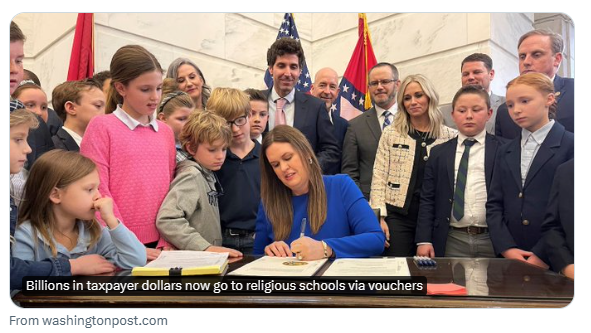
Above: A recent example of school choice coverage from the Washington Post.
What are some of the best examples of school choice coverage that you’ve come across in recent months — and why are they so great?
JC: Two [positive] examples that come to mind are the Hechinger Report’s piece on Arizona voucher schools raising tuition once the checks come and Politico’s piece on who’s been using vouchers as they’ve expanded. The reason is the same: as these vouchers expand, it’s important to ask questions about them that go beyond what I call “bumper sticker” slogans like “fund students, not systems.” Who really uses them? (A: So far, mostly kids who’ve never been in public school). How does the private market respond? (A: By raising tuition, as entirely predicted by an earlier economic analysis).
Generally, I think local statehouse reporters have also been exceptional in covering voucher bills — both in terms of the policy details and the politics. To my eyes, it’s clear when a writer has covered the process of boilerplate legislative wrangling and when they haven’t. Voucher bills have more in common with tax subsidy and budget legislation than they do bills that education reporters typically encounter.
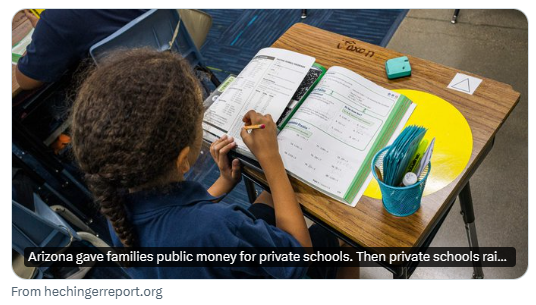
Above: A November Hechinger Report story praised above as high-quality coverage.
What are the worst coverage examples?
JC: I’m no media critic, so I’m not going to call out specific pieces. And by and large, since I’ve been vocal in the voucher space, I find most coverage largely accurate. But like I said above: A) calling vouchers anything but vouchers. If you look at the legislation, ESAs really just are “vouchers plus” — a classic tuition component plus add-ons. You have states like Arizona and Florida where those add-ons are homeschool-type expenses like learning materials and technology and, infamously, kayaks and grills. But you also have states like Iowa and Arkansas where it really is just a classic voucher, plus covering fees like uniforms and textbooks. In Iowa, the state literally holds the money in a mortgage-service type account to distribute to the private schools once parents are awarded the money. And you have to spend the dollars on private tuition first before any other items. That’s a voucher.
So here’s the deal: does the bill cover private K-12 tuition? If so, it has a voucher in it, whatever else it includes.
And example B) calling the evidence on vouchers “mixed.” It’s not mixed. Conservative think tankers say one thing, and everyone else says the other. Voucher evidence is only mixed relative to a standard of “does every single study show X?” Then no, not every single voucher study shows terrible results. But social science doesn’t work that way. And in size, scope, recency, and in terms of implementation and unintended consequences, then the evidence case against vouchers is very much not mixed. It’s as one-sided as social science gets.
People really don’t understand just how bad the test score outcomes were for vouchers 2010-2020. I think of this quote by Martin West — no lefty unionist — in the New York Times about test score drops in Louisiana for public school students who used a voucher to transfer to a private school: “‘as large as any I’ve seen in the literature’ — not just compared with other voucher studies, but in the history of American education research.”
The size of that negative impact should be featured more than it has in coverage of the issue.

Above: Cowen and his forthcoming book.
In the coverage that you see, are the reporters that you’re talking to predominantly education reporters?
JC: I would say in the early days of my more regular commentary on this stuff, say around spring of 2022, it was mostly ed reporters. I’ve come to believe a little bit that the centrality of public funding for private schools, and in particular for religious schools, is becoming clearer and clearer. So it would be helpful to see more political coverage that talks about this. We can quibble about what book bans are legislatively, but we can’t really quibble about public subsidy for private tuition. It’s a concrete policy, it’s an item in state budgets, and it is a priority for the same people pushing these other things [like book bans]. I mean, it’s one of the five things Trump talks about more regularly. He calls it “education freedom” or “school choice” more generally.
The other central fact is that overwhelmingly, at least so far, users of these voucher systems have been already in private school. That’s a really important piece. Of course, there are some kids who do transfer and they haven’t been served well in public schools. But we’re talking about massively expanding these schemes, and most of it is going to subsidize existing behavior. I think that’s where some of the ed reporters can get a little get tripped up. For the most part, I don’t think all the coverage has fully caught up to this idea that what we’re talking about is really kind of just sending new dollars to systems that [are serving people they already served].
People really don’t understand just how bad the test score outcomes were for vouchers 2010-2020.
How could education reporters deepen their coverage of choice, which Chalkbeat’s Cara Fitzpatrick described in a recent interview as “a little bit shallow“?
JC: Reporters really need to think about this as a tax or budget issue, from a technical sense. Yes, as I’ve said above, the issue is philosophically about education and democracy. But in a policy sense it’s simply privatizing an education service — not unlike hiring a bunch of vendors — and needs to be treated as such.
I also think more could be done to write about who the groups really pushing vouchers are. Going to quote a Heritage Foundation “fellow?” It’s worth noting what the group is also saying about restricting access to abortion or birth control. Going to quote the American Federation for Children? Isn’t it worth noting Betsy DeVos founded the organization? These are not ad hominem distinctions, any more than which politicians are endorsing Biden and which are endorsing Trump.
I’m a professor, but these are not academic debates, and sometimes coverage of vouchers tends to describe two opposing sides that way.
What do you think about Yana Kunichoff’s assertion that the focus of choice coverage should include whether parents have agency in the system?
JC: I agree. Whether parents feel what political scientists would call a sense of self-efficacy in politics — in this case, “do I have the power to make change on behalf of my child?” — should be covered. But then so should the results. The “Sold a Story” reporting by Emily Hanford was partly about how parents were led to believe reading practices were working for their kids when in fact those practices were not. And now right-wing critics use the Hanford reporting to blast public schools.
But they can’t have it both ways. Parent satisfaction and agency should be one important feature of education reporting on vouchers and everything else. But so should “are parents getting what they’re promised?” To go back to the Louisiana results, parents were very much “sold a story” about vouchers being a lifeline for their kids, too. And what did the vouchers do? Destroy the academic outcomes for those kids for years afterward. So let’s talk more about parent agency, yes, but as part of that conversation let’s talk about whether voucher schemes — which I call the education equivalent of predatory lending — are actually doing what their backers are promising parents.
These are not academic debates, and sometimes coverage of vouchers tends to describe two opposing sides that way.
If a reporter was working on a story about these issues and you were away, who else should they call? NCSL? Should they call ECS? Who else would you recommend?
JC: If they were calling for a summary of what the research evidence says, then someone like Chris Lubienski. I think if the question was more some of the other stuff, the political dynamics that we talked about, that I’m increasingly writing and speaking about, there’s a lot of people that have been talking about that for quite a while, like Jack Schneider for example. Nancy McLean at Duke is an economic historian who’s done a lot of work about how vouchers fit into that and Milton Friedman’s role. For legal questions, I’d talk to Jessica Levin at the Education Law Center or folks like Preston Green at UConn.
How do you think reporters should write about school choice at the individual family level? What role should family experiences with choice or traditional systems play in the coverage — as opposed to political, financial, or societal effects?
JC: This is an excellent question. I think how individual families navigate these complex systems is a crucial part of the story. Especially parents of special needs children who truly have been poorly served in some cases by their public school experience, too.
The difficulty is that it’s incredibly hard both as a researcher and, I expect, a reporter, to really meet those families organically for study or coverage that includes their voices.
Both sides, but especially the voucher lobby, have rosters of parents or adults who as children were “saved” by school choice. Betsy DeVos’s AFC employs several on a full-time basis as professional advocates. So if you’re going to commit to covering parent and student voices — a truly important and noble endeavor — the commitment needs to include doing the hard work of connecting with real families. Not those spoon-fed by professional comms folks trying to make a point.
Previously from The Grade
‘Agency in the system?’; how to cover school choice (Kunichoff interview)
What happens when education reporters write about politics (and vice versa)? (Berkshire interview)
‘A little bit shallow’: Cara Fitzpatrick calls for context & immediacy
A cautionary tale about linking school choice and segregation (2019)