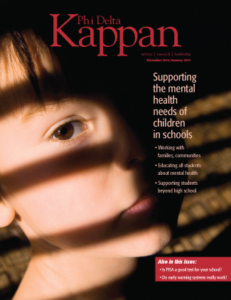
 A Look Back
“A Journey Through the Labyrinth of Mental Illness”
By Katherine C. Cowan, December 2014/January 2015
When Katherine C. Cowan’s daughter, Sara, was seven years old, she began experiencing extreme fear of going to bed at night, and the lack of sleep affected her behavior at school. In this article, Cowan describes how she and her husband tried to figure out what to do to help and how their frustration sometimes led them to make mistakes. Eventually, they were able to get therapy, which Cowan acknowledges isn’t available for many families, and the strategies and continued counseling helped — for a time.
However, when Sara was in high school, “the anxiety came roaring back, this time masked as adolescent moodiness and volatility.” Even with the knowledge she gained working at the National Association of School Psychologists, Cowan had trouble recognizing that what Sara was experiencing was more serious than typical teen problems. Sara’s self-advocacy led her to seek help, but, Cowan writes, “The labyrinth got darker and more twisted before it got better.”
Cowan chronicles how her family made their way through, providing educators a powerful picture of what it feels like for a parent, even one with resources and expertise, to take care of a child’s mental health needs. She writes:
At a time when you need understanding from others the most, the first instinct can be to erect barriers. Many parents won’t volunteer information about their child’s illness, let alone their own stress. They may not tell the math teacher that mastering Algebra is not nearly as great a concern as whether this class will be the weight that tips their child into a downward spiral.
Conversation piece
This issue examines how schools can promote mental health among students and staff. Use these questions to reflect on the issue with your colleagues.
- What mental health issues have you observed among students and staff in your school? Has this changed in recent years?
- What have been some of the most useful strategies, programs, and resources for addressing student mental health at your school? And the least useful?
- What kinds of mental health supports can you offer students in your classroom, and when do you seek additional intervention?
- How has the climate at your school affected the mental health of you and your colleagues? What might the school do to support you?
PDK members have access to discussion guides related to specific articles in each issue of Kappan. Log in to the member portal and access the discussion guides at https://members.pdkintl.org/PDK_Member_Discussion_Questions.
“We know that when kids are mentally well, they’re much more likely to attend school and do well in school.” — Sharon Hoover, co-director of the National Center for School Mental Health, as quoted in the Washington Post article, “The crisis of student mental health is much vaster than we realize,” Dec. 5, 2022.
Research Connections
The mental health support gap
While the education community has focused on the mental health of children during and after the pandemic, many students still do not have access to supportive adults at school. In fact, availability of adults to talk to about mental health issues has declined following the pandemic.
Nonprofit organization YouthTruth analyzed quantitative and qualitative data gathered from more than 500,000 middle and high school students before, during, and after the pandemic. Their most recent report showed that before the pandemic, 46% of students reported having an adult at school they could talk to when feeling depressed, stressed, or anxious. That decreased to 39% of students in spring 2021 and increased slightly to 41% in 2022-23.
During the school closures in spring 2020, 39% of students cited depression, stress, or anxiety as an obstacle to their learning. That increased to 46% in fall 2020 and 49% in spring 2021 and was at 48% in 2022-23.
Source: YouthTruth Student Survey. (2023, April). Students weigh in, part IV: Learning & well-being after COVID-19.
“The pandemic happened among a groundswell of issues. And then you have children seeing adults at war with one another on social media and in the news. I’ve had teenagers say, ‘Where are all the grown-ups? If they are fighting and can’t solve this, what does it mean for us?’ That can be terrifying for a kid.” — Amber Childs, a clinical psychologist and assistant professor of psychiatry at Yale School of Medicine, as quoted in New York Times article, “Meeting the mental health challenge in school and at home,” Oct. 6, 2022.
Social media’s impact on children’s mental heath
Social media use is nearly ubiquitous among teenagers and preteens: Up to 95% of teenagers and 40% of children ages 8-12 use some form of social media. According to a report issued by U.S. Surgeon General Vivek Murthy, there is insufficient research on whether social media use is safe for children and teens, and its impact on brain development is not known.
Social media poses both benefits and disadvantages for children and teens. It can be a source of connection and a place of social and artistic expression. However, social media may perpetuate eating disorders, body dysmorphia, and low self-esteem. There could be a link between excessive social media use and attention-deficit/hyperactivity disorder in teens.
Murthy calls for “a multifaceted effort to maximize the benefits and reduce the risk of harm posed by social media, with actions taken by groups across the spectrum: policy makers, technology companies, researchers, families, and children and adolescents themselves.”
Source: U.S. Department of Health and Human Services. (2023, May). Social media and youth mental health: The U.S. Surgeon General’s advisory.
Mental health crisis for teen girls, LGBTQ+ students
Nearly three in five (57%) U.S. teen girls felt persistently sad or hopeless in 2021 — double that of boys, representing a nearly 60% increase and the highest level reported over the past decade, according to a Centers for Disease Control and Prevention report that analyzed trends over 10 years, from 2002 to 2021.
All groups in the survey said they experienced increasing mental health challenges, violence, and suicidal thoughts and behaviors. However, girls fared worse than boys across nearly all measures. The report also highlighted distress among teens who identify as lesbian, gay, bisexual, or questioning (LGBQ+).
The report includes recommendations for schools, parents, and policy makers. It encourages schools to provide or help students connect with mental health and social services. It also recommends schools provide health education that includes helping students understand sexual consent, manage emotions, and know when to ask for help.
Source: The Centers for Disease Control and Prevention. (2023, February) The Youth Risk Behavior Survey data summary & trends report: 2011–2021.
This article appears in the November 2023 issue of Kappan, Vol. 105, No. 3, p. 5-6.