In this week’s newsletter: Dismal new NAEP scores and overly careful news coverage. A new episode of Sold a Story is out. Some ideas for better ways to cover SEL. And the Boston Globe ed team gets into the Halloween spirit!
DISMAL NAEP SCORES
The big story of the week, according to us
The new NAEP scores are out and generally show the declines we thought we’d see. Cleveland and Philadelphia schools fared particularly poorly. Catholic schools did surprisingly well — as did Los Angeles. State scores didn’t always match up with the federal results. A sampling:
🔊 Math Scores Fell in Nearly Every State (New York Times)
🔊 Pandemic Prompts Historic Decline (US News)
🔊 California and S.F. reading and math test scores a gut punch (SF Chronicle)
🔊 Philadelphia ranks near bottom (Inquirer)
🔊 Wisconsin has widest gap in US between white and Black students (WPR)
🔊 Massachusetts students hit 19-year low (Boston Globe)
🔊 Oregon school performance craters (Oregonian)
🔊 Math, reading scores see steep declines (Baltimore Sun)
🔊 Several surprises in gloomy NAEP report (Hechinger Report)
🔊 How Los Angeles Avoided National Academic Plunge (Wall Street Journal)
Other big stories this week: School board races are getting heated in places like Minnesota and Loudoun County, Virginia, with PACS funding parents rights advocates. A veteran teacher and a 15-year-old student were killed at a school shooting in St. Louis. (The shooter had his gun taken away shortly before the tragedy but somehow got it back.)
More NAEP Resources: EWA held an event last week on how to report on NAEP scores. Watershed Advisors released a helpful visual analysis of scores. FutureEd compared state and NAEP results.
FREE MONEY — UNSPENT
The best education journalism of the week, according to us
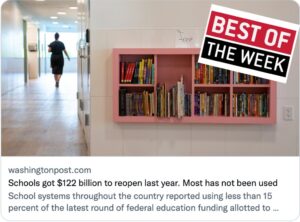
🏆 BEST: The best story of the week is the Washington Post’s Schools got $122 billion to reopen last year. Most has not been used by Lauren Lumpkin and Sahana Jayaraman. Part of the Post’s “COVID Money Trail” series, this piece looks into the third — and largest — portion of ESSER funds, which must be spent in the next two years. It’s been awhile since we’ve had a good ESSER deep dive, and this one doesn’t disappoint. Lumpkin and Jayaraman surveyed 211 districts and found that only about 15% of the funding released in spring 2021 has been spent so far. Some districts like Baltimore haven’t spent any of it. Many say they are trying to stretch it as long as possible. Others say they aren’t finding enough applicants to implement their plans. Historic in terms of their size and flexibility, ESSER funds merit close accountability reporting.
🏆 RUNNER-UP: This week’s runner-up is the Hechinger Report’s Student protests prompted schools to remove police. Now some districts are bringing them back by Neal Morton. The move to bolster school safety is a welcome change to some parents and educators but upsetting to students who campaigned to get rid of police on campus. “They’re not social workers. They’re not restorative justice coaches,” said a student advocate in Montgomery County, Maryland where officials recently reinstated school police as community engagement officers. “Expecting them to help young people, that’s dangerous.” These kinds of follow-up stories are unusual and helpful. Let’s see more, please?
BONUS:
🏆 Report: Alabama leads nation in math, reading recovery after pandemic (AL.com)
🏆 Sold A Story, Episode 3 (APM Reports)
🏆 Arriving in Numbers, Newcomer Students Face Multiple Hurdles in U.S. Schools (The 74)
🏆 Migrant crisis is ultimate test of NYC schools (Politico)
🏆 An American Girl (Washington Post)
🏆 Growing number of Indiana school districts victims of cyberattacks (WRTV)

COVERING NAEP & SEL
New commentary from The Grade
Above: The Atlantic’s NAEP story declaring school closures a “failed policy.”
What can we learn about education news from looking at this week’s NAEP coverage? I took a look around and found that the overall effort was quite strong in terms of presenting the data. But most news outlets stuck closely to the administration narrative that there is no “straight line” relationship between the dismal results and school shutdowns — despite the obvious convenience of that narrative (and abundant evidence to the contrary). At times like these, we need fearless education coverage and a willingness to break away from the pack.
Our other new piece is an analysis of recent coverage of SEL programs by outlets including NPR, the Washington Post, and NBC News in which CASEL’s Justina Schlund notes that the actual practice of SEL is a far cry from many of the claims that are being repeated by news outlets. To combat controversy-mongering coverage, she recommends including using poll data, featuring everyday parent voices, and showing readers what SEL actually looks like in the classroom. Stop quoting the same parents!
ICYMI: “Thank you, Alexander Russo, for listening, being interested in this work for years, and recognizing how important this topic is,” wrote APM Reports’ Emily Hanford in response to last week’s newsletter.
FIGHTING LEARNING LOSS
Promising innovations & signs of progress
💡 Following the release of NAEP scores, researchers have offered some key things schools can do to fight learning loss, including intensive tutoring and increased instructional time. And Alabama, leading the nation in math and reading recovery post-pandemic, offers some lessons for the rest. (Boston Globe, AL.com)
💡 Chicago Public Schools’ graduation rate has reached a record high, despite pandemic setbacks. (WBEZ)
💡 One school in St. Louis is leading the charge in diversifying the education field, by recruiting Black male teachers and asking the right questions. (NBC News)
💡 An initiative in Fort Worth aims to lower disproportionate suspension rates for Black students. (Fort Worth Star Telegram)
Follow me at @alexanderrusso for thought-provoking commentary all day, every day.

PEOPLE, JOBS
Who’s doing what, going where
Above: The Courier-Journal’s Mandy McLaren took to TikTok to explain her recent series, Between the Lines. Check out her fun videos, then be sure to read part 5 of the series, which explores what needs to happen to fix reading instruction beyond phonics.
🔥 Career moves: Idaho Statesman education reporter Becca Savransky has joined forces with ProPublica’s Local Reporting Network to investigate school funding in the state. Star StateImpact Oklahoma education reporter Robby Korth is moving to KOSU Radio in Oklahoma to be their news director. A replacement is going to be hired, but no news or job link yet.
🔥 The Atlanta Journal-Constitution is hiring a K-12 education reporter to replace Vanessa McRay, who’s moving to the higher ed beat. Idaho Education News is hiring an education reporter. And the Hechinger Report is still looking for an audience engagement editor. Deadline to apply is Nov. 7! See more openings in the ONA Career Center.
🔥 Newsletters: You may have heard of it, but the Henrico Education Weekly newsletter is new to me and seems worth a subscription if you’re in Virginia. Written by new Henrico Citizen education reporter Anya Sczerzenie, it includes coverage of the Henrico School Board, COVID-19, and more. Any other new (and worthwhile) journalist-produced education newsletters out there? We want to know!
PODCASTS, RESOURCES
What’s happening and new research
⏰ Podcasts & segments: ABC News and FiveThirtyEight released the first episode in their American Turning Point series on critical race theory and how it has politicized school board races. Rachel Aviv, the New Yorker’s occasional education writer, was interviewed for the Longform podcast, where she offered some tips on interviewing and finding stories. And Episode 3 of APM Reports’ Sold A Story is out, exploring the rise and fall of Reading First — and the role of politics and teacher preferences in its demise. While most reviews are gushing, a new one from Natalie Wexler comments, “complex and fascinating as it is, [the series] only scratches the surface of the reasons behind our current literacy crisis.”
⏰ ICYMI: The Atlantic held its 2022 Education Summit, featuring journalists like Adam Harris. EdSource had a virtual event on how teachers can support English language learners.
⏰ Resources: Brookings released a report on how 100 large and urban districts are attracting and retaining staff. Pew published a new piece about transportation-related obstacles to education, including community colleges without transit stops within walking distance. The National Council on Teacher Quality has released a fascinating database comparing 140 large districts’ collective bargaining agreements.
THE KICKER

Things are getting spooky at the Boston Globe!
From left to right: Ed data reporter Christopher Huffaker, fellow Julian Sorapuru, education editor Melissa Taboada, digital producer Adria Watson, and enterprise reporter Deanna Pan. (H/T Melissa)
That’s all, folks. Thanks for reading!
Reply to this email to send us questions, comments or tips. Know someone else who should be reading Best of the Week? Send them this link to sign up.
Using Feedly or FlipBoard or any other kind of news reader? You can subscribe to The Grade’s “feed” by plugging in this web address: http://www.kappanonline.org/category/the-grade/feed/.
Read more about The Grade here. You can read all the back issues of The Grade’s newsletter, Best of the Week, here.
By Alexander Russo with additional writing from Colleen Connolly.
ABOUT THE AUTHOR

Alexander Russo
Alexander Russo is founder and editor of The Grade, an award-winning effort to help improve media coverage of education issues. He’s also a Spencer Education Journalism Fellowship winner and a book author. You can reach him at @alexanderrusso.
Visit their website at: https://the-grade.org/