In this week’s newsletter: The federal Juneteenth holiday brings a handful of stories about race in education. Big news from the Baltimore Banner and ProPublica. Five bad habits of education journalism — and how to break them. And a Washington Post editor earns high praise.
WHITE PARENTS, BLACK EDUCATORS
The big story of the week, according to us:
The big story of the week is the Juneteenth-related coverage about race and inequality in education. Among the most notable stories: a harrowing ProPublica feature about white parents harassing a Black educator and a fascinating New York Times piece about the trend towards HBCUs:
🔊 White Parents Rallied to Chase a Black Educator Out of Town, Then Followed Her to the Next One (ProPublica)
🔊 Why Students Are Choosing H.B.C.U.s: ‘4 Years Being Seen as Family’ (New York Times)
🔊 These schools made racial equity their mission. Now they face hostile legislation. (Chalkbeat Indiana)
🔊 Racial disparity in Portland schools’ discipline mirrors national patterns (Portland Press Herald)
🔊 Rifts between CMS leaders and Black faith group widen as talks end abruptly (WFAE)
🔊 Why LAUSD Is Being Advised To Step Up Recruitment Of Black Teachers (LAist)
🔊 Rethinking claims of racial bias in special education (Hechinger)
🔊 Pandemic pods designed by leaders of color offer lessons for traditional schools (K-12 Dive)
🔊 Tennessee law expands teaching of Black history for grades 5-8 (Tennessean)
🔊 As cops leave schools, a new model of resolving conflicts takes shape (Chicago Sun-Times)
Other big stories from the week: Poor ventilation and a lack of air conditioning have put schools across the country in vulnerable positions amid a deadly heat wave (Kaiser Health News, Star Tribune, San Jose Spotlight, Chalkbeat Detroit). And graduations and end-of-year reflections show where schools have progressed — and where challenges remain — more than two years after the pandemic began (Miami Herald, KQED, The Public’ Radio, Sacramento Bee, Tennessean).
GRADUATION HIGHS & LOWS
The best education journalism of the week, according to us:
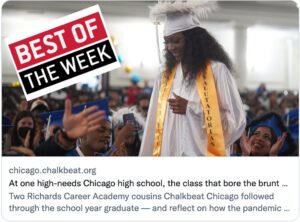
🏆 BEST: The best story of the week is At one high-needs Chicago high school, the class that bore the brunt of COVID’s toll graduates by Mila Koumpilova for Chalkbeat Chicago. The story focuses on two seniors at Richards Career Academy, cousins Gerlia Baker and Keshawn Arnold. As you might expect, it dives into the statistics, but the real strength of the story is Koumpilova’s on-the-ground look at the less tangible ways the pandemic has affected this class and these individual students. Gerlia, who had hopes of being valedictorian, struggles to keep it all together — earning good grades, caring for her four younger siblings, being captain of the basketball team, and working on the student council — and narrowly misses taking the top spot. Keshawn struggles with low attendance and behavioral issues and spends more time sitting on the bench during basketball games than he used to. During the graduation ceremony, the straight-talking principal tells the class, “You have been cheated” by a pandemic that disrupted more than half of their high school career. She also cautions them not to let that fact consume them. Koumpilova doesn’t mince words in her reporting either. The pandemic “sank GPAs,” “upended school athletic seasons,” and “sapped motivation,” she writes. But she also leaves an important space to reflect on students’ resilience.
See also: Self-Love and Inner Work Help Oakland Students Make It to Graduation (KQED)
🏆 RUNNER-UP: This week’s runner-up is Ivy Tech spent years trying to improve rock bottom graduation rates — and it’s working by Dylan Peers McCoy for WFYI Indianapolis. As this story depicts, the typical student at community colleges faces challenges that many students at four-year institutions do not: parenting, full-time jobs, breaks in their education, remediation needs. One student Peers McCoy features is a single mom raising an autistic son and working full-time. To better serve its students, Ivy Tech has restructured its remedial classes, drastically lowering the number of students taking those classes for no credit, and accelerated others to allow students to earn college credit faster. Ten years ago, the school had a dismal 5% graduation rate for its two-year program. Now that number is 14% — still low, but leagues ahead of where it was.
See also: How to fix education’s racial inequities, one tweak at a time, a memorable 2019 story about changes at Pasadena City College.
BONUS STORIES:
🏆 Does class size really matter? (Chalkbeat)
🏆 Paraprofessionals Get Low Pay, Little Support (EdWeek)
🏆 Hundreds of teens earned associate’s this year — & then graduated high school (Dallas Morning News)
🏆 Addressing dyslexia early changes brain’s neurobiology for better (CBS News)
🏆 How an East Bay school turns into a community school under California’s model (EdSource)
🏆 “Prove to the World You’ve Lost Your Son” (Slate)
🏆 Almost 100 Texas school districts have added their own police departments since 2017, but not everyone feels safer (Texas Tribune)
🏆 In One of the Largest Charter School Scams in History, No One Will Serve Jail Time (Voice of San Diego)
THE ED BEAT’S BAD HABITS
New commentary from The Grade
In recent months, a handful of exquisitely unhelpful habits have seemed to take hold in education journalism, often resulting in misleading, conflict-centered, and reality-skewing coverage.
Chief among them are highlighting intense emotions — whether or not they match the available facts — and putting teachers at the center of education stories.
However, the summer is a great time for everyone to reflect, regroup, and try out new things.
So take a look at this week’s new column from me, 5 bad habits of education journalism — and how to break them.
Media update: Journalists think they’re doing a much better job reporting the news than the general public (Pew Trust). It’s too hard to find useful news, say readers in Delaware (Nieman Lab). Minnesota Public Radio has lost a ton of staff and may soon lay off the all-star APM Reports education team (Minnesota Racket). There’s a new source diversity tracking tool (Reynolds Journalism Institute).
For thought-provoking education media commentary and insights all day, every day, follow me at @alexanderrusso.
PEOPLE, AWARDS
Who’s doing what, going where
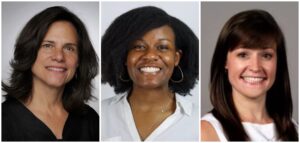
Above, from left to right: Liz Bowie, Kristen Griffith, and Jessica Calefati anchor the education team at the Baltimore Banner, which officially launched this week.
🔥 The Baltimore Banner is officially up and running this week, and their education team is looking strong with former Baltimore Sun reporter Liz Bowie; Kristen Griffith, a former education reporter who previously worked with Bowie at the Sun; and Politico alum Jessica Calefati. Check out Bowie’s recent profile of Baltimore City Public Schools CEO Sonja Santelises. Also, they’re still looking for an education editor and a higher ed reporter, so apply!
🔥 Congrats: Former education reporter Sharon Lurye is rejoining the beat as AP’s new data journalist. EdWeek’s Stephen Sawchuk moved up from reporter to editor and will manage a team covering teaching, learning, and curriculum. Las Vegas Review Journal education reporter Julie Wootton-Greener says she’s back at her desk after maternity leave and looking for new story ideas. WFAE’s Ann Doss Helms and Steve Harrison won a regional Murrow award for investigative reporting for their three-part series on learning loss and remote learning last year! And former Atlanta Journal-Constitution education reporter Marlon Walker is launching the Marshall Project’s first local news team in Cleveland. Congrats to all!
🔥 Pro tip: Alexandria Now’s James Cullum thwarted attempts by school board members to block reporters from attending a meeting by entering the locked building through an underground parking garage.
EVENTS, REPORTS
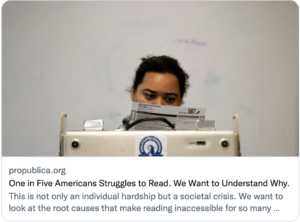
Above: ProPublica is launching a new project on literacy in the U.S. and the impact of so many children and adults not being able to read well (or at all). Journalists Anna Clark, Aliyya Swaby, and Annie Waldman are among the key journalists involved.
⏰ Appearances: USA Today’s Alia Wong discussed her investigation on how COVID-19 impacted early childhood development. Vox’s Rachel Cohen spoke about housing policy at a New America event. And NPR’s Anya Kamenetz spoke on a Dart Center panel on mental health of children and caregivers. (Her new book “The Stolen Year” was named in LitHub’s 29 works of nonfiction you need to read this summer.)
⏰ Resources: The CDC released an air quality report earlier this month on schools’ strategies to improve ventilation since the pandemic began. A new report from RAND focuses on stress among teachers and principals, with the well-being of Hispanic/Latinx teachers, mid-career teachers, and female teachers and principals the lowest. A report from CRPE describes lessons learned from K-12 learning arrangements created by and for people of color during the pandemic. And lastly, check out USA Today’s fact check of the viral — and false — claim that an Illinois high school was using race-based grading.
⏰ So long: Audrey Watters announced she’s moving on from her much-admired ed tech newsletter Hacked Education Weekly News and much of her work in the sphere. “I have to put this decade-long project to rest so that I can move on to something that doesn’t consume me in its awfulness and make me dwell in doom.”
THE KICKER
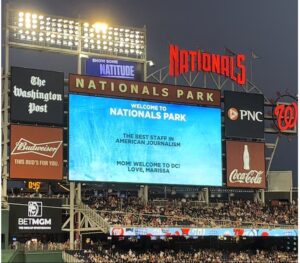
“Get you a local editor who takes the entire department to a baseball game and then does this (cc: @semelm, the best editor in American journalism),” tweeted the Washington Post’s Moriah Balingit.
That’s all, folks. Thanks for reading!
Reply to this email to send us questions, comments or tips. Know someone else who should be reading Best of the Week? Send them this link to sign up.
Using Feedly or FlipBoard or any other kind of news reader? You can subscribe to The Grade’s “feed” by plugging in this web address: http://www.kappanonline.org/category/the-grade/feed/.
Read more about The Grade here. You can read all the back issues of The Grade’s newsletter, Best of the Week, here.
By Alexander Russo with additional writing from Colleen Connolly.
ABOUT THE AUTHOR
Alexander Russo
Alexander Russo is founder and editor of The Grade, an award-winning effort to help improve media coverage of education issues. He’s also a Spencer Education Journalism Fellowship winner and a book author. You can reach him at @alexanderrusso.
Visit their website at: https://the-grade.org/