In this week’s newsletter: Schools face scrutiny over their safety plans and mental health screenings. A reporter reflects on investigating a beloved high school journalism teacher’s predatory behavior — and his own complicity. A school-focused podcast wins a Peabody award. And a Queens student shot while home studying leaves a startling message for reporters.
SCRUTINIZING SCHOOL SAFETY
The big story of the week, according to us:
More police? More mental health counselors? More active shooter drills? How about social media monitoring software? A little more than two weeks after Uvalde, the big story of the week is schools’ responses to possible holes in their school safety plans — even as mass school shootings like the one in Uvalde remain rare:
🔊 School Shootings Are Too Common, but Schools Are Still Relatively Safe (The 74)
🔊 In Uvalde, a Search for Answers: How Could This Happen? (New York Times)
🔊 Texas was building a program to find troubled students and prevent school shootings. It hadn’t reached Uvalde yet. (Texas Tribune)
🔊 DeSantis quietly signs school-safety bill that adds more mental health training (Miami Herald)
🔊 CA spending millions to promote ‘red flag’ law following shootings nationwide (Mercury News)
🔊 Many Connecticut school districts haven’t filed required safety reports (CT Mirror)
🔊 Here’s how two Mass. school districts approach active shooter drills (Boston Globe)
🔊 Here’s how Indiana tried to make schools safer from shootings (WFYI)
🔊 After Uvalde, Teachers Wonder ‘What More?’ (New York Times, see also AP)
🔊 Students of color push back on calls for police in schools (AP)
Other big stories from the week: In Uvalde, teachers, students, and community members are asking hard questions about how the shooting unfolded while troubling details keep emerging (NYT, The 74, Texas Tribune, ABC News, New York Times). Some advocates are questioning why everyday gun violence generally goes uncovered, while mass shootings at schools receive such massive attention (Washington Post, Houston Chronicle). And in Massachusetts, the debate rages over whether the state should take over Boston Public Schools (Boston Globe, WBUR).

COVID SPENDING SPREE; OUTDATED PUNISHMENTS
The best education journalism of the week, according to us:
🏆 BEST: The best story of the week is Spending spree: Oversight scarce as billions in COVID aid poured into California schools by Robert Lewis and Joe Hong in CalMatters. There’s been a smattering of reporting around the country on how schools and districts are spending the landmark federal stimulus money, but hardly any that takes as deep a look at that spending as this story does. While the stimulus money was greatly needed, it came quickly and with the caveat that it must be spent within a relatively short time period. And there’s little state oversight in how it’s being spent. Now districts are scrambling to use it all on anything and everything. And I mean everything. One district used some money to buy an ice cream truck that they used to drive around and give kids learning from home free ice cream in the beginning of the pandemic. “When I was told that I kind of went off,” said one source. In the absence of good data kept by the state, Lewis and Hong went to several school districts themselves and asked to see their accounting ledgers. This kind of dogged reporting is what we need to hold districts accountable and to highlight best practices and approaches where they can be found.
See also Schools Can’t Spend Covid Aid Fast Enough for Aging Buildings (WSJ).
🏆 RUNNER-UP: This week’s runner-up is ‘State-sanctioned violence:’ Inside one of the thousands of schools that still paddle students by Tara García Mathewson in the Hechinger Report and the Mississippi Center for Investigative Reporting. García Mathewson spent seven months reporting on paddling, an issue that isn’t widespread nationally but whose existence in 2022 may be surprising and offending. She finds some shocking policies, including one handbook rule that instructs “no more than three licks and one paddling a day.” Thirty-one states ban the practice, and in the remaining states, most don’t use it. But in the handful of places where paddling is still used, like in Mississippi where García Mathewson did most of her reporting, it’s rampant. In the 2017-18 school year, more than 69,000 students were hit 97,000 times — and it was all school sanctioned. As in most other kinds of school punishments, kids of color — and particularly Black boys — are most likely to be hit. This disproportionality may not surprise us anymore, but it deserves our attention. There have been some other great investigations on corporal punishment over the last few years, and this story should be right up there with it.
BONUS STORIES:
🏆 Across the country, educational equity was in vogue. Then it wasn’t. (Wall Street Journal)
🏆 Most big districts will offer virtual learning this fall (Chalkbeat)
🏆 Florida’s Alarming Reading Scores: Third-Grade Test Shows Only 1 in 4 Proficient (The 74; see also Politico)
🏆 School enrollment is falling, and not just because of COVID (Sacramento Bee)
🏆 Robb Elementary in Uvalde was integral to Mexican-American equality in the city (NPR)
🏆 N.J. is supposed to replace Newark’s crumbling schools. So far, it hasn’t. (Chalkbeat Newark)
🏆 Children in ‘COVID generation’ are seeing developmental delays (USA Today)
**Correction: Elly Fishman’s book Refugee High came out last summer. Apologies!

INVESTIGATING YOUR FORMER TEACHER
New commentary from The Grade
Above: Sexual improprities by former high school journalism teacher Eric Burgess (left) were uncovered by his former student, Insider reporter Matt Drange (right).
What’s it like when your former high school journalism teacher turns out to have been a serial sexual predator while you and everyone else looked the other way? That’s the scenario Insider’s Matt Drange encountered when — inspired in part by Bethany Barnes’ 2017 reporting on sexual harrassment in schools — Drange began looking into rumors and allegations at his Los Angeles-area alma mater, Rosemead High School.
In this week’s new interview, we asked Drange about the experience of writing what turned out to be a viral first-person story, including his effort to keep the focus on the women who spoke to him about their experiences and his reflections on the complicity of the school and other students. “I grappled with whether I’d been a part of a community that allowed troubling behavior to go unchecked.”
The presence of sexual predators is devastating for students and a persistent problem for schools, which tend to look the other way, try to handle the situation internally, or pass the teacher on to another district. This despite seven-year-old federal ESSA regulations calling on them to take a more robust approach. So far, only nine states have adopted comprehensive policies that encompass current and prospective employees — and so far as I’ve seen only US News has covered the new report calling on states to do better.
For thought-provoking education media commentary and insights all day, every day, follow me at @alexanderrusso.

PEOPLE, AWARDS
Who’s doing what, going where
Above: Earlier this week, NBC News’ Mike Hixenbaugh (bottom left) and Antonia Hylton (bottom right) won a Peabody Award for Southlake, their investigative series about a racial reckoning in a Texas school district.
🔥 More congrats: Philadelphia Inquirer education reporter Melanie Burney is the incoming president of the NJ SPJ. Higher ed reporter Melissa Korn is celebrating 15 years at the Wall Street Journal/Dow Jones. The team at Chalkbeat New York won a New York Press Club award for their story “A (remote) day in the life of NYC third graders.” And WLRN’s Jessica Bakeman won several regional Murrow awards for her series about COVID’s effects on Florida children.
🔥 Fellowships: EWA has named its newest class of reporting fellows, a group of 12 reporters who will receive up to $10,000 to publish deeply reported education stories. There are both rising stars and proven veterans in this latest group, plus lots of interesting topics like Jemma Stephenson’s project on magnet school admissions for the Montgomery (Ala.) Advertiser. And the Dart Center for Journalism and Trauma announced its 2022 class of Early Childhood Global Reporting Fellows, including former Boston Globe education editor and current O’Brien fellow Sarah Carr, who will report on the challenges and promise of the U.S.’s early intervention program for babies and toddlers with disabilities. Congrats to all!
🔥 Local news spotlight: Yes, that was the Connecticut Mirror’s Ginny Monk in the New York Times, captured in an image covering a state board of ed meeting where controversy erupted over a proposed mental health clinic at Killingly High School. “More proof that local reporting is where it’s at,” tweeted Mirror editor Elizabeth Hamilton. Asked about covering the story, Monk tells us, “it’s been most important for me to listen to and amplify the voices of those students (who spoke at the meeting).” You can read more about what happened in Killingly in this piece for the Mirror. (Also, shoutout to the Hartford Courant’s Seamus McAvoy, who began reporting on the proposed clinic back in April.)
🔥 Newsletters: The District an investigative newsletter focused on Georgia’s DeKalb County schools that Decaturish editor Dan Whisenhunt describes as an effort to address “pent-up anger” among readers about alleged cronyism and nepotism and general lack of accountability. Also: Don’t sleep on The Unmuted, which is a NYC parent newsletter offshoot of S. Mitra Kalita’s EpiCenter run by Nicole “Bronxmama” Perrino. You can subscribe here.
EVENTS, PODCASTS
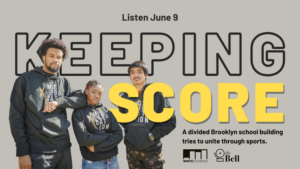
Above: “Keeping Score,” a new four-part series out yesterday from WNYC Studios and The Bell, tells the story of what happens when different schools housed in the same Park Slope school building try merge sports teams.
⏰ More podcasts: The New York Times’ Dana Goldstein was on EWA Radio, talking about changes in reading instruction. The Washington Post’s Valerie Strauss was on WNYC’s the United States of Anxiety, talking about what she learned reporting on a tough year for schools. And though it’s not a podcast, GBH Boston has a new series out on housing in Massachusetts, and it should have lots of implications for education.
⏰ Appearances: The Orlando Sentinel’s Scott Travis, the Philadelphia Inquirer’s Melanie Burney, and her colleague Kristen Graham appeared at the Rowan Journalism Conference, talking about school gun violence and covering education. KUT Austin public radio interviewed the Dallas Morning News’ Ari Sen about the false positives schools are getting from social media monitoring software programs. On Wednesday, Chalkbeat co-hosted a webinar on COVID and mental health. And EdNC held an event yesterday on the science of reading, moderated by reporter Rupen Fofaria.
⏰ To mark the two-year anniversary of The Objective, co-founder Gabe Schneider shared some reflections on what it’s been like to build an outlet as a person of color and while holding down another full-time job. “Journalists being free to challenge the status quo is critical to shifting the industry,” writes Schneider. “That means union protections. Open and honest conversations. And entry-level journalists having space to think/grow. That’s what we’re trying to do.”
THE KICKER
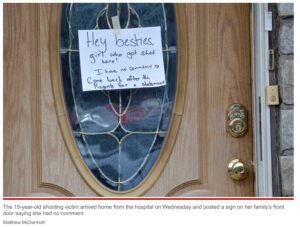
“Hey besties, girl who got shot here!” opens the strangely breezy note posted on the front door. “I have no comment ❤️️. Come back after the Regents for a statement.” – NY Post via Alex Zimmerman
That’s all, folks. Thanks for reading!
Reply to this email to send us questions, comments or tips. Know someone else who should be reading Best of the Week? Send them this link to sign up.
Using Feedly or FlipBoard or any other kind of news reader? You can subscribe to The Grade’s “feed” by plugging in this web address: http://www.kappanonline.org/category/the-grade/feed/.
Read more about The Grade here. You can read all the back issues of The Grade’s newsletter, Best of the Week, here.
By Alexander Russo with additional writing from Colleen Connolly.
ABOUT THE AUTHOR
Alexander Russo
Alexander Russo is founder and editor of The Grade, an award-winning effort to help improve media coverage of education issues. He’s also a Spencer Education Journalism Fellowship winner and a book author. You can reach him at @alexanderrusso.
Visit their website at: https://the-grade.org/