In this week’s newsletter: Schools struggle with all sorts of student behavior — and it’s unclear if interventions are warranted or working. Trade news coverage of education focuses too much on schools, not kids, I write in a new piece. A Virginia-based ed reporter leads the way in coverage of the Newport News tragedy. And student journalists in Oakland slap their district with a lawsuit over accessing public records.
STUDENT BEHAVIOR STRUGGLE
The big story of the week, according to us
The big story of the week is schools struggling with student behavior — and the uncertainty surrounding schools’ responses.
Denver officials say guns in schools are up. Weapons and drugs in the surrounding community are becoming a major school problem, according to Kansas City district officials. School was canceled in St. Paul after a high school student was shot at a rec center. There’s been a recent spate of shootings near Portland high schools. Kids at a Georgia boot camp brawled. Some parents and educators in Cleveland are concerned about school security staffing shortages.
But it’s not yet clear what’s working to combat the problem — whether it’s new laws flagging potential school shooters in Fort Lauderdale or panic button badges in Las Vegas. Philadelphia educators are adjusting how they work with students who struggle to resolve conflicts or deal with strong emotions. And they’re using a new weapons detection system in Atlanta schools.
Given all these stories, I worry that media coverage of student behavior challenges may be overstating the problem, which could lead to punitive and expensive overreactions from school officials.
Other big stories this week:
Virginia shooting: Parents, students, and teachers crowded a Newport News school board meeting complaining that student behavior has been increasingly out of control, even before the recent shooting. This kind of school shooting is exceptionally rare, but generates attention in large part because the event violates societal expectations. The student’s backpack was searched the day he shot his teacher, his parents weren’t in class with their acutely disabled son, as they had been all year, and the firearm was allegedly trigger-locked and secured by the parents.
Online tutoring: A pair of stories in the Hechinger Report and Washington Post dig into online tutoring and whether it really is the harbinger of post-pandemic academic recovery (hint: maybe not).
Science of reading: More and more schools are shifting their reading instruction to incorporate the “science of reading” — this time in Racine, Wisconsin, and Buffalo, New York. Also: The New York Review of Books reviewed APM Reports’ “Sold a Story.”
African American studies: Florida Gov. Ron DeSantis has blocked an AP course on African American studies from being taught in the state’s high schools, with education officials saying it is “contrary to Florida law.”
ENGAGING STUDENTS
The best education journalism of the week, according to us
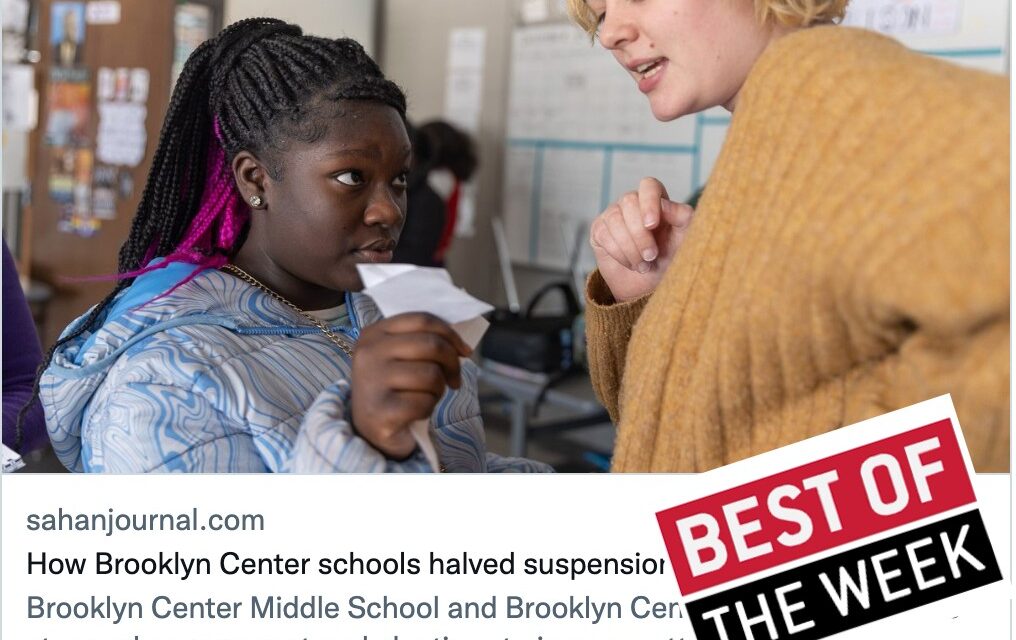
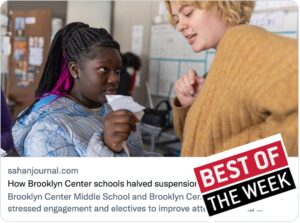
In a week full of strong education coverage, my pick is Becky Dernbach’s Sahan Journal story, How Brooklyn Center schools halved suspensions and absenteeism.
The piece describes how the district’s middle and high schools developed an enrichment program based on student interests featuring twice-weekly classes like solving CSI-like mysteries and small business development — and adapted core classes to include culturally relevant information and ethnic studies.
The piece features in-class details (and images) that have become somewhat unusual in education reporting. It also addresses challenges when the new program was first rolled out and acknowledges that the district is unique in its system-wide use of the community schools model. It’s that rarest of things: a solutions story that’s not a puff piece.
RUNNERS-UP:
🏆 The geometry teacher is a recording. The chemistry students often teach themselves. (Washington Post)
🏆 Is Arizona’s school choice program leading the country or leaving its public schools behind? (Deseret News)
🏆 A once-segregated Denver school fights to stay integrated 50 years after historic court order (Chalkbeat Colorado)
🏆 The lights have been on at a Massachusetts school for over a year because no one can turn them off (NBC News)
🏆 District adopts conservative social studies standards (Colorado Public Radio)
🏆 Leaving an integrated city (New York Times)
🏆 Why super-strict classrooms are in vogue in Britain (The Economist)
🏆 Oklahoma’s endorsement of religious charter schools could alter legal landscape for choice (The 74)
COVER KIDS, NOT SCHOOLS
What we’ve been up to at The Grade
It’s an awkward, chummy setup between trade publications and the education systems they depend on — but we’re all so used to it we don’t even notice the problems it creates.
I used to blame social media and national news outlets for problematic schools coverage. But then I started to notice how much education trade publications focus too much attention on educators and school systems — not in a good way.
Check out my piece, Cover kids, not schools, and then let me know what you think most ails education coverage.
COLORADO SEEKS PARENT INPUT
Coverage of promising school innovations & signs of progress
💡 A family engagement center in Colorado is improving collaboration between parents and teachers in five districts. (Colorado Sun)
💡 A new approach to writing instruction in Sumner County, Tenn., is boosting student confidence and test scores. (EdWeek)
💡 Dozens of Washington schools are working to increase the amount of time students with disabilities spend in the classroom with grade-level peers. (Crosscut; for another perspective on inclusion, see this research review from the Hechinger Report.)
💡 An AP government class in Kirkland, Wash., leads to proposed legislation that would end gender-based pricing. (Seattle Times)

PEOPLE, JOBS
Who’s going where and doing what. Plus job openings.
Above: Virginian-Pilot and Daily Press education reporter Nour Habib live tweeted an angry Newport News community meeting and co-wrote this very helpful story about what happened. Give her a follow if you haven’t already done so.
🔥 Downsizing: Some big-city NPR affiliates like WBEZ Chicago and KPCC LA have decent-sized education news teams, but several other well-established newsrooms like WNYC, WAMU (Washington, DC), GBH (Boston), and WHYY (Philadelphia) are down to one full-time beat reporter — or none. The latest instance that I know of is at KQED San Francisco, which has gone from a two-person team down to zero. I’m told that the station has no immediate plans to replace education reporters who moved to other beats or left the station.
🔥 Reflections: There’s quite a lovely and long reported essay in the Boston Globe this week from author and former editor Peter Thomson exploring the “radical, forgotten experiment in educational integration that changed my life.” I wish more journalists — education reporters in particular — were able to look back on their own experiences and reflect on how they shaped their lives and beliefs.
🔥 Job openings: The Seattle Times Ed Lab is hiring a reporter to replace Jeanie Lindsay. Check previous editions of the newsletter for jobs that may still be open.
🔥 New names: Follow LA Daily News’ new education reporter Clara Harter, who replaces Linh Tat (who’s now covering City Hall). Bridge Michigan’s Janelle D. James is covering breaking news along with government, climate, and education.
🔥 Accountability: ProPublica is known for their accountability reporting, but a recent story about a New Mexico district’s high rate of expulsion of Native students deserves extra kudos. After the story was published, the superintendent tried to disqualify the data and even got school board support behind him, but ProPublica reporters clapped back and disproved his numbers again.
EVENTS, BOOKS, INSIGHTS
What’s happening and new research
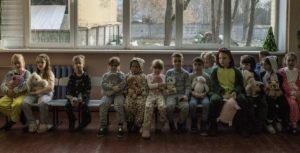
Above: If you haven’t seen it yet, check out this stunning photo essay about a school in Kyiv that continues on despite air raid alarms and rolling blackouts. It’s well worth the time.
⏰ Appearances: Click here to watch a replay of yesterday’s Open Campus Media webinar, telling the full story of HBCUs, featuring the New York Times’ Erica Green, The Atlantic’s Adam Harris, and fellows in the HBCU Student Journalism Network. The Hechinger Report’s Tara García Mathewson was part of a News Leaders webinar Wednesday on the research showing that having school leaders of color improves outcomes of all students, especially students of color.
⏰ Books: Washington Post reporter Laura Meckler’s “Dream Town” — about Shaker Heights and its quest for racial equity in schools — will be out in August. So will Chalkbeat editor Cara Fitzpatrick’s “The Death of Public School: How Conservatives Won the War Over Education in America.” And David Zweig’s pandemic schools book “An Abundance of Caution” is due out sometime this year, though no release date has been announced.
⏰ Deadlines: Looking to dive deep into a subject for a big project? Apply by Jan. 31 for a Nieman Fellowship to spend two semesters at Harvard learning from classes of your choosing and honing your craft. For more on how to apply, click here. Sign up for the EWA national seminar June 1-4 in Atlanta, Ga.
⏰ Innovations: EdNC has launched an ongoing equity audit of its schools coverage. Is any other education news outlet or team pushing as hard as they are on DEI? Check out the Nieman writeup of the still-new HBCU Student Reporting network, which pays student journalists to cover the HBCUs they attend. (It’s an Open Campus Media project, you may not be surprised to hear.) The Nieman Lab reports that the Minnesota-based Sahan Journal found a new way to reach parents by hosting a Facebook live conversation specifically for Somali parents in the state and coming up with recommendations for fixing issues they saw in the school system. A Q&A with climate journalist Ajit Niranjan in CJR makes the case for YouTube as an untapped platform for reaching audiences, which is a very good point. And NPR has tried a new tactic to reach young readers and their teachers with a kid’s guide to climate change, which includes a printable comic.
THE KICKER
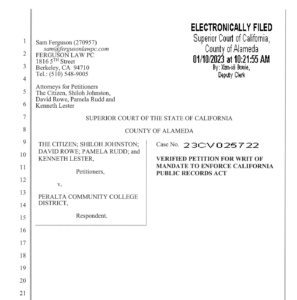
Student journalists at a community college in Oakland have filed a lawsuit to enforce the California Public Records Act. “It’s a sad fact of the law that it often takes litigation to enforce it,” writes Insider investigative reporter Matt Drange. But, “major kudos to these students for going to court — we’re all better for it.”
ABOUT THE AUTHOR

The Grade
Launched in 2015, The Grade is a journalist-run effort to encourage high-quality coverage of K-12 education issues.