In this week’s newsletter: Districts are facing frustrated parents and concerned educators as they try to make decisions on whether to end mask mandates. An education journalist in Rochester critiques his own paper’s past coverage. And one ed reporter shares personal ties to what’s happening in Ukraine.
DISTRICT MASKING DILEMMA
The big story of the week, according to us:
Districts are struggling to make school masking decisions now that state mandates are winding down, creating a patchwork of different timelines and metrics. Some parents are increasingly impatient. Others are worried about what mask-optional will be like for their kids. In one district, teachers refused to come to school in response to the end of mandatory masking. In other places, peer pressure is turning mask-optional into mask-free:
🔊 Districts Get Caught Between Health Authorities and Parent Pushback (Wall Street Journal)
🔊 Peer pressure is ending mask usage in schools (Washington Post)
🔊 Schools say they’re caught ‘between a rock and a hard place’ (San Diego Union-Tribune)
🔊 Teachers caught in the middle as schools wait for next steps on masking (KPBS Public Media)
🔊 MD votes to return decision to local school systems (Washington Post)
🔊 VA districts drop mask mandates to comply with new state law (Washington Post)
🔊 Mandate staying for Chicago Public Schools, but some parents demand off-ramp (Tribune)
🔊 Most N.Y. Voters in Poll Want More Data Before School Mask Mandate Ends (New York Times)
🔊 Wake schools hustle to reconsider mask mandates (WRAL Raleigh, NC)
🔊 El Dorado Hills district changes mask enforcement after students protest (KCRA Sacramento)
🔊 Several OR districts plan drop mask mandates before March 31 (Oregonian)
🔊 Rancho Santa Fe school district makes masks optional, despite state mandate (San Diego Union-Tribune)
For more on mask-optional coverage, see MEDIA TIDBITS.
Another big story this week is the wave of superintendents quitting and leaving districts scrambling to fill the positions at a crucial time. Reporters look into what’s causing the mass exodus (or whether there even is a mass exodus) in places like Douglas County, Colorado, Hinsdale, Illinois; central Iowa, and Boston.
LACK OF SOURCES, INSUFFICIENT INTEREST
New commentary from The Grade
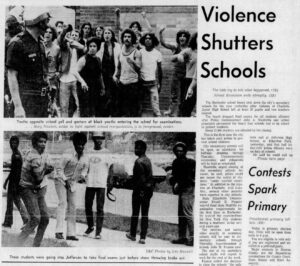
Above: A Democrat and Chronicle story from 1972.
In this week’s column, Rochester Democrat and Chronicle education reporter Justin Murphy found insufficient interest and inadequate sources in local coverage of school integration efforts during the 1960s and ‘70s — especially when it came to coverage of Black families and students. The Democrat and Chronicle co-published the piece, which is just the second such audit of past education coverage that I’m aware of. (The other was published by the Kansas City Star.)
Also: Journalist Nic Garcia reflected on his past experiences on the education beat at Chalkbeat Colorado. “The instinct to refocus the debate on the real-world consequences for students” should separate education journalists from the rest of the pack, according to Garcia, whose insightful piece we commissioned and placed in the Colorado Sun.

RECONSIDERING MISBEHAVIOR; GUN VIOLENCE IN PHILLY
The best education journalism of the week, plus a runner-up and some bonus stories.
🏆 BEST: The best story of the week is These first-graders may be acting out, but they’re also acting like 6-year-olds by Claire McInerny for KUT, Austin’s NPR station. We love stories that take readers inside the classroom — and you can’t beat it when the experience is presented in an audio story. But more than this, McInerny’s story stands out for its more nuanced look at the impact of the pandemic on some of the youngest students. Most stories these days focus on teachers’ laments about how behind and out of control students are. But McInerny explores the notion that, while these kids might have missed the lesson on how to sit “criss-cross applesauce,” they are learning in a natural way — from interacting with each other. And their behavior is developmentally appropriate. Instead of blaming the pandemic for “bad behavior,” McInerny’s story begs the question, should we reconsider how we teach young students? These kids are doing exactly what comes naturally.
🏆 RUNNER-UP: This week’s runner-up is Too many lockdowns to count: Gun violence has touched everything at one Philly school by Kristen A. Graham in the Philadelphia Inquirer. City gun violence is often covered by breaking news or crime reporters, but when you read deeper accounts you’ll see how many of the victims are kids — students. It’s a sobering story, but Graham does a great job of reporting on how gun violence impacts students and schools, which are supposed to be safe havens but increasingly are failing to be so. At the North Philadelphia U School, students are struggling to cope with trauma and grief after witnessing violence or losing a friend or family member. With shootings happening near the school, their time outdoors is more restricted as teachers fear for their safety. Amid all this, their ability to focus in the classroom and recover from pandemic learning loss is diminished. “They’re numb, disconnected. Sometimes they don’t want to do work,” a school counselor says in Graham’s story. “They’ll say, ‘Miss, you don’t know what’s going on. My friend just got killed.’”
BONUS STORIES:
🏆 Lowrider teacher became top Johnson County school leader (Kansas City Star)
🏆 States are revamping reading instruction. Illinois is just catching up. (Chalkbeat Chicago)
🏆 Projecting huge enrollment losses, Portland plans to cut back staff (Oregonian)
🏆 Substitutes in Camouflage (New York Times)
🏆 Some school systems pause diversity programs amid pushback (AP)
🏆 New ethnic studies requirements mean more lessons on race (Boston Globe Magazine)
🏆 Home schooling nearly doubled in NYC since pandemic’s start (Chalkbeat NY)
🏆 What you need to know about Minneapolis/St. Paul educators’ plan to strike (Sahan Journal)
MEDIA TIDBITS
Thought-provoking commentary on the latest coverage.
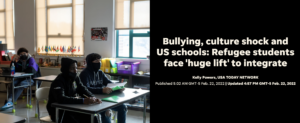
Above: Kelly Powers reported for the York Daily Record/USA Today from Lancaster, Pennsylvania, on refugee students and their unique needs and experiences.
📰 COVERING REFUGEE STUDENTS: USA Today’s Kelly Powers, who recently wrote a lovely piece about refugee students (see above), tells us she focused on students in Lancaster because it’s a district that serves lots of refugee kids compared to other similar districts — and she’d heard a lot about the district’s efforts while working on a previous story. “I knew I wanted to hear more.” Looking to find out if your area serves refugee students? Powers offers this database of refugee settlement numbers and recommends contacting settlement agencies and working with ESL teachers. You don’t necessarily need a translator, she says, depending on the level of English your student subjects have achieved.
📰 EDUCATION REPORTING AS A SERVICE: In anticipation of Tuesday’s scheduled release of a follow-up report on education coverage in 20 metro areas, check out the recommendations for addressing the mismatch between parents and education news (on page 35 of the original report). They include covering solutions, bringing informal information into traditional news, and diversifying distribution channels. “Education reporting is a service,” the report reminds. Want an example of what that looks like? Check out URL Media’s You know your child’s lottery number. Now what?. Parents shouldn’t have to stalk Facebook or Twitter to navigate their children’s education.
📰 MASK-OPTIONAL, OR MASK-FREE? There’s been an enormous amount of coverage of the recent decisions states and districts have been making, but relatively little so far about the actual experience of schools that are going mask-optional. What does it look like? How is it working? What happens to kids and staff who don’t feel safe in a mask-optional setting? Some teachers in Northern California didn’t show up when the district relaxed its mask mandate. (Some schools had to cancel class in response.) The Washington Post reports that peer pressure is turning most mask-optional schools mask-free. But what about school-based transmission rates going up (or not)? What about school attendance rates going up (or down)? More than a week later, this Las Vegas Review Journal story is still the best story I’ve seen about what the actual experience is like in schools. Get in there if you can, folks. Your readers need to know how it’s going.
📰 HOW TO AVOID FOCUSING ON THE ANGRY WHITE PARENTS: Seeing all the anti-CRT and anti-DEI coverage lately, I can’t help but think of researcher Matt Delmont’s insight into how media coverage of white resistance to desegregating Boston schools actually amplified white anti-integration parents’ concerns rather than contextualizing them. The white protesters became the story, not the longstanding systemic inequality of the segregated system for Black and brown communities. How to avoid that happening again? Give readers context early and often, explaining why DEI initiatives were deemed necessary in the first place. Prominently feature people who favor the DEI and antiracism initiatives or helped bring them in, or whose experiences of school have been directly affected by them. Use polling data to contextualize individual responses. And put the protests in history context, reminding readers about how past panics about sex ed and the teaching of evolution were resolved.
📰 RESOURCES: Idaho and Illinois stand out on a helpful new report from Pew showing the percentage of parents in each state who say they still aren’t working because of childcare responsibilities related to school closures and quarantines. Education Next has a new map — and lots of other data — demonstrating the global learning crisis from the pandemic. If you’re tracking mask mandates, or want to compare your district to others around the country, Burbio is tracking policies by state, with a new update each Sunday. District Administration is also tracking them. And if you’re writing about teaching race in schools, take a look at this CBS News poll showing that Americans overwhelmingly reject the idea of banning books about history or race. Speaking of polls, most DC parents are satisfied with their schools, according to the Post, and most California voters support mask and vaccine mandates.
Looking for media commentary and analysis all day, every day? Follow me at @alexanderrusso.
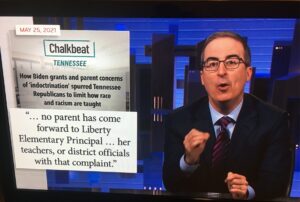
PEOPLE, JOBS, KUDOS
Above: Kudos to Chalkbeat Tennessee and journalist Marta Aldrich, whose reporting on conflicts over teaching about race in the state was featured on the HBO show Last Week Tonight with John Oliver. (H/T Alex Zimmerman for the screen grab.)
🔥 Staying safe: “I never felt directly threatened,” Fort Wayne (Ind.) Journal Gazette education reporter Ashley Sloboda told us about her experience covering parent protests at local school board meetings. “But I certainly felt uneasy.” She says she “felt silly” sometimes, thinking she needed an escort back to her car. But she accepted it once and also had an editor accompany her to a meeting, she told us. She also stopped wearing newspaper apparel. “I had Jan. 6 and the attitudes toward the press that day in the back of my head, and I knew my name was sometimes mentioned on social media. I thought the people mentioning my name were harmless, but I didn’t know who else may be out there.”
🔥 Job moves: Julianna Morano, who covered education as an intern for the Virginian Pilot, is moving to California to report on early and K-12 education for the Fresno Bee Ed Lab. Reach out to her with tips! And in case you missed it, Kaitlin Gebby is leaving the Cleveland Daily Banner, where she recently covered the McMinn County School Board and the ban on “Maus,” for a new job in Cincinnati. Congrats to both!
🔥 Job openings: Chalkbeat Chicago is hiring a bureau chief to replace Cassie Walker Burke. The Arizona Republic is hiring a schools reporter to report on how K-12 issues are affecting kids, families, and teachers. The Post and Courier in Charleston, South Carolina, is hiring a daily news reporter for their Ed Lab. The Oregonian is hiring an education reporter. The Boston Globe is hiring a higher education reporter, as well as a digital producer for their Great Divide team. Idaho Education News is hiring a journalist. The Seattle Times is looking for an Ed Lab reporter. Politico California is hiring an education reporter. Go apply!
🔥 Passing it on: Bethesda Beat’s Caitlynn Peetz talked to high school honors English students about her experience covering Montgomery County Public Schools. And the New York Times’ Dana Goldstein says she’s doing her best to help mentor young journalists, despite her busy schedule. “When I was in my early 20s, I wondered why there weren’t many female journalists in their 30s and 40s available for informal mentoring, drinks, coffees, etc. Now that I’m a parent I know the answer! But I’m still trying my pandemic best to make time for this,” she tweeted.

EVENTS & APPEARANCES
Above: We loved the story and photos in this NPR piece on Teen dreams and disappointments after the world’s longest COVID school closure in Uganda, by Halima Athumani and Esther Ruth Mbabazi. Give it a read – you won’t be disappointed.
⏰ Media appearances: New York Daily News education reporter Michael Elsen-Rooney was on WNYC’s Brian Lehrer Show talking about the latest news in NYC education, including mask rules and graduation rates. Chalkbeat New York bureau chief Amy Zimmer was on WBAI’s Driving Forces to talk about public education in NYC.
⏰ ICYMI: Nikole Hannah-Jones spoke alongside Ta-Nehisi Coates on a panel at the Knight Media Forum on “how Howard University worked to reframe and elevate the conversation around truth, journalism and clarity.” Bridge Michigan had an event with reporters Ron French and Isabel Lohman on how COVID has impacted Michigan’s K-12 students.
⏰ Podcasts: Texas Public Radio’s Camille Phillips hosts a new podcast called The Enduring Gap about the gulf between white and Latino students in San Antonio when it comes to college access and graduation rates. And the LA Times podcast goes to Marfa, Texas, where Houston bureau chief Molly Hennessy-Fiske reports on efforts to save a long-shuttered school — and make it a national historic site to teach about segregated schools for Latino students.
⏰ Upcoming: Don’t miss the education-focused panels at NICAR (March 3-6). They include “Finding racial disparities in education through data” on March 3 featuring EdWeek’s Eesha Pendharkar and “Using DataLab to analyze federal education data” on March 5 with Tracy Hunt-White from the U.S. Department of Education. See the full schedule here. Previously mentioned: A new report on education coverage in 20 metro areas is scheduled for release on Tuesday, a followup to the recent report on parents’ interests in education coverage.
THE KICKER

Above: “As some of you know, I was born in Kyiv,” begins a moving Twitter thread from CalMatters higher ed reporter Mikhail Zinshteyn (pictured above). He describes how he shies away from calling himself Ukrainian because back then it was the USSR and his Jewish family eventually fled for the U.S. Still, he writes, it’s “where I learned to sorta smile.”
That’s all, folks. Thanks for reading!
Reply to this email to send us questions, comments or tips. Know someone else who should be reading Best of the Week? Send them this link to sign up.
Using Feedly or FlipBoard or any other kind of news reader? You can subscribe to The Grade’s “feed” by plugging in this web address: http://www.kappanonline.org/category/the-grade/feed/.
Read more about The Grade here. You can read all the back issues of The Grade’s newsletter, Best of the Week, here.
By Alexander Russo with additional writing from Colleen Connolly.
ABOUT THE AUTHOR

Alexander Russo
Alexander Russo is founder and editor of The Grade, an award-winning effort to help improve media coverage of education issues. He’s also a Spencer Education Journalism Fellowship winner and a book author. You can reach him at @alexanderrusso.
Visit their website at: https://the-grade.org/