In this week’s newsletter: A subset of kids continues to experience serious academic and mental health setbacks. Some schools are suspending kids for being absent. A reporter takes us inside the new AP class in Black history. We pick the nine most memorable education stories we saw in 2022. And one 12-year-old kid has the knack for scoring impressive interviews.
KIDS IN CRISIS
The big story of the week, according to us
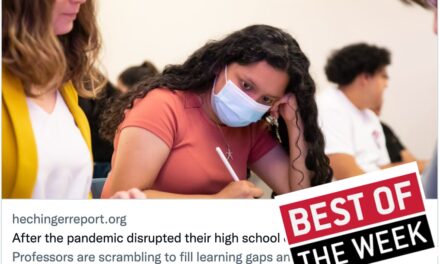
The big story of the week is that so many students are still suffering mentally and emotionally — and, in some cases, seem to be falling further behind. It’s more than some schools have bargained — or budgeted — for, and the feds are beginning to intervene in places like Fairfax, Virginia. A sobering round-up of coverage:
🔊 Many kids are struggling. Is special education the answer? (AP)
🔊 The crisis of student mental health is much vaster than we realize (Washington Post) See also the Post’s coverage of schools’ use of telehealth to address the crisis.
🔊 Young Americans increasingly end their own lives (Economist)
🔊 Feds Flag Districts’ Failures to Serve Students With Disabilities (EdWeek)
🔊 Oregon students with disabilities were promised extra help post-pandemic, but 15 months later, aid is limited (Oregon Live)
🔊 Chicago doubled the number of social workers in schools. Is it helping? (Chalkbeat)
🔊 How much pandemic relief money reaches SC’s neediest students remains unclear (Post and Courier)
🔊 Only 1 in 9 Los Angeles students will attend extra learning days. What happened? (LA Times)
Other big stories this week: A grand jury report condemned Loudoun County Public Schools’ handling of sexual assaults, which led the school board to fire its superintendent. A report shows that Black students in Michigan are far more likely to be held back than other kids for being more than a grade level behind in reading. And some Connecticut districts are seeking a waiver from new state reading laws.

INSIDE THE CLASSROOM, SUSPENSIONS
The best education journalism of the week, according to us
🏆 BEST: The best education story of the week is Teens embrace AP class featuring Black history, a subject under attack by Washington Post enterprise reporter Sydney Trent. This story features good old-fashioned in-class reporting, which is crucial for coverage of stories like this. It eschews much of the political debate about critical race theory and focuses instead on how the new AP course — which is being piloted in about 60 schools nationwide — was developed and what’s now happening in the classroom. The day Trent observed the class, the students were talking about Haitian Vodou and how religion can be used as power, opening many of their eyes to a part of history they didn’t know or had misconceptions about. “I don’t think you can go through life without knowing your history,” one Black student reflected. “You wind up feeling lost or unsure of yourself. It’s harder to form an identity.” You may remember that the LA Times’ Melissa Gomez wrote a similarly good story about an ethnic studies class last year, but these stories don’t come around as often as I’d like.
🏆 RUNNER-UP: This week’s runner-up is When the punishment is the same as the crime: Suspended for missing class by the Hechinger Report’s Tara García Mathewson and the Arizona Center for Investigative Reporting’s Maria Polletta. This story reveals a frustrating irony that exists in schools in Arizona and elsewhere that suspend kids for coming late, cutting class in the middle of the day, or missing the whole day. Mathewson and Polletta should be praised for their effort at gathering data that isn’t readily available and revealing some surprising findings, like the fact that students have collectively missed tens of thousands of school days due to suspensions for being absent. They also speak directly to kids and families who experienced this, as well as a principal who justified the practice by saying, “there are times when consequences have to happen.” We’re told that follow-up stories exploring the problem and possible solutions are in the works.
BONUS:
🏆 The Corporation Exploiting Washington’s Special Education System (ProPublica/Seattle Times)
🏆 Students return to D.C.-area schools, but not in pre-pandemic numbers (Washington Post)
🏆 California public schools allow ‘pay to learn’ summer courses at high prices. Is it legal? (LA Times)
🏆 Colorado teen demanding more comprehensive sex ed curriculum after Roe overturned (Denver Post)
🏆 Texas moves toward revoking largest teacher prep program’s accreditation (Dallas Morning News)
MOST MEMORABLE STORIES OF THE YEAR
New from The Grade
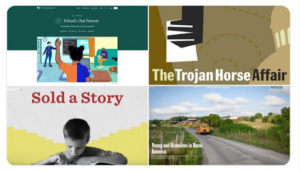
The Grade’s 9 most memorable K-12 education stories of 2022 include familiar selections like Sold a Story and Between the Lines along with much less-known ones like School’s Out Forever and The Trojan Horse Affair.
Vulture’s list of best podcasts also features The Trojan Horse Affair. And The 74 has a “jealousy list” of stories they wish they’d thought of, featuring some envy-inspiring artwork.
Also: This week’s revelations about student sexual assault in Loudoun County remind us all how often mainstream news outlets ignore or downplay legitimate concerns. Please stop turning a blind eye when adults fail to do their jobs.
And: It’s been more than 3 weeks since the 6th and final episode of Sold a Story, The Reckoning. Where’s the enthusiastic follow-up from other major news outlets?
DIVISIVE SUCCESS IN DENVER
Promising innovations & signs of progress
💡 Though it divided the district and disrupted schools, Denver’s decade-long reform strategy relying on school choice and accountability led to better test scores and higher graduation rates. (Colorado Public Radio; see also Denver Post)
💡 Chicago public schools are looking to replicate Nashville’s success in setting up career academies for high schoolers who want to enter high-demand industries upon graduating. (Chalkbeat Chicago)
💡 Indiana is creating new graduation tracks for students interested in entering the workforce, getting a job with their school district, or joining the military. (Chalkbeat Indiana)
💡 Hundreds of CUNY education students are providing high-dosage tutoring to struggling readers in New York City. (Chalkbeat NY)
💡 Amid bus driver shortages, school districts are turning to tech-enabled outside companies for their transportation needs. (EdWeek)
Read more about the importance of covering promising innovations and preliminary successes.
Follow me at @alexanderrusso for thought-provoking commentary all day, every day.

PEOPLE, JOBS
Who’s doing what, going where
Above: Meet Zshekinah Collier, a Report for America corps member and ed reporter for WYPR Maryland, who’s digging into a heavily funded plan to improve education in the state.
🔥 New ed lab: Speaking of Report for America, the organization is partnering with the Mississippi Free Press to launch a new Education Equity Solutions Lab next year! Stay tuned for more on what they plan to cover and how.
🔥 Job openings: California-based EdSource is hiring an editor. WFYI Indianapolis is still looking for a statewide education reporter. CalMatters is hiring a community college reporter, a brand new position. Check previous editions of this newsletter for more jobs that may still be open.
🔥 Layoffs: The Salem Statesman Journal’s Natalie Pate was among the recent Gannett layoffs, just four months after the company laid off hundreds of others. Last week, we shared that Columbus Dispatch education reporter Michael Lee was also laid off. We’re rooting for them and any others who have been affected. They’re not alone. Check out this 2020 essay we published about one education reporter’s roller-coaster experience of being laid off from her first job.
🔥 NYT walkout: Former education reporter Dana Goldstein was among the more than 1,000 employees who walked off the job yesterday in response to stalled contract negotiations. Erica Green also voiced her support: “✊🏿to the more than 1,000 of my colleagues today taking part in this unfortunate but necessary measure.” Colleagues Troy Closson and Sarah Mervosh also tweeted their support.
APPEARANCES, REPORTS
What’s happening and new research
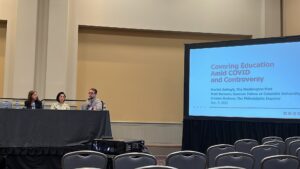
Above: The Philadelphia Inquirer’s Kristen Graham, Washington Post’s Moriah Balingit, and Chalkbeat’s Matt Barnum appeared on a recent National Council for the Social Studies panel. Picture courtesy of Gale Morrison. Anyone have a recording?
⏰ Audio and TV segments: The New York Time’s Lulu Garcia-Navarro hosted an opinion audio documentary on kids, parents, and dyslexia. (Read about her personal experience with dyslexia.) And NBC News featured a segment on a Baltimore school yoga program’s expansion to serve Native American students.
⏰ Media appearances: APM Reports’ Emily Hanford was on WBUR On Point to talk about the major reckoning in teaching children how to read. She also appeared on a New Haven panel on reading and on Angela Davis’s Minnesota Public Radio show. Voice of San Diego education reporter Jakob McWhinney joined the outlet’s VOSD Podcast to talk about a dramatic unionization effort at one of the nation’s most well-known charter schools. WBUR education editor Suevon Lee was on the station’s podcast The Common to talk about Boston’s busing issues, teacher strikes, and the near takeover of the district. And NYT Magazine’s Samantha Shapiro was on EWA Radio talking about her reporting on homelessness among rural students.
⏰ Resources & reports: Results from NWEA test scores across the country show an uneven recovery from the pandemic, creating an “urgency gap,” as reported by Chalkbeat and The 74. The Hechinger Report’s Jill Barshay dug into the results from two conflicting studies on whether a student’s “growth mindset” makes a difference. And Google released a report on the future of education (including the role of education in preparing students for work and technological advances in teaching) based on a study across 24 countries.
THE KICKER
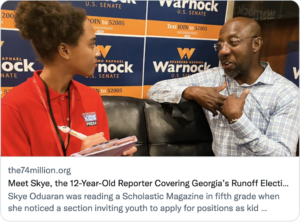
Raphael Warnock came out ahead in this week’s election in Georgia — and so did this 12-year-old reporter, who snagged an interview with Warnock, as well as Georgia’s governor. She’s even reported from the White House. Check out Asher Lehrer-Small’s fun profile of the promising young reporter, Skye Oduaran.
That’s all, folks. Thanks for reading!
Reply to this email to send us questions, comments or tips. Know someone else who should be reading Best of the Week? Send them this link to sign up.
Using Feedly or FlipBoard or any other kind of news reader? You can subscribe to The Grade’s “feed” by plugging in this web address: http://www.kappanonline.org/category/the-grade/feed/.
Read more about The Grade here. You can read all the back issues of The Grade’s newsletter, Best of the Week, here.
By Alexander Russo with additional writing from Colleen Connolly.
ABOUT THE AUTHOR

The Grade
Launched in 2015, The Grade is a journalist-run effort to encourage high-quality coverage of K-12 education issues.