In this week’s newsletter: Enrollment dips impact budgets and threaten to close schools. A slew of solutions stories. A new outlet challenges journalism traditions. A way to make journalism awards more meaningful. And how to cover school culture war conflicts.
LOST ENROLLMENT
The big story of the week, according to us:
The big story of the week is the enrollment declines experienced by districts and states and across age ranges. The declines began well before the pandemic in many places. However, enrollment losses are highest among districts that stayed remote longest, and preschool enrollment also crashed nationwide:
🔊 School enrollment fell most in districts that stayed remote (The Washington Post)
🔊 Enrollment losses in cities prompt talk of school closures (Chalkbeat)
🔊 Pandemic to blame for first pre-K enrollment drop in 20 years (K-12 Dive) See also: The 74 and US News
🔊 As enrollment drops, 40% of San Diego schools face deficits (San Diego Union-Tribune)
🔊 Sacramento schools at risk of financial distress with enrollment declines (Sacramento Bee)
🔊 Declining enrollment clobbers California’s schools (CalMatters)
🔊 California’s rural far north grapples with declining enrollment (EdSource)
🔊 School enrollment in S.F. is a maddening ‘mystery.’ Here’s why it’s even worse this year (SF Chronicle)
Other big stories this week: Districts are paying teachers more and offering bonuses to get them to stay (Milwaukee Journal Sentinel, Hartford Courant). A sobering report showed that firearms are now the leading cause of death for U.S. children and teens (NBC News, Boston Globe, Post & Courier, New York Times). And countries around the world are stepping up to educate the influx of Ukrainian refugee children (CBC News, Wall Street Journal, The Guardian).
THE GREAT MATH TEXTBOOK HOAX
New commentary from The Grade
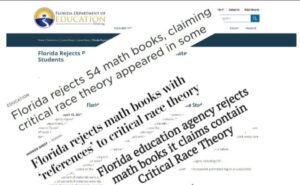
Above: How the media got suckered into covering a juicy but baseless press release.
Last week’s Florida math textbook roller-coaster suggests that instead of assuming that everything newsmakers say is news, reporters should ask “whether it’s something we should be amplifying.”
That’s the conclusion that contributor Greg Toppo arrives at in his new column about what he dubs the Great Math Textbook Hoax of 2022.
“No assignment editor (or late-night comedian) could resist” a Friday afternoon press release from the Florida Department of Education claiming that math textbooks were being rejected for indoctrinating students, notes Toppo.
But they should have. “Instead of making DeSantis back up what he was saying … news outlets rushed ahead and reported his unsupported claims.”
Coming soon: Frontline education reporters share their own ideas for how to cover culture war stories.
SOLUTIONS, SOLUTIONS, SOLUTIONS
The best education journalism of the week, plus a runner-up and some bonus stories.
🏆 BEST: The best story of the week is ‘More than a warm body’: Schools try long-term solutions to substitute teacher shortage by Neal Morton in Hechinger Report and the Seattle Times. In a story full of great details, Morton describes one Washington district’s efforts to fix the sub problem by hiring full-time, salaried “floaters” who can step in on short notice. The benefit is not only a higher likelihood the absence will be filled, but the teachers are also likely to have more familiarity with the schools and their students. Other places that have taken similar measures credit the approach with helping schools survive the pandemic.
🏆 RUNNER-UP: This week’s runner-up is What a New York school district can teach urban schools about keeping students on track by Diana Dombrowski and Gary Stern in the Rockland/Westchester Journal News and USA Today. Dombrowski and Stern report on the two-decade turnaround of Yonkers schools, the fourth-largest in New York state. Long known for low graduation rates and test scores and high poverty, Yonkers has experienced a dramatic increase in graduation rates. The secret to its success? “The main lesson from Yonkers’ success is that everything starts with seeing students as individuals,” the reporting duo writes. Parents report that teachers really spend time with their kids and engage with them, pushing them to explore their interests and challenge themselves academically. Other things the district has done: stabilizing leadership and decreasing turnover, starting conversations about college prep in kindergarten, and hiring teachers who can speak immigrant students’ native language.
For other great solutions-oriented pieces from the week, check out stories on remote learning for English learners (Chalkbeat), teaching refugee children (The Guardian), universal preschool (Chalkbeat Colorado), and in-school mental health for teachers (KQED MindShift).
BONUS:
🏆 The education culture war is raging. But for most parents, it’s background noise (NPR)
🏆 New research shows controversial Reading Recovery program eventually had a negative impact on children (APM Reports)
🏆 Schools and Police Punish Students With Costly Tickets (ProPublica/Chicago Tribune)
🏆 Bowser’s vow of better middle schools falls short in poorest D.C. wards (Washington Post)
🏆 Black and Hispanic students shut out of AP classes in New Jersey (Chalkbeat Newark)
🏆 Continued student struggles are weighing on teachers (Boston Globe)
🏆 Despite fears, teacher retirements were down last year in Wisconsin (WPR)
🏆 Michigan is the ‘worst state’ for children with dyslexia, lawmaker says (Detroit Free Press)
COVERING 2022
Thought-provoking commentary on the latest coverage.
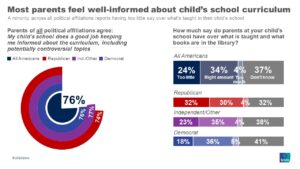
Above: According to a new Ipsos poll, most parents feel that their child’s school keeps them well-informed about the curriculum.
📰 SCHOOL CULTURE WAR COVERAGE: It’s a choice editors and reporters make, how much coverage to give conservative education proposals compared to other pressing issues. Some, like the New York Times, appear to be very much focused on covering conservative efforts to change the ways schools operate. Others like NPR and to some extent the Washington Post appear to focus on more systemic issues. I hope that newsroom leaders will continue to reflect on their story assignment decisions. Dramatic and disturbing as they may be, instances of conservative politicization of school boards and efforts to restrict teaching materials are not thus far truly widespread, broadly successful, or — most important — particularly popular among many parents or voters. The highly decentralized American system of public education has weathered no small number of controversies over the decades. And there’s no shortage of systemic problems in education that warrant ongoing coverage.
📰 TOO LITTLE SCRUTINY OF THE CDC, TOO LATE? First, Chalkbeat’s Matt Barnum eviscerated the CDC for its woeful record on COVID school safety over the past two years, noting a series of mistakes and miscommunications that, among other things, likely led schools to maintain quarantine requirements (during delta) that “might have been unnecessary if the CDC’s guidance had been understood and adhered to.” But it was too little, too late for parent activist Karen Vaites, who lambasted Barnum and the rest of the education beat for having failed to scrutinize the CDC’s recommendations earlier and more vigorously.
📰 REINVENTING EDUCATION NEWS IN NORTH CAROLINA: What happens when you put a non-journalist in charge of a nonprofit education news organization? You get something like EdNC. The seven-year-old state education news service is led by Mebane Rash, a lawyer by training. In a new first-person piece, Rash writes about all the ways that EdNC focuses on what readers need, not the way things have been done by traditional news outlets. There’s lots of field work, a commitment to share the platform with marginalized communities, and engagement tools that are being picked up by other outlets and networks.
📰 MAKING EDUCATION JOURNALISM MORE TRANSPARENT: Last Friday, prominent news outlets impatient with the lack of transparency around newsroom diversity in journalism called on the Pulitzer committee to make newsroom transparency a prerequisite for winning its award. That got me thinking: what if the Education Writers Association led the way and took the same approach with its annual education journalism awards? Four out of five education journalists identify as white, according to EWA’s 2021 survey — a figure that hasn’t changed over the previous five years. Lots of education outlets and teams including NYT, Washington Post, NPR, WNYC, Philadelphia Inquirer, The 74, EdSource, and AL.com declined to share demographic information for The Grade’s 2021 diversity snapshot. At very least, EWA or education news outlets could support the petition.
Looking for media commentary and analysis all day, every day? Follow me at @alexanderrusso.

PEOPLE, JOBS, AWARDS
Who’s doing what, going where.
Above, clockwise from top left: The New York Times’ Lola Fadulu, Politico California’s Blake Jones, the Richmond Times-Dispatch’s Jess Nocera and Sabrina Moreno, the CT Mirror’s Ginny Monk, and KQED’s Daisy Nguyen.
🔥 Comings and goings: The NYT’s Lola Fadulu is subbing in for NYC education reporter Eliza Shapiro, who’s off working on a project. Welcome her to the beat and send her tips and ideas. Blake Jones is leaving Idaho to become Politico California’s new education reporter. In the wake of Kenya Hunter’s departure, the Richmond Times-Dispatch’s Jess Nocera is now covering education in Richmond and state-wide, and Sabrina Moreno is covering Chesterfield County government and schools. The CT Mirror has hired another Report for America fellow, Ginny Monk, to cover education after former fellow Adria Watson left for the Boston Globe. And Daisy Nguyen, who’s covered breaking news for the AP for over 20 years, is moving to KQED to report on early childhood learning and care.
🔥 Job openings: Politico is hiring an education newsletter writer and K-12 reporter. USA Today is looking for an education editor to replace Chrissie Thompson. They’re also still hiring a K-12 enterprise reporter to replace Erin Richards. The Washington Post is hiring a higher education investigative reporter and a culture of higher education “roving reporter.” EdSource is hiring an editor, an equity reporter, and a California student journalism corps editor. The Dallas Morning News is hiring a reporter for their Education Lab. Check previous editions of the newsletter for other listings that may still be open.
🔥 Awards: The 74’s Mark Keierleber, the Denver Post’s Jessica Seaman, the Texas Tribune’s Kate McGee, and the LA Times’ Brittny Mejia were named Livingston Award finalists. Kenya Hunter, who’s now with Capital B, won a data journalism award from the Virginia Press Association for her big series on diversity at the Maggie Walker Schools. And the Post and Courier’s Sara Gregory, formerly of the Virginian-Pilot, won first place in education reporting. The Madison County Record won the 2021 Taylor Family Award for Fairness in Journalism for their reporting on a school board covering up sexual assault allegations. And in case you missed it, Fox45 in Baltimore won an IRE Award for their “Failure Factory” story on how Baltimore public schools failed to educate students and mismanaged funds. Congrats to all!
APPEARANCES, RESOURCES
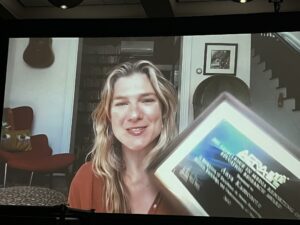
Above: NPR’s Anya Kamenetz accepting the Excellence in Media Reporting on Education Research Award from the American Educational Research Association. Congrats!
⏰ Appearances: The New York Times’ Dana Goldstein was on NPR’s Fresh Air, talking about the culture wars swirling around schools. WFYI Indianapolis’ Lee Gaines and Dylan Peers McCoy were part of a Twitter Spaces conversation on the special education teacher shortage and what can be done to solve it. McCoy was also on Slate’s What Next podcast talking about the same thing. EdNC CEO Mebane Rash spoke to the Schlechty Center about school leadership.
⏰ New ventures: After much anticipation, The Emancipator, a project from the Boston Globe aimed at reframing the national conversation on racial equity, is now live! And there’s good news for education reporters and readers. Co-EIC Amber Payne tells us they have plans to contract with freelance education reporters and also feature the voices and perspectives of students, “which we find are often missing from the conversation.” And KPCC’s LAist is launching a new series called Hidden Curriculum exploring “the labor that students have to put into navigating murky college structures — things that you don’t find out from the admissions brochures,” according to education editor Ross Brenneman.
⏰ Resources: The 74’s Mark Keierleber reports on a national poll that shows that a large majority of Americans are against book bans and support expanding classroom discussions on race and sexuality. NPR’s Anya Kamenetz shares a new Ipsos poll showing that concerns about race and gender issues in schools are limited to a vocal minority of parents. The Harvard Youth Poll shows that young Americans believe public education is more important to the country’s future than the military, technology, and democracy, and only 34% of respondents said they were satisfied with the current state of education. A new NEA report tells us that from 2020 to 2021 we lost 1,881 teachers (0.06%) and 1,160,135 students (2.65%), or one teacher for every 617 students lost, according to Mike Antonucci. Check his math by reading Tables A-2 and B-2. And lastly, are you covering school enrollment shifts? Chalkbeat Chicago’s Mila Koumpilova has you covered in this EWA how-to.
⏰ Justice for Sierra: About 50 people gathered at Norfolk City Hall in Virginia on Tuesday to demand answers after Virginian-Pilot education reporter Sierra Jenkins was killed in a March shooting, along with two others. Police have not announced any arrests yet. “It is about accountability,” said Jenkins’ best friend, Drew Ferebee.
THE KICKER
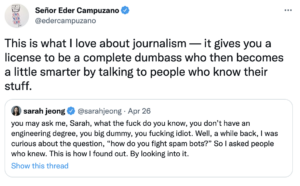
“This is what I love about journalism — it gives you a license to be a complete dumbass who then becomes a little smarter by talking to people who know their stuff.”
— Minneapolis Star-Tribune reporter Eder Campuzano
That’s all, folks. Thanks for reading!
Reply to this email to send us questions, comments or tips. Know someone else who should be reading Best of the Week? Send them this link to sign up.
Using Feedly or FlipBoard or any other kind of news reader? You can subscribe to The Grade’s “feed” by plugging in this web address: http://www.kappanonline.org/category/the-grade/feed/.
Read more about The Grade here. You can read all the back issues of The Grade’s newsletter, Best of the Week, here.
By Alexander Russo with additional writing from Colleen Connolly.
ABOUT THE AUTHOR

Alexander Russo
Alexander Russo is founder and editor of The Grade, an award-winning effort to help improve media coverage of education issues. He’s also a Spencer Education Journalism Fellowship winner and a book author. You can reach him at @alexanderrusso.
Visit their website at: https://the-grade.org/