May 2021
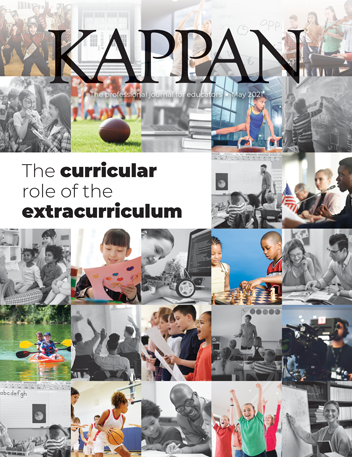
Ask a random American to name some of the extracurricular activities commonly offered by the nation’s public schools, and they’ll rattle them off easily enough: the jazz band, gymnastics, baseball, yearbook, Future Farmers of America, the debate team, the robotics club, and on and on. But ask them why these particular activities are offered as extracurriculars, as opposed to regular classes, and they’ll likely respond with a blank stare.
Sure, we all know that the rules are different for extracurricular activities — you can choose whether to participate, and you don’t have to worry about tests and grades. But that doesn’t answer the question: What defines them as extracurriculars in the first place? By what logic do we assign, say, history and chemistry to the regular curriculum, while categorizing debate and robotics as extra?
No doubt, it has a lot to do with how important we consider each subject area to be. Some subjects (reading, writing, math, the social studies, and the sciences) play such essential roles in preparing young people for college, careers, and civic life that we’d be crazy not to include them in the regular curriculum. Few of us would say the same about jazz and gymnastics.
However, many of us would argue that when it comes to preparing students for civic life, the study of debate is, in fact, just as important as the study of history. And when it comes to college and career readiness, hasn’t the study of robotics become just as important as the study of chemistry? Never mind that activities such as theater productions, sports teams, and service organizations help students build skills in teamwork, leadership, and organization that are every bit as important as the academic skills they build in the regular curriculum.
In short, importance is a judgment call — which means that the shape of the curriculum has always been a source of conflict. We can’t include everything, so we argue about what to put in and take out, and we end up excluding subjects that many of us judge to be just as important as those that have made the cut.
For decades, K-12 education has managed to stumble along despite its inconsistencies. If a handful of important subjects have been relegated to the extracurriculum, then so be it. Today, however, we seem to be moving toward a point where it simply no longer makes sense to differentiate the curriculum and the extracurriculum in terms of their relative importance.
As the contributors to this month’s Kappan point out, our public schools are in the midst of a major reevaluation of what truly matters to the children and communities they serve. While nobody denies the value of reading, writing, and the rest of the “core” curriculum, greater and greater numbers of us have come to argue that we must give equal priority to social-emotional learning, health and fitness, career exploration, youth development, and other goals that we’ve long neglected.
Simply put, the regular curriculum is far too small a container for all of the subjects and skills that we’ve come to define as essential. If we have no choice but to divide those subjects and skills into different containers, then let’s dispense with the labels regular and extra. Perhaps it would be better to describe them as co-curriculums, for instance, signaling that while they may differ in some ways — such as the amount of choice, autonomy, and creativity they afford, the extent to which we treat the subject matter as fixed or open, and the amount of time we devote to them — they have equally valuable contributions to make to students’ overall development.
ABOUT THE AUTHOR

Rafael Heller
Rafael Heller is the former editor-in-chief of Kappan magazine.