
English learners who remain classified as such past an appropriate amount of time face lower academic achievement and higher dropout rates. Helping them requires dealing with long-standing systemic issues.
English learners (ELs) are often referred to as the “fastest growing population” in K-12 schools (Najarro, 2023). The EL population has grown by 35% in the last 20 years (UnidosUS, 2022), and today roughly one in 10 public school students is an EL (National Center for Education Statistics, 2023). However, unlike other groups of students who are categorized by static characteristics such as race or ethnicity, English learners are grouped based on their assessed proficiency in English. Membership in this group is meant to be temporary. The natural ebb and flow of the EL subgroup (Tankard Carnock, 2017) is supposed to be that children get classified, receive targeted services for English language development, and then get reclassified once proficient in English.
The majority of ELs are U.S.-born (Bialik, Scheller, & Walker, 2018) and enter the U.S. education system in the early grades. By the upper elementary grades, these students reach a “reclassification window,” and Karen Thompson (2015) found that “students not reclassified by this point in time become less likely ever to do so” (p. 25). ELs that do not reclassify after a set amount of time are often labeled long-term English learners (LTELs), a subgroup of ELs that continues to grow across the country. This means that in addition to new ELs entering school each year, LTELs are bloating the EL subgroup, beyond what we’d see if students were receiving rigorous and developmentally appropriate support and reclassifying in a timely manner.

Understanding long-term ELs
Currently, there’s no universal LTEL definition (Sahakyan & Poole, 2022). However, states that receive federal Title III funding are required to report the number and share of ELs who have not been reclassified within five years (U.S. Department of Education, 2016). According to federal non-regulatory guidance, this reporting requirement does not establish a universal definition; rather, “the reporting requirement under ESEA Section 3121(a)(6) may be instructive in determining which ELs served under Title III are long-term ELs” (U.S. Department of Education, 2016, p. 38). According to data submitted by states to meet this requirement in 2020-21, 1.5 million ELs exceeded the five-year suggested period, representing 31% of the total EL population that school year (ED Data Express, 2023). In other words, a significant portion of ELs did not reclassify within what is considered a reasonable and developmentally appropriate timeline. Why does this matter?
Research has shown that students labeled as LTELs tend to have lower academic outcomes, are at higher risk of dropping out, and are less likely to graduate on time than other students (Cashiola, 2021). Conversely, ELs who reclassify by elementary school tend to go on to achieve academic success on par with, and in some cases exceeding, that of their monolingual peers (Villegas & Ibarra, 2022). However, as recent research concluded, negative outcomes among students labeled LTELs are “resulting symptoms of systemic problems, not the root cause nor the inevitability, of educational disparities” (Umansky & Avelar, 2022, p. 141). Illana Umansky and Janette Avelar (2022) found that students labeled as LTELs are uniquely positioned to expose cracks in the educational system that create unequal opportunities to learn and advance beyond the EL label. Rather than placing scrutiny on individual students labeled as LTELs, education leaders should be reflecting on the “distinct environmental and contextual factors that shape LTEL-considered students’ experiences” (Umansky & Avelar, 2022, p. 141).
In a seminal 2010 paper on LTELs, Laurie Olsen identified certain shared schooling experiences among students who had fallen into the LTEL category in select districts in California. These include:
- Not receiving language development support.
- Being given elementary school curricula/materials not designed to meet EL needs.
- Weak language development program models and poorly implemented EL programs.
- Inconsistent programs.
- Narrowed curricula and having partial access to full curriculum.
- Social segregation and linguistic isolation.
- Cycles of transitional moves.
Ensuring that ELs are reclassifying in a reasonable and appropriate amount of time requires us to examine deep cracks that have existed in EL education for a long time. Before we can eliminate the systemic and institutional barriers that have failed these students — rather than continuing to place the onus on individual students — we must deal with several underlying data collection and policy issues.
Inconsistent thresholds
To start, without an official LTEL definition, we have an unclear, inconsistent, and incomplete understanding of how many students are not reclassifying in a reasonable amount of time.
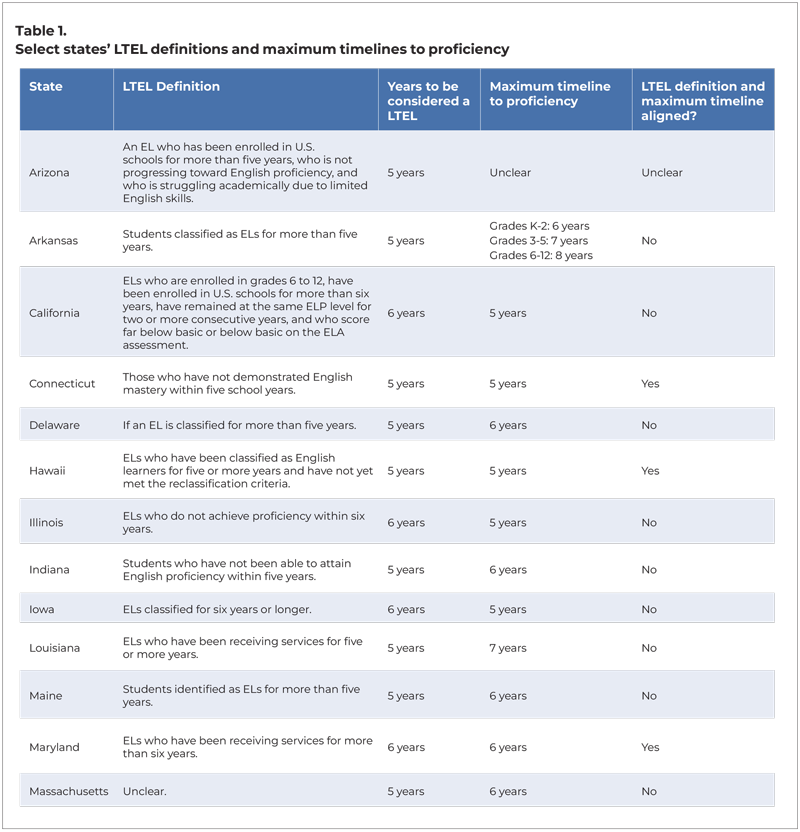
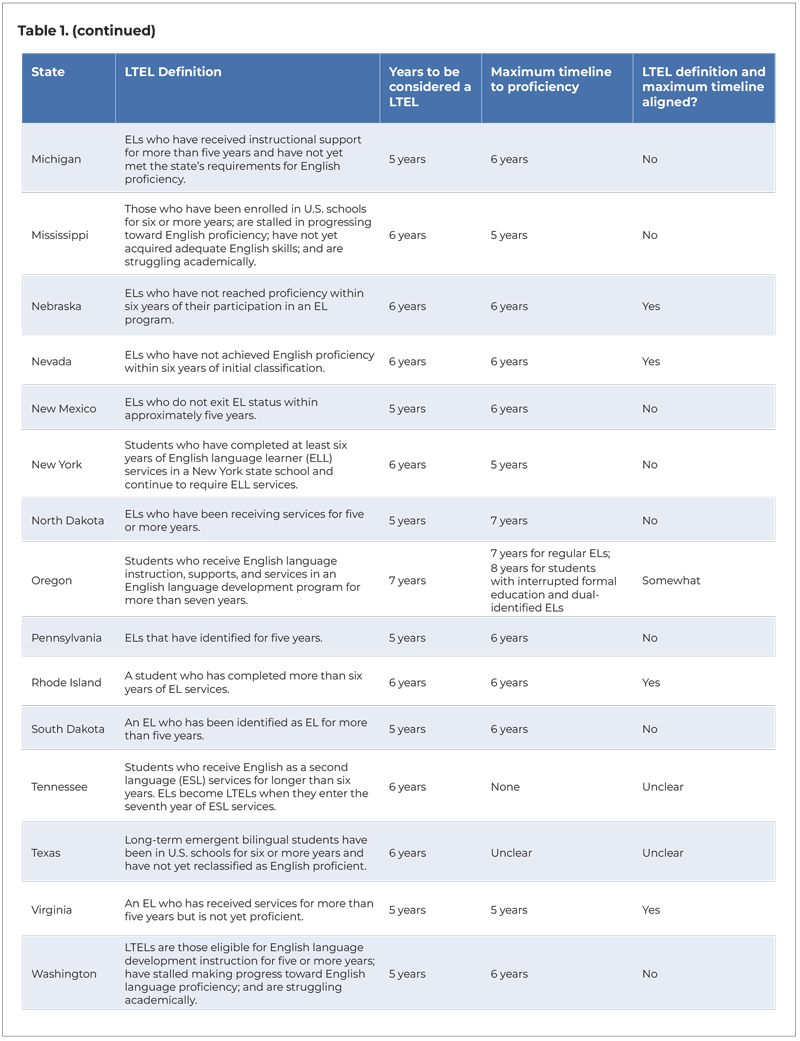
Although data reported pursuant to Title III provides a starting point for how many students may be labeled as LTELs, federal law allows states to adopt their own thresholds for what constitutes a reasonable amount of time to be reclassified (U.S. Department of Education, 2016). A scan of states’ policies found that 28 states have adopted an LTEL definition (see Table 1). Of these, 16 states use a five-year threshold (in line with the non-regulatory guidance); 11 states use a six-year threshold; and one state (Oregon) uses a seven-year threshold. The rest do not have a working LTEL definition.
Having inconsistent definitions across the country means that a student may be considered a LTEL in one state and not another. Additionally, states that have adopted a different threshold than the one suggested by the U.S. Department of Education (five years) essentially have two different groups of students categorized as LTELs, one for federal reporting purposes and another for statewide policy and practice decisions.
Additionally, some states, such as California and Mississippi, include additional criteria. California, for example, states that, to be considered an LTEL, a student must be enrolled in grades 6-12, remain at the same English-language proficiency (ELP) level for two or more consecutive years, and score far below basic or below basic on the English language arts (ELA) assessment. And Mississippi states that an LTEL is a student whose progress toward English proficiency has stalled, who has not yet acquired adequate English skills, and who is struggling academically. Unlike a straightforward calculation such as the number of years a student has been an EL, some of these additional stipulations can be considered subjective. For example, in Mississippi, who decides what it means to have stalled in developing English, what “adequate English skills” are, and what it means to be “struggling academically”? These additional criteria may be open to interpretation and add a level of subjectivity.
Different reclassification expectations
The Every Student Succeeds Act (ESSA) allows states to establish their own criteria to determine whether students are ready to exit EL status. At minimum, criteria must include results from the statewide English language proficiency assessment, but states are allowed to require additional criteria. Experts in the field have cautioned that these criteria should focus only on students’ linguistic skills and minimize the potential for subjective judgments (Hakuta, 2011).
But even when states use only objective measures, inconsistencies abound. States that use the same proficiency exam (such as the WIDA ACCESS) have different cut scores to determine ELs’ language proficiency. Additionally, even though ESSA requires that ELs within a state be identified, assessed, and reclassified using the same standards, there is evidence that reclassification in some states still varies greatly from district to district (Hill et al., 2014). For example, a recent report by the Parent Organization Network in California found that the current reclassification system has too many requirements, only one of which is standardized, with too much variation in implementation across schools (Simeón, Amezcua, & Rosales, 2023).
Relatedly, the maximum amount of time an EL has to reach proficiency, also known as the maximum timeline to proficiency, varies by state. Every EL’s personal timeline to proficiency depends on individual characteristics, such as initial ELP level and age, for example. However, ESSA required states to adopt a maximum timeline to proficiency by which they expect all ELs in the state to exit EL status. A scan of states’ ESSA plans found that these timelines range from five to eight years (Villegas & Pompa, 2020). What’s more, maximum timelines to proficiency do not always align with states’ LTEL definition (see Table 1). And because ESSA does not enact accountability measures for schools when ELs exceed that timeline, practically speaking, these maximum timelines to proficiency carry little weight.
The lack of consistency around definitions of proficiency, maximum timelines to proficiency, and LTEL status makes it difficult to track whether various models of EL instruction exacerbate or mitigate the likelihood that a student will be labeled a LTEL. In their work on LTELs, Umansky and Avelar (2022) found that there was an “overwhelming English language orientation, to the detriment of language diversity and core content instruction” and that the services ELs are provided are often homogenous and inappropriate (p. 141). Could these EL education characteristics be preventing ELs from reaching proficiency within a reasonable amount of time? Unfortunately, limitations of our data systems and policies do not allow us to see the whole picture.
Specific state-level data
To be sure, some states are paying more attention to LTELs than others, and we can learn from the data these states are collecting. California, for example, has an LTEL definition that it uses to collect and report data in a user-friendly portal (https://dq.cde.ca.gov/dataquest/). The state also created a category for ELs “at risk” of becoming LTELs (California Department of Education, n.d.-b). Thanks to these data-
collection mechanisms, California leaders know that there are more than 370,000 LTELs in the state and an additional 211,000 students considered at risk of becoming LTELs (California Department of Education, 2023, n.d.-a).
In Texas, researchers at Rice University conducted extensive research and concluded that the state should adopt a five-year threshold for ELs to be classified as LTELs (Cashiola & Potter, 2020). They then used this definition to investigate the growth of the LTEL population in Texas between the 2000-01 and 2014-15 school years. During that time, the percentage of 1st graders who began school as ELs increased slightly, but the percentage of ELs who became LTELs increased by almost 90% (Cashiola & Potter, 2021). More specifically, their research found that 67% of ELs who started 1st grade in 2014-15 became LTELs (72,500 students), compared to 36% of ELs who started 1st grade in 2000-01 and became LTELs (around 24,800 students).
English learners are grouped based on their assessed proficiency in English. Membership in this group is meant to be temporary.
Michigan has implemented a policy to help ensure that administrative hurdles do not stand in the way of ELs who are ready to be reclassified, thereby increasing the likelihood that they will become LTELs. Here, the state implemented an “auto-exit” policy in the summer of 2020 for ELs in grades K-12 who had an overall performance score of 4.8 or higher on the state’s ELP assessment (WIDA ACCESS). The state first applied this policy to ELs in grades 3-12 and decided to expand to those in grades K-2 after commissioning the University of Michigan to conduct research on the matter (Mavrogordato & Bartlett, n.d.). These policies were adopted because the commissioned research found that educational experiences and policies that keep students classified as ELs for too long run the risk of having “deleterious effects such as restricted access to honors and college preparatory coursework, higher dropout rates, decreased rates of college enrollment, and a greater likelihood of needing remedial coursework in college” (Mavrogordato & Bartlett, n.d.).
State and federal policy recommendations
How can we translate what we’ve found (or not found) into accountability policies that ensure all English learners, regardless of where in the country they may live, are being provided with an adequate and effective education? Absent a universal LTEL definition, here are a few recommendations for state education agencies (SEAs) and the U.S. Department of Education to consider:
- At minimum, SEAs should ensure they have a working LTEL definition that they can use to collect data on these students and make these data publicly accessible in a user-friendly way. States that do not have their own LTEL definition can simply publish the data they are already required to collect and report for Title III and begin to use these data to identify underlying factors affecting these students.
- SEAs should ensure their LTEL definitions and maximum timeline to proficiency are aligned.
- SEAs should evaluate their reclassification criteria to ensure the proficiency cut scores appropriately identify those that are ready to exit EL status and that their reclassification criteria are being applied evenly across districts.
The U.S. Department of Education should consider incorporating accountability measures for schools and districts with high numbers/shares of LTELs, as well as those where ELs are not reclassifying within the state’s maximum timeline to proficiency. This can be done through Title I of ESEA when it is reauthorized.
An EL does not become an LTEL overnight. Instead, the growing number of LTELs points to chronic systemic failures to help students reach English proficiency. Failure to address these issues will continue to have real-life implications for these students who need support, not stigmatization.
References
Bialik, K., Scheller, A., & Walker, K. (2018, October 25). 6 facts about English language learners in U.S. public schools. Pew Research Center.
California Department of Education. (n.d.-a). English learners in California schools. www.cde.ca.gov/ds/sg/englishlearner.asp
California Department of Education. (n.d.-b). Glossary of terms for English learner (EL) reports.
Cashiola, L. (2021, April 6). Students still learning English are taking longer to become proficient, raising concerns about future struggles. Urban Edge.
Cashiola, L. & Potter, D. (2021). Increases in long-term English learners (LTELs) in Texas. Rice University and Houston Education Research Consortium.
Cashiola, L. & Potter, D. (2020). Long-term English Learners (LTELs): Predictors, patterns, and outcomes brief 1: Defining LTEL. Rice University and Houston Education Research Consortium.
ED Data Express. (n.d.). Data Download Tool: Title III ELs not prof in 5 yrs in 2020-21. U.S. Department of Education.
Hakuta, K. (2011). Improving educational outcomes for English language learners: How ESEA reauthorization can help. WestEd.
Hill, L., Betts J.R., Chavez, B., Zau, A.C., & Volz Bachofer, K. (2014). Pathways to fluency Examining the link between language reclassification policies and student success. Public Policy Institute of California.
Mavrogordato, M. & Bartlett, C. (n.d.). Research brief: Establishing a default auto-exit procedure for K-2 English learners in Michigan. Michigan State University.
Najarro, I. (2023, January 30). The growth of Hispanic students and English learners nationwide — in charts. Education Week.
National Center for Education Statistics. (2023). Condition of education: English learners in public schools. U.S. Department of Education.
Michigan Department of Education. (2023, July 27). English learner (EL) exit reporting guidelines.
Olsen, L. (2010). Reparable harm: Fulfilling the unkept promise of educational opportunity for California’s long term English learners. Californians Together.
Sahakyan, N. & Poole, G. (2022). “Every” student succeeds? Academic trends at the intersection of (long-term) English learner and IEP status. Journal of Education for Students Placed at Risk (JESPAR), 28 (1), 69-96.
Simeón, A., Amezcua, D.J., & Rosales, M.E. (2023). 5 key learnings from working with parents of English learners for three years. Parent Organization Network.
Tankard Carnock, J. (2017). Seeing clearly: Five lenses to bring English learner data into focus. New America.
Thompson, K.D. (2015). English learners’ time to reclassification: An analysis. Educational Policy, 31 (3), 330-363.
Umansky, I.M. & Avelar, J.D. (2022). Canaried in the coal mine: What the experiences and outcomes of students considered long-term English learners teach us about pitfalls in English learner education . . . and what we can do about it. Journal of Education for Students Placed at Risk (JESPAR), 28 (1), 122-147.
UnidosUS. (2022, October). Investing in English learners: Federal recommendations.
U.S. Department of Education. (2016, September 23). Non-regulatory guidance: English learners and Title III of the Elementary and Secondary Education Act (ESEA), as amended by the Every Student Succeeds Act (ESSA).
Villegas, L. & Ibarra M.A. (2022, August 8). Former English learners outperform English-only peers on Texas’ state assessments. New America EdCentral blog.
Villegas, L., & Pompa, D. (2020). The patchy landscape of state English learner policies under ESSA. Migration Policy Institute.
This article appears in the October 2023 issue of Kappan, Vol. 105, No. 2, p. 13-18.
ABOUT THE AUTHOR

Leslie Villegas
LESLIE VILLEGAS is a senior policy analyst with the Education Policy program at New America, Washington, DC.