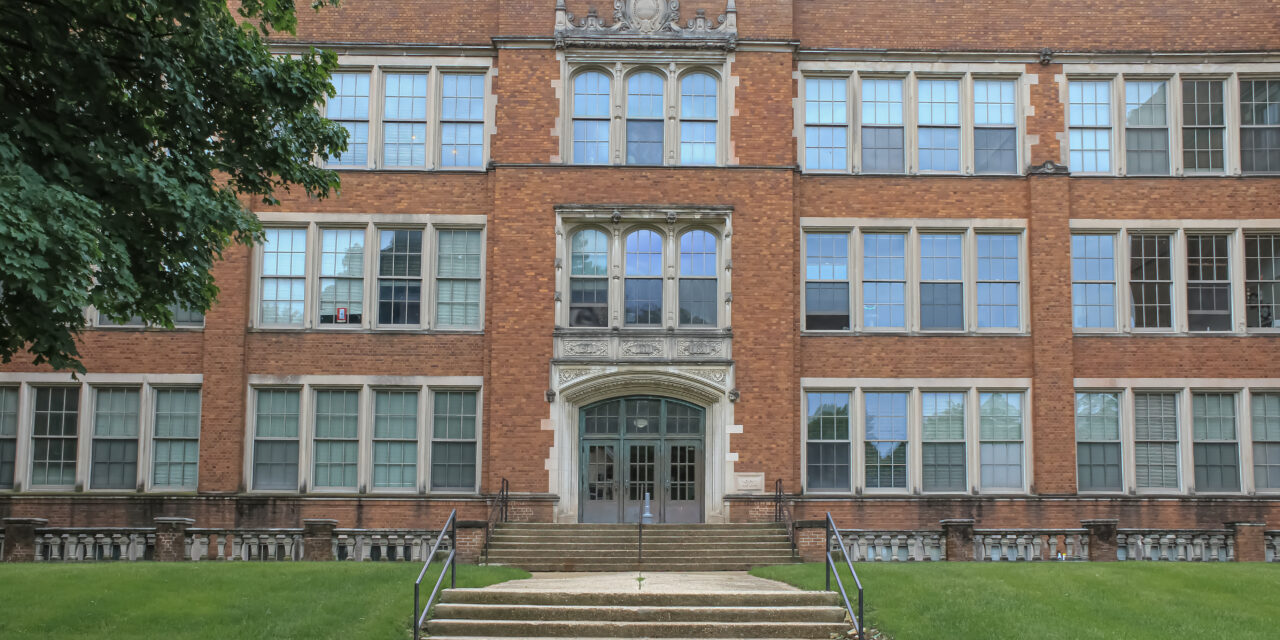
The democratic comprehensive high school is increasingly being replaced by a delivery system for individualized credentials.
At a Glance
- For decades, scholars have debated whether academic, workplace, or citizenship skills are more important in high schools.
- In 1959, James Conant envisioned comprehensive high schools as places that brought together students from different backgrounds for a shared civic experience.
- The growth of school choice options has limited the ability of high schools to serve as a shared civic space.
- As society has become more fragmented, schools have been hesitant to tackle contentious topics to help students build citizenship skills.
- High economic stakes have led families to see school as increasingly important for giving students credentials.
In 1959, James B. Conant, chemist, former Harvard president, and ambassador to Germany, issued an influential educational policy report, The American High School Today, commonly referred to as the Conant Report. The Carnegie Corporation commissioned the report in response to some alarming claims made about educational quality in the U.S. at the time. The source of many of these claims was prominent academic Arthur Bestor. In his book Educational Wastelands, he wrote that American high schools had become watered down, disrespected by professionals, and inferior to others in the world — a similar pattern of argument we have seen in the U.S. educational arena every couple of decades.
For the report, Conant compared U.S. secondary schools to those in other countries. He concluded that the democratic comprehensive high school model in the United States was superior to other models. He saw high schools as shared civic institutions where young people from different walks of life would learn together, debate public issues, and graduate into the obligations of democratic citizenship. He saw a common curriculum and school culture as essential to holding the republic together. The Conant Report would be the basis of high school curricula and structure that largely remains in many U.S. high schools today.
A little over four decades after the Conant Report, historian John Rury revisited Conant’s ideas in his essay “Democracy’s High School?” (2002). He noted how racial segregation, youth culture, and economic change had fragmented the comprehensive high school. Rury questioned how much the U.S. ever actually lived up to Conant’s vision.
Rury charted the erosion of the democratic common comprehensive high school. Today, the high school landscape has shifted even further. We now perhaps confront its dissolution. What remains isn’t so much a comprehensive high school for democracy, but a patchwork of outsourced experiences, where individualized learning and a focus on the pursuit of individual credentials takes precedence over the greater good.
Debating the purpose of the public high school
Debates over the role of U.S. public high schools have persisted since in the late 19th century. Much of the debate has centered on whether schools should emphasize a college preparatory liberal arts curriculum or vocational education (Angus & Mirel, 1999; Krug, 1964). The 1892 Committee of Ten, led by Harvard’s Charles Eliot, recommended a uniform, liberal arts curriculum for all students to promote civic preparation, regardless of post-graduation plans (National Education Association, 1894). But as enrollment rose — from 10% of teens in 1900 to nearly 30% by 1920 — progressives challenged this model, calling it elitist and irrelevant to most students.
The 1918 Cardinal Principles, issued by the Commission on the Reorganization of Secondary Education (CRSE), expanded high school aims to include not just academics but also citizenship, vocation, health, and character (Thayer, 1932). This shift aligned with the 1917 Smith-Hughes Act, which funded vocational programs aimed at keeping students engaged and addressing workforce needs. Though praised for reducing dropouts, vocational tracks also reinforced social and racial stratification (Altenbaugh, 2003; Rury, 2013).
Post–World War II reforms
Following World War II, debates over the high school’s purpose reemerged. Bestor’s Educational Wastelands (1953) proposed a return to rigorous liberal education for all, echoing the European model, where students followed a common curriculum before choosing specialized tracks in later grades.
The Conant Report, in contrast, recommended that small high schools consolidate to offer a wider array of courses. To maintain rigor, high-achieving students are placed on separate tracks from other students. These findings helped institutionalize tracking systems and promote broader curricular options. The belief was that the comprehensive high school could help preserve U.S. democracy by being a place where students of all backgrounds could congregate together and share some common courses outside of restrictive tracks (Angus & Mirel, 1999; Conant, 1958; Cusick, 1983; Ravitch, 1983).
Reform in the 1980s and beyond
By the 1980s, Conant-inspired reforms were under scrutiny. The 1983 report, A Nation at Risk (National Commission on Excellence in Education, 1983), charged that American high schools were aimless and ineffective. Studies like Shopping Mall High School (Powell, Farrar, & Cohen, 1985) argued that average students were often left with unchallenging options, while high achievers and students with disabilities received more structured support. Philip A. Cusick (1983) found that schools serving more students of color offered less rigorous academic experiences. Sedlak, Wheeler, Pullin, and Cusick (1986) further documented how low expectations in under-resourced schools led to weak academic environments.
In response, reformers pursued a market-based agenda. Milton Friedman’s (1980) school choice advocacy gained traction in the 1990s, bolstered by Politics, Markets, and America’s Schools (Chubb & Moe, 1990). Charter schools, vouchers, and virtual education expanded rapidly in the 2000s and 2010s, offering parents alternatives to traditional public schools and reframing education as a competitive market.
Democracy revisited
In 2002, John Rury took another look at James Conant’s vision for the American high school, arguing that the democratic ideals Conant once championed had been steadily eroded by deep social transformations in postwar America. Rury traced this unraveling through three intersecting shifts: race, culture, and the economy.
First, racial segregation, both formal and informal, undermined any real chance at the common school ideal. As Black families moved North during the Great Migration, urban school systems calcified into racially and economically divided spaces. Conant, in Slums and Suburbs (1961), acknowledged that urban high schools were increasingly segregated and deeply unequal, rendering his call for a unified civic culture through schooling aspirational at best.
Second, Rury points to the rise of youth culture in the 1950s and ‘60s as another force that pulled schools away from their civic mission. High schools became spaces more defined by consumerism, peer dynamics, and resistance to adult authority than by any serious engagement with democratic values or shared political life. The ideal of deliberation gave way to dances, denim, and electric guitars. Efforts to teach civic participation often ran into the buzzsaw of an increasingly individualistic culture that prioritized personal freedom over collective responsibility.
Third, economic transformations reshaped the very logic of the high school curriculum. The collapse of the manufacturing sector and the rise of knowledge-based industries inflated the value of a college degree, and high schools ramped up academic expectations while allowing vocational tracks to decay. The result was a sorting mechanism that prioritized individual achievement and upward mobility over the shared civic mission Conant had envisioned.
Conant’s vision almost 60 years later
Rury’s (2002) analysis of the Conant Report took place right before a major punctuation of political, cultural, and economic change in the U.S. Standardized curricula, the rise of smartphones, online schooling, populist politics, and now artificial intelligence have all affected the high school experience. So where does Conant’s vision stand today?
Politics: Standardization, choice, and conflict
Conant’s democratic vision has faded even further in recent decades, threatened by political forces that have led students and their families to seek options outside the comprehensive high school, fragmenting the high school experience, while ideological battles have turned schools into spaces for ideological conflict, rather than shared deliberation.
In 2002, the No Child Left Behind Act (NCLB) was signed into law, effectively creating a new regime of academic content standards and testing for U.S. high schools. The public sharing of school test data and graduation rates fueled a school choice movement throughout the 2000s and 2010s, with charter schools, vouchers, and educational savings accounts presented as potential “solutions” when data from standardized tests showed public schools performing poorly.
Beyond the school choice movement, students have more options than ever regarding how they earn their diplomas. One of the fastest growing curricular choices within U.S. high schools is the option of dual enrollment, which merges the high school and higher education. In the 2023–24 academic year, approximately 2.8 million high school students participated in dual enrollment nationwide, up from about 2.5 million in 2022–23 and roughly 1.5 million in 2021, according to data from the U.S. Department of Education’s Integrated Postsecondary Education Data System (IPEDS) (Fink, 2025). In Tennessee alone, dual enrollment participation in community and technical colleges increased by 68% between fall 2015 and fall 2022 (Tennessee Board of Regents, 2023).
With this rate of growth, one might wonder if the two systems will merge more totally at some point. We see this happening in early college high schools, which partner with colleges so that students earn both a high school diploma and degree upon graduation. Students also have the opportunity to earn both college and high school credits through online programs (Varkey et al., 2023). With such a proliferation of options, it is becoming increasingly difficult for U.S. high schools to be spaces that bring together young people from all walks of life.
Adding to the challenge, local schools have become a flashpoint in broader ideological battles. In Florida, Texas, and other states, policies like the Stop WOKE Act, restrictions on Advanced Placement courses, and politically driven book bans have recast civic education as controversial territory (Goldstein, 2022; Hornbeck & Malin, 2023). Outside advocacy groups now fund school board candidates, politicizing what were once nonpartisan roles (Abowitz, 2024; Southern Poverty Law Center, 2023).
Teachers, caught in the middle of the conflict, are increasingly self-censoring (Hornbeck, 2025). A 2023 RAND study found that one in four teachers avoid discussing politically sensitive topics because they fear backlash (Kaufman et al., 2023). The democratic classroom that Conant envisioned — a space for deliberation, disagreement, and civic learning — has been replaced by risk-averse silence in some restrictive environments.
Culture: Fragmentation in a digital age
Conant’s vision depended on students sharing not only space but a sense of civic identity. That kind of shared experience is increasingly rare. Today’s students often form and perform their identities in algorithmically tailored digital subcultures. American technology and social media scholar danah boyd (2014) describes this phenomenon as the rise of “networked publics” where civic discourse competes with curated feeds, viral memes, and misinformation.
Meanwhile, students are expressing their political and cultural identities more visibly in school — often clashing with administrators, teachers, and other students. Some students bring outrageous behavior that’s accepted in online communities into the classroom (Vail, 2023).
At the same time, algorithms that promote controversy and conflict over civil discourse and communication, have led some adults, including parents and policy makers, to view schools with suspicion. Some schools have responded by adapting their curriculums. Social studies teachers, for example, have reported changing the way they approach teaching current events, even not teaching some topics that could be interpreted as divisive and therefore not allowed by state statute (Hornbeck, 2025). When avoidance of controversy becomes the norm, students miss out on opportunities to build essential citizenship skills at working across disagreement (Barton & Ho, 2023; Fournel & Margolis, 2024; Stitzlein, 2021).
Economy: From sorting to scarcity
In the 1950s, the comprehensive high school was designed to sort students into future roles: worker, technician, scholar. But the 21st-century economy has rendered that model largely obsolete. Middle-skill jobs have disappeared, and education has become a proxy for economic survival (Levy & Murnane, 2004).
Today, the stakes are higher and the ladder narrower. According to the Georgetown Center on Education and the Workforce, 70% of jobs now require postsecondary credentials and the wage gap between high school and college graduates has grown dramatically (Carnevale, Rose, & Cheah, 2021). That shift has turned high school into a place where access to advanced coursework, extracurriculars, and college prep determines future economic mobility.
David Labaree (1997, 2018) argues that education has shifted from a public good to a private investment. Families now seek an edge in the educational marketplace, not a common civic experience. In this context, Conant’s dream of a shared, comprehensive high school has become harder to locate.
The outsourced high school: A new reality
According to Rury (2002), Conant’s vision was undermined early on by racial and economic segregation and has continued to decline ever since. Today, however, we must ask whether the democratic aim of the public school exists at all.
Across the country, students increasingly earn credits through online platforms, dual enrollment programs, or satellite college campuses. Simultaneously, a federal school voucher proposal under the Trump administration — worth $20 billion over four years — aims to help families pay for private school tuition nationwide, marking an unprecedented attempt to nationalize school choice policy (Turner, 2025). As of 2025, 17 states have at least one type of universal private school funding mechanism, allowing public funds to flow to private schools (Stanford, Lieberman, & Ifatusin, 2025).
This new “outsourced high school” may offer flexibility, but it comes at a civic cost. Under this model, students rarely share a common curriculum or public space, limiting opportunities for cross-class, cross-racial, and cross-political engagement. The comprehensive high school, once envisioned as a civic melting pot, has become a decentralized marketplace of educational transactions.
Additionally, over the past two decades, the American high school experience has become increasingly centered on job preparation and college readiness, often at the expense of civic education (Baumann & Brennan, 2017). Federal policy has reinforced this trend, with laws like the Every Student Succeeds Act and the Strengthening Career and Technical Education for the 21st Century Act (Perkins V) directing attention and funding toward workforce development and college preparation. According to the 2019 PDK Poll, only 28% of parents believed that preparing students for civic life should be the main goal of education (PDK International, 2019).
The comprehensive high school, once viewed by many as a microcosm of American democracy, is now more like a delivery system for academic credentials. The panoply of choices now available may serve individual needs, but it undermines the collective democratic mission that Conant once championed.
What now?
If the democratic aim of high school is becoming less relevant, we face an urgent question: How do we not only revive civic education, but reimagine high school as a shared public space where young people can practice democracy?
Barnard College President Leon Botstein (1999) argued 25 years ago that students should finish high school in the 10th grade, rather than languish in a school setting that does not serve them. A recent Brookings study (Winthrop, Shoukry, & Nitkin, 2025) found that today’s U.S. 10th graders don’t get as much out of school as they should. Among their findings:
- 26% of U.S. 10th graders say that they love school.
- 44% say they learn a lot.
- 29% say they get to learn things they’re interested in.
- 33% say they develop their own ideas.
- 42% say they use thinking skills over memorization.
- 39% feel they belong at school.
If we want students to be engaged in high school, we need to offer learning that interests and motivates them. What might a democratic comprehensive high school rooted in Conant’s vision look like today? And is a renewed commitment to the democratic ideals of the public high school still possible?
References
Abowitz, K.K. (2024, June 3). School boards, long locally focused and nonpartisan, get dragged into the national political culture wars. The Conversation.
Altenbaugh, R. J. (2003). The American people and their education: A social history. Merrill/Prentice Hall.
Angus, D. L., & Mirel, J. (1999). The failed promise of the American high school, 1890-1995. Teachers College Press.
Barton, K.C. & Ho, L. (2023). Collaborative deliberation in the classroom. Phi Delta Kappan, 104 (5), 44-49.
Baumann, P. & Brennan, J. (2017). State civic education policy: Framework and gap analysis tool. Education Commission of the States.
Botstein, L. (1999, May 17). Let teenagers try adulthood. The New York Times.
Boyd, D. (2014). It’s complicated: The social lives of networked teens. Yale University Press.
Carnevale, A.P., Rose, S.J., & Cheah, B. (2021). The college payoff: More education doesn’t always mean more earnings. Georgetown University Center on Education and the Workforce.
Chubb, J.E. & Moe, T.M (1990). Politics, markets, and America’s schools. The Brookings Institution.
Conant, J.B. (1959). The American high school today: A first report to interested citizens. McGraw-Hill.
Conant, J.B. (1961). Slums and suburbs: A commentary on schools in metropolitan areas. Signet Books.
Commission on the Reorganization of Secondary Education. (1918). Cardinal principles of secondary education. Department of the Interior, Bureau of Education.
Cusick, P.A. (1983). The egalitarian ideal and the American high school: Studies of three schools. Longman Publishing Group.
Fink, J. (2025, September 30). High school dual enrollment grows to 2.8 million. Community College Research Center.
Fournal, J. & Margolis, A. (2024). Good conflict. Phi Delta Kappan, 105 (8), 32-37.
Friedman, M., Friedman, R. D., & Adams, J. (1980). Free to choose: A personal statement (Vol. 249). Harcourt Brace Jovanovich.
Goldman Sachs. (2023, March 27). Generative AI could raise global GDP by 7 percent.
Goldstein, D. (2022, April 18). Florida rejects math textbooks, citing “prohibited topics.” The New York Times.
Hornbeck, D. (2025). How social studies teachers in the united states conceptualize and teach about democracy: Survey perspectives. The Social Studies, 1-16.
Hornbeck, D., & Malin, J.R. (2023). Demobilizing knowledge in American schools: Censoring critical perspectives. Humanities and Social Sciences Communications, 10 (1), 1-13.
Kaufman, J.H., Diliberti, M.K., & Thompson, L.E. (2023). Walking on eggshells: Teachers’ responses to classroom restrictions. RAND Corporation.
Krug, E. A. (1964). The Shaping of the American High School. Harper & Row.
Labaree, D.F. (1997). How to succeed in school without really learning: The credentials race in American education. Yale University Press.
Labaree, D.F. (2018). Public schools for private gain: The declining American commitment to the public good. Phi Delta Kappan, 100 (3), 8-13.
Levy, F. & Murnane, R.J. (2004). The new division of labor: How computers are creating the next job market. Princeton University Press.
National Commission on Excellence in Education. (1983). A nation at risk: The imperative for educational reform. U.S. Department of Education.
National Education Association. (1894). Report of the Committee of Ten on secondary school studies, with the reports of the conferences arranged by committee. American Book Company.
PDK International. (2019). Frustration in the schools: Teachers speak out on pay, funding, and feeling valued. Phi Delta Kappan, 101 (1), NP1-NP24.
Powell, A.G., Farrar, E., & Cohen, D.K. (1985). The shopping mall high school: Winners and losers in the educational marketplace. Houghton Mifflin Harcourt.
Ravitch, D. (1983). The Troubled Crusade: American Education, 1945-1980. Publication Sales, Basic Books, Inc.
Rury, J.L. (2002). Democracy’s high school? Social change and American secondary education in the post-Conant era. American Educational Research Journal, 39 (2), 307-336.
Rury, J. L. (2013). The historical development of urban education. In Urban Education (pp. 8-19). Routledge.
Sedlak M., Wheeler C., Pullin D.C., Cusick P.A. (1986). Selling students short: Classroom bargains and academic reform in the American high school. New York, NY: Teachers College Press.
Southern Poverty Law Center. (2023). Year in hate and extremism 2023: Anti-CRT and school board disruption.
Stanford, L., Lieberman, M., & Ifatusin, V.A. (2024, January 31; updated 2025, May 8). Which states have private school choice?Education Week.
Stitzlein, S. (2021). Even as our nation seeks unity, let there be dissent in schools. Phi Delta Kappan, 103 (1), 43-48.
Tennessee Board of Regents. (2023, April 24). Dual enrollment in Tennessee’s community and technical colleges increased 68% since 2015.
Thayer, V. (1932). The Report of the Commission on the Reorganization of Secondary Education. Junior-Senior High School Clearing House, 7 (1), 49-55.
Turner, C. (2025, May 14). What to know about a federal proposal to help families pay for private school. NPR.
Vail, K. (2023). Preventing online radicalization and extremism in boys. Phi Delta Kappan, 104 (7), 30-35.
Varkey, T.C., Varkey, J.A., Ding, J.B., Varkey, P.K., Zeitler, C., Nguyen, A.M., Merhavy, Z.I., & Thomas, C. R. (2023). Asynchronous learning: A general review of best practices for the 21st century. Journal of Research in Innovative Teaching & Learning, 16 (1), 4-16.
Winthrop, R., Shoukry, Y., & Nitkin, D. (2023). The disengagement gap: Why student engagement isn’t what parents expect. The Brookings Institution.
This article appears in the Spring 2026 issue of Kappan, Vol. 107, No. 5-6, pp. 46-50.

ABOUT THE AUTHOR

Dustin Hornbeck
Dustin Hornbeck is an assistant professor of educational leadership and policy studies at the University of Memphis, Tennessee