Welcome back! Some items go back to the last week of November since there was no Friday newsletter that week.
In this week’s newsletter:
📌 Fifty years of IDEA — for better and worse
📌 How Boston dropped the ball for 93% of ELL students
📌 Matt Barnum talks about the “file drawer problem”
📌 Private school choice as a full-time beat? It’s happening.
SPECIAL ED AT 50
The big education story of the week:
The big education story of the week is the 50th anniversary of the Individuals with Disabilities Education Act (IDEA) — and reflections on the stubborn shortfalls and unintended consequences of the federal law.
Trade outlet K-12 Dive created a particularly good package about the much-publicized milestone, first covering how a focus on meeting individual needs under the law benefited students with and without disabilities and the second covering widespread shortages in special education providers along with possible solutions.
Other national outlets focused their coverage on the recent reshaping of the Department of Education under the Trump administration — most of which remain theoretical for now (NPR, The 74, Politico, EdWeek). Local and regional outlets described the challenges of finding the educators and funding to meet the law’s lofty promises (Honolulu Civil Beat, Bridge Michigan, Boston Globe).
Meanwhile, a much-discussed piece in The Atlantic this week argues that IDEA-style accommodations at elite universities have been stretched to result in “rich kids getting extra time on tests.”
Other big education stories of the week include shortages of childcare vouchers in diverse places (Mississippi Today, Chalkbeat, Orlando Sentinel), a deeper understanding of the blue shift in school boards since last month’s elections (Politico, On The Media, Houston Chronicle), and Australia’s just-starting teen social media ban (The Atlantic, CNN, Reuters).
BOSTON’S ELL FAILURE, CHILD FARMWORKERS, & A COMPASSIONATE LOOK AT CONSERVATIVE ACTIVISM
The best education journalism of the week:
🏆 Demand for bilingual education outpacing Boston schools efforts to keep up
If only all accountability reporting could be as clear and succinct as this Boston Globe story by newly-appointed enterprise education reporter Mariana Simões. In less than 1,300 words she explains how limited staffing and programs resulted in just 7% of English language learner students enrolling in beneficial dual-language programs. She also shows how the situation got so bad and the current efforts to remedy the problem. See also: Tara García Mathewson on why kids in Texas are more likely to get dual language than those in California.
🏆 California’s child farmworkers: Exhausted, underpaid and toiling in toxic fields
Kids as young as 12 share what life is like working in the loosely regulated agricultural industry in this devastating investigation by the LA Times’ Robert J. Lopez. The cost of this low-wage, high-risk work is brought home through interviews with 61 young farm workers who labor when school is not in session, along with stark portraits by Barbara Davidson.
🏆 How a Homeschool Mom Came to Love Public Schools
This story by Laura Pappano and Emma Epperly in the Hechinger Report shows how one conservative Christian mom became an advocate for her school district in blood-red Idaho. It’s a compassionate profile of one person and her community during a tumultuous time, showing how local school boards have become intertwined with national politics. Can we have more nuanced coverage of education politics like this, please?
We also liked: High Expectations, Hard Work, and a Pirate Ship, (Voice of San Diego), School Integration Has Lost Steam. Will Mamdani Revive It in New York? (New York Times) Education Department breakup divides K-12 community (K-12 Dive) and The rise of deepfake pornography in schools: ‘One girl was so horrified she vomited’ (The Guardian).
THE “FILE DRAWER PROBLEM”
With a career that spans Teach For America, The 74, the Wall Street Journal, and now a second stint at Chalkbeat, Matt Barnum is one of the most interesting journalists on the beat.
One particularly interesting journalism challenge Barnum identifies in this new interview is the media habit of shelving stories that confirm expectations (which Barnum calls the “file drawer problem”).
Watch or read: Matt Barnum tells (almost) all!
New! Listen at Apple Podcasts or Spotify
In case you missed it, The Grade’s Thanksgiving roundup includes the Houston Chronicle, Oregon Journalism Project, WBEZ, the Baltimore Banner, and the AP. Also: Hard to believe it, but The Grade began publishing with Phi Delta Kappan nine years ago!
PEOPLE, EVENTS, & MORE
📰 People: Former USA Today national education reporter Erin Richards is building a new neighborhoods team at her hometown paper. The Boston Globe’s new-ish enterprise education reporter Mariana Simões is already doing great work. Welcome Berkeleyside’s first-ever higher education beat reporter, Felicia Mello! Lexington parent-turned-journalist Kyle York is profiled in the Boston Globe for exposing the inner workings of his kid’s school district. The Arkansas Democrat-Gazette’s Josh Snyder is now what may be the first education reporter covering the ESA beat. “I initially thought finding stories each week related to LEARNS would prove a greater challenge,” Snyder says. “But it’s been astounding how one piece of legislation can touch so many different areas of education.” NY1 education reporter Jillian Jorgenson has broken the news that she has had a super-cute baby and is on leave.
📰 Innovations: Don’t sleep on the Oregon Journalism Project, an exciting new collaborative effort to spur (it so happens) blue-state improvements in education and other areas. The much-loved Seattle Hall Pass /Rainy Day Recess podcast may be winding down, but The Bulletin is a new Seattle education newsletter to check out. The Grade isn’t the only one experimenting with audio-based stories. Hechinger Report’s Jill Barshay tells readers that they can listen to a 16-minute version of her look back at the past year in education research.
📰 Episodes: A new documentary, “Thoughts and Prayers,” looks at how gun violence has led to school lockdown drills becoming a universal part of childhood in America and sparked a $3 billion industry. The filmmakers are interviewed on PBS NewsHour. In a recent segment, WNYC’s On The Media featured Amanda Jones, the Louisiana-based school librarian who wrote That Librarian about her experiences with recent book bans, and is featured in The Librarians, a film about Jones and others. WBUR’s Here & Now featured the heated debate about students getting worse at math. Consider This ran a special on the future of special education.
📰 Numbers: Only 41% of children between the age of zero to four are being read to every day. Four out of five New York state schools reported more positive classrooms and better student engagement since banning cellphones. America’s largest 100 school districts are more segregated by race and economic status than they were in the late 1980s. While school-age kids represent enrollment-based revenue for schools, they represent costs for city government. Overall spending on public education is nearing $1 trillion.
📰 Quotes:
“We should give teachers guns so parents quit harassing them about what books they assign.”
“I’ve become accustomed to national media turning a blind eye to the South.” –
“Don’t worry Dems, you’re trusted!”
“This reporter spent the pandemic calling moms like me privileged Karens… and now is like, “gee, what happened to all the families in cities?“
“In many liberal communities, talking of test scores — even the word achievement — has come to sound right-coded.”
KICKER
Always save the best for last.

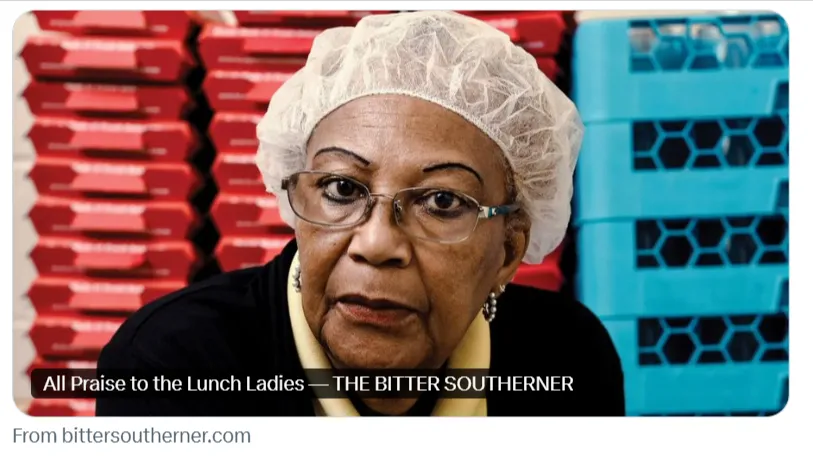
“She tells of a student who kept trying to save her meal to carry home, because she didn’t have anything to eat there. Seiber-Garland and her staff found a way to provide her with a second meal for the evening.”
All Praise to the Lunch Ladies (images and words at THE BITTER SOUTHERNER)
That’s all, folks. Thanks for reading!
With research and writing from Abraham Kenmore.