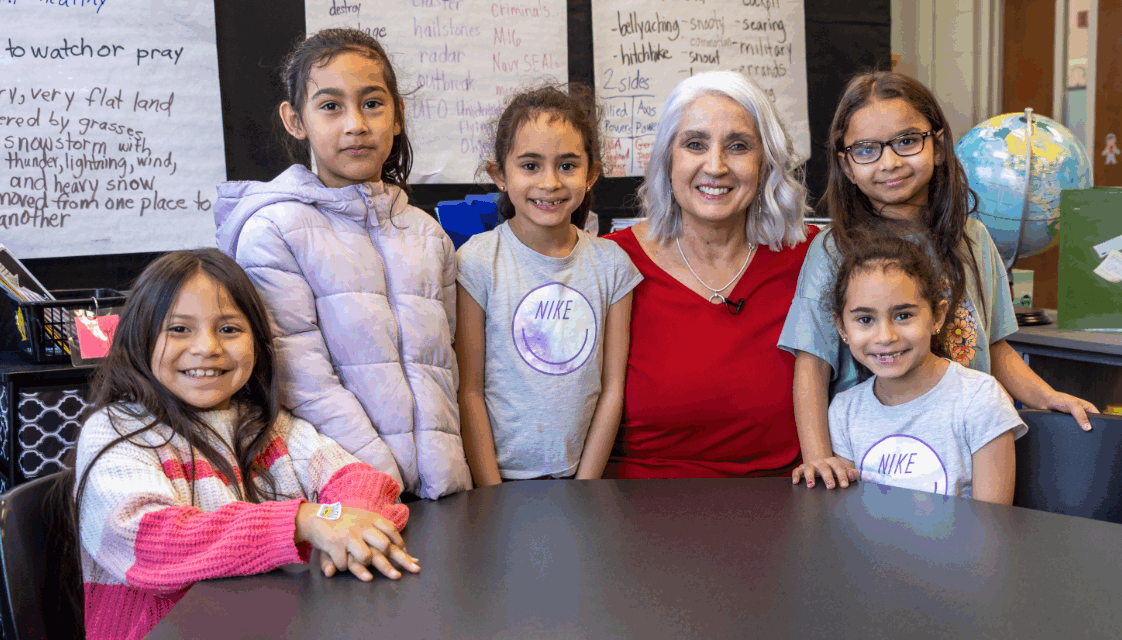
Missy Testerman had been happily teaching first and second graders for 30 years at Rogersville City School in rural East Tennessee. She was not considering making a change. Then, in 2021, the school’s English as a second language (ESL) teacher confided to Testerman that she was moving out of the district.
Rogersville City has a population of 4,600. Many families can trace their roots in the region back 100 years. A small number of newcomer families also live in the area. Testerman worried that the teacher’s departure would affect the school’s multilingual students. Like most rural schools, Rogersville City would struggle to find a qualified replacement.
Testerman, the 2024 National Teacher of the Year, decided to solve the problem by taking advantage of the state’s Grow Your Own initiative and adding an ESL endorsement. She currently serves as the district’s ESL specialist and ESL program director.
Testerman spoke with Phi Delta Kappan recently about supporting multilingual students and their families, rural school teacher recruitment challenges, and the importance of teacher mentors.
PHI DELTA KAPPAN: Why did you want to become a teacher?
TESTERMAN: I always knew that I wanted to be a teacher from the moment that I first walked into kindergarten. My teacher’s name was Mrs. Brown. She was young and cute and trendy, and she made learning fun. I fell in love with the idea that Mrs. Brown could teach us things, and then we learned it and knew how to do it. It was not just falling in love with school. It was falling in love with the teaching and learning process. I was just amazed by that entire process, and from that moment forward, I knew I wanted to be a teacher.
KAPPAN: As a first-generation college goer, what support did you get from teachers or staff to steer you to where you wanted to go?
TESTERMAN: I had teachers all along the way who told me, “You will do well in college.” But a lot of that dates back to second grade. My teacher, Mrs. Rhymer, told me I would be an excellent teacher. I was quiet in school, but every day during reading groups, I was in charge of my group. I came alive in that role. I remember her saying that to be a teacher, you had to go to college. That was the first time I had ever heard the word college. I thought college was a place where you went to learn to become a teacher. Imagine my surprise when I found out you can learn how to be lots of things in college! I’ve had so many encouraging teachers who pointed out I could be a successful student and a successful teacher. In high school, guidance counselors were pivotal in helping me fill out those college applications and follow the processes that students have to go through to be admitted to college. When you’re the first person in your family to do that, a lot of times, no one in your house understands that process.
KAPPAN: Why did you make the change and get your certification in ESL?
TESTERMAN: I had taught first and second graders for 30 years and I loved it. I had no plans of changing anything. The older I got, the more I appreciated being able to hang out with 6- and 7-year-olds after I didn’t have any 6- and 7-year-olds in my personal life anymore. But one morning in August 2021, one of my best school friends, our school’s English as a second language teacher, came to me and said that she would be leaving at the end of the school year because her husband was taking a job in Middle Tennessee. This lady and I had co-taught the English language learners who were in my classroom in second grade for years. We were a great team. We believed in the same philosophy — that ESL students needed rigorous, high-quality instruction to succeed. She was more than our school’s ESL teacher. She was a resource for these families to get the things they needed within our community. She was the school liaison to these parents. Her leaving would be a huge loss, not just for our school but also for those students.
We are in a very rural, ultra-conservative part of Tennessee. If you haven’t lived here for years, it’s hard to adapt to the area. I was worried about what would happen to those students and who would advocate for them because I’d had so many of them in my classroom. I was invested in them and their families. The very next day, I received an email from the state of Tennessee that went out to all Tennessee teachers. It explained that if you were currently teaching in Tennessee, you could add an endorsement in a hard-to-fill licensure area at no cost through Tennessee’s Grow Your Own program. The hard-to-fill licensure areas at that time were special education, high school math, and English as a second language.
I asked my director to recommend me for this program, because each school system in Tennessee could recommend one person. He did so not knowing this teacher was leaving because she’d asked me not to tell anyone. I convinced him that it would be great professional development for me because I was the teacher who taught these ESL students. I completed the coursework during that school year, and at the end of the school year, I took my first ever Praxis at age 52 and passed it. I became our school’s ESL teacher, our ESL program director, and the Title 3 director as well. I have not regretted one moment of that change ever.
KAPPAN: What are some of the challenges that rural schools face in recruiting teachers, especially for hard-to-fill positions?
TESTERMAN: Rural schools have a hard time recruiting many positions: high-level math and science, special education, and ESL. Most of the teaching force in a rural community comes from people who are already living there. It’s very difficult for rural systems to recruit people to move to a very small place just for the job. Rural systems are often limited in how much money they can pay teachers because they don’t have a huge tax base to draw from. You’re asking someone to move into a remote part of the country where it may take you half an hour or an hour to get to the closest Target, and you’re not even going to pay them a large amount of money. So those are all challenges we face in my area every year.
KAPPAN: You help your students and their families with more than just the instruction.
TESTERMAN: One of the most important things about the role of an ESL teacher or a teacher of multilingual students is that he or she is not just someone who delivers academic content or supports students as they learn academic content. Teachers of multilingual learners help students learn English to be able to read, write, listen, and speak while students are trying to learn high-level math, science, English, and social studies. In addition, these teachers serve as the liaison between the school and the family. They also serve as the liaison between the family and the community. Many times, I have students who need medical care above and beyond what our wonderful school nurse can do. I do things like finding a care provider and making an appointment for them. Occasionally, I’ll go to the appointment at the parents’ request to support the translation between the doctor and the mother.
A few years ago, I had a student who was really stressed out: A third grader who was having a rough day at school because his mom was worried. She got a notice in the mail that she needed to renew her car tags, and she didn’t know where to go to do that. The courthouse is a block from our school. I had him call his mom and tell her that he was going to stay with me until 3:30 when the traffic cleared out. Then, he and I would walk to the courthouse. We would meet his mom there, and he could use his English skills in that setting to help get the car tag. He was so proud of himself because he was able to take his mom’s words, translate them into English, and get that taken care of. It was a great lesson for him to see also that his English skills will help him advocate for his family, in addition to helping him learn all the things that he needs to learn at school to be successful.
KAPPAN: Why is it important to support students and their families in their life outside of school?
TESTERMAN: If our students are going to be successful and feel like they’ve adapted to our area, then they and their parents need to be part of our community. Some of those things are essential, like going to the doctor or getting car tags, but small things like being able to play sports are also important. It helps students make more friends and connections. It also helps their parents meet new people within our community. It helps our community see that these people are just like us. They are good parents. They care about their kids. So, when I can get a student involved in these extracurricular things, it’s just a win-win for everyone: for the child; for the family; for other families; and for the general, overall health of our community. Multilingual teachers are trying to be a bridge between community perception and reality.
KAPPAN: Why is mentoring new teachers so important?
TESTERMAN: As a new teacher, I was able to teach next door to the absolute best teacher. I was 21, so I thought Mary Jo was ancient, but she was actually in her early 30s. Mary Jo took me under her wing. She taught me not just how to be a better teacher — because she was such a fabulous teacher — but also how to be a teacher leader. You were just expected in Mary Jo’s world to be an advocate for your students. She started taking me to school board meetings the first month I worked there, and I was horrified. I worried that I wasn’t supposed to be there. She said, “Missy, it’s an open meeting. Anyone off the street can walk in and be there.” That became something I did. I went to every single school board meeting because she taught me that was what we did.
And when you have a problem with your principal, you don’t go to the lounge and complain to everyone else because that won’t fix it. You come up with a solution that you think could work better, you prepare to show that it’s best for kids, and then you go talk to your principal. That was the best lesson that a new teacher could learn. I’m so grateful that I had that advantage with Mary Jo. I hope I’ve paid that forward through the years of mentoring new teachers. We continue to build this legacy of strong teachers who are leaders by passing along those skills that someone else helped us to develop.
KAPPAN: You are speaking at the Educators Rising National Conference in June. What advice will you give those aspiring teachers?
TESTERMAN: I am so excited to get to address those young people who want to be educators. They’re so energetic. And let’s face it: Our schools need that excitement and that energy because sometimes you lose that. We need those new people to help us keep that level of excitement. My advice for aspiring teachers is to find a Mary Jo, someone who’s going to have your back and help you grow in your teaching skills. Find a teacher — someone who’s 10 to 15 years out, someone you want to be like in 10 to 15 years — and say, “I would love for you to mentor me because someday I want to be the type of teacher you are.” Two things will happen. One, because you came to them, they will want to invest in you and help make you a better teacher. Two, you’re going to pass along some of your positive energy to someone who probably needs it. We’ll pass on some wisdom, and in exchange, they can infuse some of that energy into us.
Testerman’s interview is featured in episode 15 of PDK’s podcast “There’s Power in Teaching.” You can subscribe via Amazon Music, Apple Podcasts, and Spotify podcasts. Or you can subscribe directly using our RSS feed.
This article appears in the Summer 2025 issue of Kappan, Vol. 106, No. 7-8, pp. 39-42.

ABOUT THE AUTHOR

Kathleen Vail
Kathleen Vail is editor-in-chief of Kappan magazine.
Visit their website at: https://pdkintl.org/