A new book by journalist David Zweig asks hard questions about COVID school closures and the coverage that they received.
By Alexander Russo
No matter how much policymakers and journalists try to ignore it, the question whether the US COVID response was worth the turmoil it caused just keeps coming back.
In March, two Princeton professors published a book asking hard questions — and the New York Times’ Mike Barbaro interviewed them on The Daily – a rare move for the podcast.
Vox’s Kelsey Piper wrote about the absence of any real reckoning about what happened – and why one may never happen despite the need.
The Grade ran a series of pieces on the 5th anniversary of the beginning of the pandemic including reflections from journalists on their performance during the pandemic.
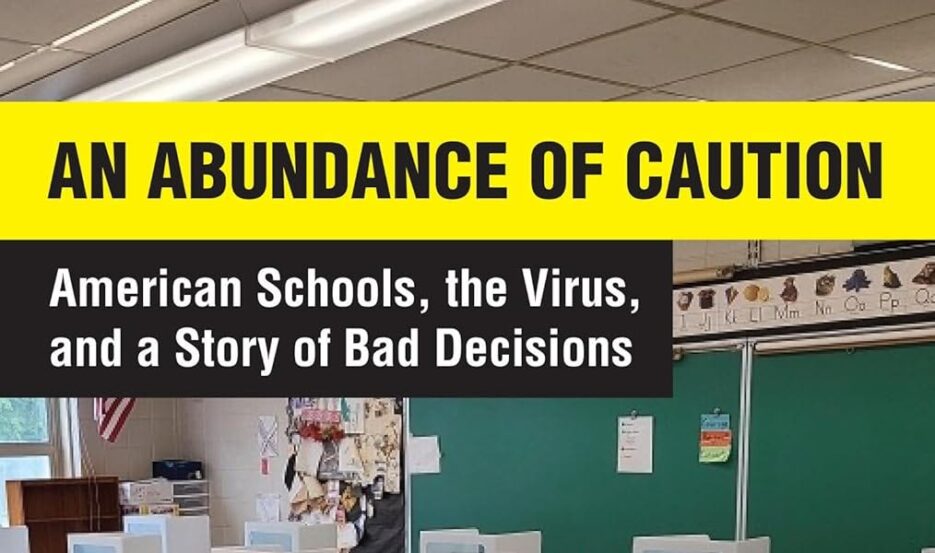
Now comes journalist David Zweig’s new book, AN ABUNDANCE OF CAUTION (MIT Press/Penguin Random House), which has several chapters examining the media’s failure to cover the COVID response with enough skepticism and care.
Zweig’s journalism — including his piece for The Grade about New York City’s infamous 3% rule — was among the most powerful and skeptical I came across during the pandemic. A freelancer and parent of school-age children, he was nonetheless able to get pieces placed in WIRED, New York magazine, and the New York Times.
In the following interview, Zweig talks about the benefits of operating outside the world of journalism, his accomplishments and regrets, and what he hopes journalists will learn for the next pandemic.
“I hope journalists will read through the case studies in my book and see how news outlets continually reported statements by health professionals without asking for evidence to support those statements,” says Zweig. “As a result, the American public was deeply misled about supposed risks from schools and children, and equally misled about supposed benefits from keeping children out of school.”
“I hope journalists will read through the case studies in my book and see how news outlets continually reported statements by health professionals without asking for evidence to support those statements.”
Conducted via telephone and electronically, the following interview has been edited and condensed.
How did the experience of writing about schools and COVID compare to your experiences writing about other things as a journalist?
Zweig: At the very beginning of the pandemic, I pretty much hit a brick wall. I was surprised, because the places I was pitching, I had done work for them in the past. I had just published a piece for the Times not that long before that was the most read piece in the entire paper for a day or two. So I wasn’t just some rando. But in the beginning, I was pretty much shut out until I found a sympathetic editor who at the time was at Wired. Once I got that going, after that first piece, I was able, for the most part, to publish what I wanted to publish. I did a long string of pieces at Wired and then did a whole bunch of pieces at New York and the Atlantic. And I also did one piece for the Times, and then just kind of sprouting out from there to a number of other places as the pandemic wore on.
“In the beginning, I was pretty much shut out.”
Why wasn’t the media coverage as robust and skeptical as it could or should have been?
Zweig: A really big part of my book is media criticism, and the main thrust of it is documenting the failures of a lot of the legacy media and also the broader elite culture in America. People were motivated to behave in certain ways that supported certain narratives that they wanted to believe.
I try not to spend too much time nitpicking factual errors. I don’t think that’s really the main issue. Everyone makes mistakes. It’s about the framing of certain topics in a way that you can write an entire article and it can be fact-checked, and everything in there can be true, but yet the framing of the article itself is what’s problematic. And that’s a major point in my book that I try to illustrate along the way, that it’s not necessarily that there are errors, but rather it’s that reporting gets conducted through a certain lens. And that’s in many ways far, far more problematic than simple errors along the way.
What was the problematic frame that you were seeing?
Zweig: I tried to not make claims without having evidence behind those claims, yet much of the reporting in the legacy media on the pandemic and in particular on children and schools, was filled with all sorts of statements, whether made by the journalists themselves or whether by quoting certain experts or professionals, without evidence provided to support the claims being made. My book is basically a case study of that occurring over and over and over again in a lot of the legacy media.
“You can write an entire article and it can be fact-checked, and everything in there can be true, but yet the framing of the article itself is what’s problematic.”
Was there anyone else out there with you, in terms of journalists telling the full story?
Zweig: Alec Macgillis wrote that really nice piece for The New Yorker, which was such an anomaly. I regret not mentioning that in my book. Alex Gutentag did a lot of great reporting, though I can’t remember if it was specific to kids in schools. Anya Kamenetz wrote a really important piece on daycares, which I highlight in my book. I thought that was super important and great reporting.
Is there anything that you did that you as a journalist, that you regret doing, or that you wish you’d done differently or just outright didn’t do?
Zweig: I wish that, to the extent this was possible, whenever the earliest that it was allowed, I had gotten on a plane and went to Europe and just did first-hand reporting on what was going on with the kids, families, and schools. I don’t think necessarily that that would have changed the thrust of my reporting. But as a writer, it certainly would have added a lot of color to what I was doing, and given more narrative and emotional weight to what I was doing.
“I wish that… I had gotten on a plane and went to Europe and just did first-hand reporting on what was going on with the kids, families, and schools.”
For myself, I wish that I’d gone out and done my own reporting in the neighborhood, talking to kids and parents and educators about what the shutdown was really like, instead of spending so much time complaining about the absence of this kind of coverage.
Zweig: For a time, all the coverage of schools that I had been seeing was negative. Every piece highlighted the dangers and what had gone wrong. So I pitched New York magazine a story showing the success stories and I went to schools that were open full time five days a week. And so I went to two schools in Westchester County, where I live, and documented what they’re doing, And I also did a really in-depth analysis of case rates in the different school districts in Westchester County, which showed what I had already written about and predicted, which is that being open full time did not lead to an increase in cases relative to schools that were closed. There was no meaningful difference.
I almost never did the sort of classic magazine-style journalism where you highlight one, two or three people, and do these sort of long form profiles and use those anecdotes as a launch point to some bigger topic. It’s a perfectly legitimate, and very engaging style of reporting. But to me, I feel like that style of reporting can often be very misleading. You can choose whoever you want as your protagonist in your piece, and obviously that’s going to shape the narrative in whatever way you want. Whereas my reporting, for the most part, I really tried to just make it about ‘Here’s what a study says.’ Or ‘the coverage of these particular studies or these claims are or are not valid.’ It’s probably less fun for the reader. It’s not like a true narrative in the sense that you don’t have an emotional connection to a particular kid, but that’s the style of reporting, rather than sort of narrative-driven reporting, that I’ve always been drawn to.
“I almost never did the sort of classic magazine-style journalism where you highlight one, two or three people…”
Is there anything you did that was not as effective or constructive as you hoped or that you would do differently?
Zweig: There probably were moments where I gave in on something, perhaps to an editor, that I kind of regret giving in on, but it’s a dance, a relationship and a partnership. So you have to choose your battles. And I, you know, in order to get things published, sometimes you have to yield on any number of points that you’re trying to make. So there’s probably a few where I wish I had kind of held firm a little bit more right on some point, but, but nothing giant.
I also wish that I’d spent less time focused narrowly on traditional news outlets, when there was so much else being written out there in nontraditional outlets and by non-journalists.
Zweig: I published a bunch of pieces in Wired, New York, and The Atlantic. But I think I occupied a very rare lane where I was writing a lot of pieces that ran contrary to the establishment narratives that were in the Times and other legacy media. Yet I was able to do that largely within the legacy media. There were other writers who wrote to me and said, ‘I don’t know how you got that piece published.’ Ultimately, I started a Substack [called Silent Lunch], but that was after I had already published a lot of pieces in larger outlets. It wasn’t because I couldn’t necessarily get pieces published in legacy outlets.
“I was writing a lot of pieces that ran contrary to the establishment narratives… Yet I was able to do that largely within the legacy media.”
What was the secret to your pitching counter-narratives to traditional outlets?
Zweig: The only thing I can say is I had a couple of sympathetic editors who believed in what I was doing, and that my reporting tended to almost entirely be focused on ‘What does the evidence show? What does this particular study show?’
If you have a writer who’s coming to you with something that goes against the sort of accepted position, but yet he just gave this three-page bullet list of evidence to support the case he’s making, at least a few editors have enough intellectual integrity to acknowledge that the argument was well supported. Most editors aren’t there. They have their own narrative. They have their own thing in mind. And it doesn’t matter what amount of evidence I provide to them if it doesn’t support the narrative they want. They’re not going to do it. But thank God there are at least some editors where their interest is, ‘What’s the truth? What’s actually happening?’
I don’t know if it’s something in my character. My interest is not in being a contrarian. It’s just that I felt like I was following where the facts led me and I just tend to feel kind of like an alienated person in general. So for me, being cast aside, you know, outside the in group, I already sort of feel that way. I just felt like I just don’t care about that as much as I think other people do. If you have someone who’s a staff writer at the New York Times or something like that, they didn’t get there by being an iconoclast. They got there by getting good grades in school, then going to Brown, then knowing the right people, and so on. So I just think there’s a whole ecosystem of people who get into these places because they only paint within the lines.
“My interest is not in being a contrarian. It’s just that I felt like I was following where the facts led me and I just tend to feel kind of like an alienated person in general. So for me, being cast aside, you know, outside the in group, I already sort of feel that way.”
What did you make of the 5th anniversary of COVID last month? Are you seeing any major shifts or changes, from policymakers or news outlets?
Zweig: I’m not aware of any policy shifts, but I suspect the confirmation of Jay Bhattacharya at NIH and Marty Makary at FDA may lead to some much-need changes in our nation’s health agencies.
What needs to happen next, for American society and for traditional journalism? What do you hope the book will accomplish?
Zweig: My goal for the book is for it to serve as a historical record. I want people to understand how scientists — the “experts”— aided by an unquestioning legacy media, ignored and dismissed evidence that didn’t fit with their preferred view. As a result, the American public was deeply misled about supposed risks from schools and children, and equally misled about supposed benefits from keeping children out of school. I hope journalists will read through the case studies in my book and see how news outlets continually reported statements by health professionals without asking for evidence to support those statements or, short of that, without investigating to find the evidence themselves.
Previously from The Grade
How the pandemic response destroyed the learning culture in one Baltimore high school