The actor who plays a polarizing history teacher on Netflix’s hit TV show “Adolescence” defends the show’s depiction of schools and teachers.
By Alexander Russo
Pretty much anyone who’s seen “Adolescence” — Netflix’s four-part series about online bullying, incel culture, and student-on-student violence — has had a strong reaction to the second episode, which takes place at a school filled with miserable, anxious students and clueless, seemingly indifferent educators. There’s fighting on the playground. It smells.
“I can’t stand this fucking place,” says one of the two detectives making a hapless visit to the school looking for clues about how one student Jamie came to be accused of murdering his classmate Katie. “Does it look like anyone’s learning anything in there?”
One of the most vivid characters the detectives meet during their visit is Mr. Malik, Jamie’s seemingly indifferent history teacher.
In one scene, the disheveled trainee appears to have been absent from his class for an extended period of time (and is showing the class a video). In another, he tells a detective he doesn’t know much about Jamie beyond his grades.
“Look, these kids are fucking impossible,” says Malik (below left), before walking away. “What am I supposed to do?”

Educators and experts have debated the accuracy of the story and its usefulness to informing the public.
However, according to UK-based actor and writer Faraz Ayub, the depiction of the school and of his character is largely accurate.
The actor is careful to note that not all teachers are like Mr. Malik, and not all schools are like the one in the show — but they’re not rare, either.
“It’s a particular type of school set in a particular environment a very inner-city city environment,” says Ayub in a recent video interview. “I think that it’s a reflection of a lot of those schools.”
“It’s a particular type of school set in a particular environment a very inner-city city environment.”
In part, Ayub bases his assessment — and his performance — on personal experiences as a younger person.
“My experiences with teachers were mostly negative. I felt like I was very misunderstood. I always had this escape route of creativity and art. But I feel like if I didn’t have that, then you don’t know what other avenue I had. No one ever asked me about where I was going; I had no direction.”
“This story is kind of a wake-up call to people to see that the school in itself — not just the parents and home — plays a very vital part in forming the minds of young men and young women — and in particular the neglected have been the young men.”
His message to educators is clear: “I just want to show to teachers they can have a very powerful impact on a pupil with positivity, with words of possibility.”
“I just want to show to teachers they can have a very powerful impact on a pupil with positivity, with words of possibility.”
This is a message that is echoed in the episode itself, including a moment in which one of the detectives notes that, even in the most struggling schools like the one she attended as a child, there were bright spots:
“There’ll be some good teachers in there,” she says, recalling a favorite teacher who helped her get through school. “All kids really need is one thing that makes them feel good about themselves.”
Asked about the response to his performance, Ayub says that he hasn’t heard from any of his former teachers. But he has heard a lot from his relatives — many of whom are educators — and that the response has been very positive.
“They’ve all said that it’s a very relatable. Mr. Malik, they said, is a representation of a lot of modern teachers, which is the feedback that I’ve gotten.”
Overall, Ayub seems to have had a good experience with the show.
In particular, he says that Mr. Malike’s first entrance “was quite fun to shoot.” In it, Malik appears belatedly in the classroom, cinching up his belt as he walks in. “He’s not coming out of the bathroom,” says Ayub. “He’s just someone who probably forgot to tighten his belt on his way to work and realizes that he needs to fix it.”
According to Ayub, we see Mr. Malik “in a very contradictory appearance to how a teacher should be presented or should be portrayed.” Malik “has his own issues he’s dealing with, and it shows showcases to the audience where Jamie’s schooling had an effect on what happened to him and his actions,”
The student-teacher relationship is complicated, though. As Malik belatedly returns to class, one of the students calls out to him that the students have covered for him in his absence. This reveals that while he might seem indifferent or inattentive to viewers, he may be popular among the students.
“Mr. Malick is very authentic,” says Ayub. “You know, his unkempt appearance, his lack of interest. Maybe they’re charmed by that in some way. I think he just kind of comes in there, does his job and he kind of lets them have their way. It’s kind of like, ‘You do what you want to do. As long as you take a bit of notice of what I’ve provided for you in terms of what you have to learn today, just chill out and relax.’”
“And I think that kind of is what students want… I think his leniency, his sort of laissez-faire sort of chill attitude — surprisingly, which is a negative trait — also endears some of the students as well.”
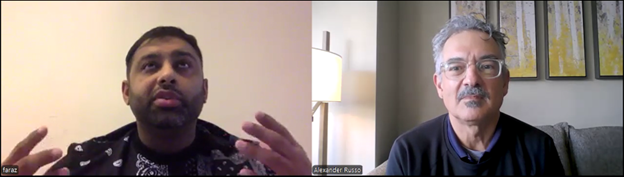
Above: Actor and writer Faraz Ayub (left), discussing Mr. Malik, the character he plays on “Adolescence.”
Asked about other favorite parts of the segment, Ayub focuses on the interactions between one of the detectives and his son, who attends the school — and, like the accused murderer Jamie, feels misunderstood and alienated.
According to Ayub, “the son is trying to speak to his father, trying to make him understand the sort of the angst that he’s feeling of sort of young men in today’s generation.”
In terms of the show’s message to educators and school administrators, Faraz says, “I know you’ve got a difficult job, and I know it’s not getting any easier. But what I would hope that you take away from the show would be to just know that you have a very big impact on these young adolescents. What you do with them forms a very significant part of who they become as they get older. And I think that’s a big responsibility.”
“The takeaway from the second episode is to really understand that responsibility and to ensure that, whatever difficult circumstances you have, to raise these young men and these young women, to prepare them for life in a manner which enables them to fulfill their potential.”
Ayub has appeared in several feature films including his current leading role in SKY PEALS. He is currently writing a new piece and can be reached at @officialfaraza on Instagram or through his agent, Accelerate Management.