A LOOK BACK
Supporting math thinking
By Alice P. Wakefield
November 1997, pp. 233-236
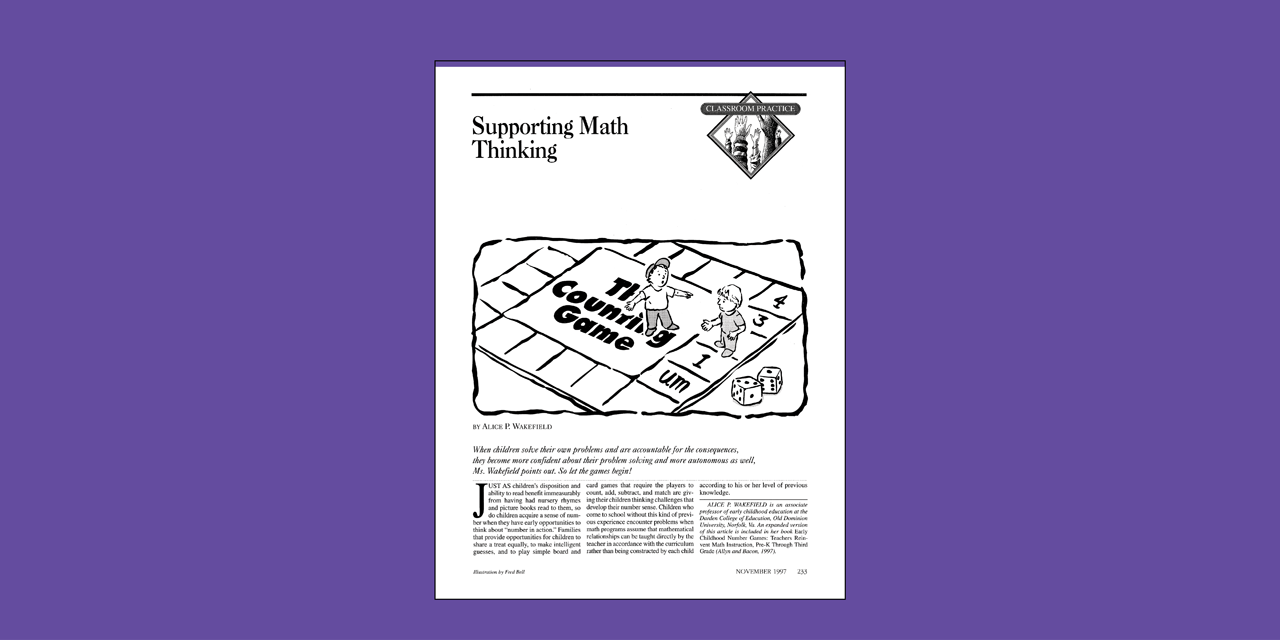
Bring on the games! That’s the message Alice P. Wakefield, an associate professor of early childhood education, shared with Kappan readers in her 1997 article on encouraging numeracy in the early grades. “Dice, cards, and board games offer perfect opportunities for children to practice adding small numbers together repeatedly without growing bored,” Wakefield notes. “Repetition, coupled with active thinking, leads to remembering — and, more important, helps them construct their number sense.” Forming an understanding of mathematics in this manner is by far preferable to a steady supply of worksheets, reasons Wakefield, who says young children learn best by trial and error.
Although students inarguably benefit from committing core math facts to memory, “passively learning them by rote is not only unpleasant, it may also be counterproductive,” Wakefield posits. “When memorizing prevents children from actively thinking about and figuring out number solutions for themselves, there is little, if any, mental growth.” Games provide an excellent opportunity to discover math concepts and commit certain facts to memory with an immediate payoff for children who experience the thrill of using those facts within the context of play. “When children solve their own problems and are accountable for the consequences, they become more confident about their problem solving and more autonomous as well,” Wakefield notes.
CONVERSATION PIECE
This issue of Kappan focuses on the mathematics education students need. Use these questions to reflect on the topic with your colleagues:
- Share some of your own experiences with math education. What has made you feel most confident and interested in math?
- Why do you think it’s socially acceptable for people to say they’re “not math people”?
- What kinds of programs does your school have in place to help students build more positive math identities?
- How would you change the math curriculum? What would you spend more time on, and what would you cut back on?
PDK members have access to discussion guides related to specific articles in each issue of Kappan. Log in to the member portal and access the discussion guides at https://members.pdkintl.org/PDK_Member_Discussion_Questions.
RESEARCH CONNECTIONS
Supporting marginalized students in mathematics
Student-teacher interactions, the practice of sharing power within the classroom, and teachers’ math knowledge are key components of inclusive and equitable mathematics pedagogy. Promoting a positive “math identity” for all students and helping them realize the usefulness of the subject are likewise crucial to supporting marginalized students in mathematics. Yet, too often, U.S. schools fall short of those goals, particularly with low-income students and students of color.
In a recent study published by the American Educational Research Journal, researchers convened 67 focus groups with 251 predominantly Black high school students from a large urban school district in Nashville, Tennessee. Although students shared both positive and negative experiences, researchers found that Black girls in particular were more likely “to have a negative math identity and to misunderstand the utility value of math.” The researchers conclude “that math teachers, schools, and school districts need to intentionally listen to marginalized students, especially Black girls.” Of particular concern is bolstering math knowledge and identity, as these “can be important tools for their future career options, empowerment, critical consciousness, and continued liberation.”
Source: Douglas, A., Rittle-Johnson, B., Adler, R., Méndez-Fernández, A. P., Haymond, C., Brandon, J., & Durkin, K. (2024). “He’s probably the only teacher I’ve actually learned from”: Marginalized students’ experiences with and self-perceptions of high school mathematics. American Educational Research Journal, 61 (5), 915-952.
“We are in a very interesting time in the world where we’re determining what counts as mathematics.” – Cathery Yeh, University of Texas at Austin, quoted in “Universities Are Teaching Competing Math Philosophies to Future Teachers. Why That Matters” (Education Week, Sept. 28, 2023)
‘Detracking’ math classrooms
Sequoia Union High School District in California’s Bay Area has implemented a promising new strategy for boosting math achievement. Under the Algebra I Initiative, 9th-grade students with previous math scores well below grade level were placed in a standard Algebra I classroom alongside peers who had previously scored at or above grade level. Teachers in these classrooms received professional support to implement new approaches to learning and emphasized high expectations and a growth mindset for all students.
In “a strikingly positive collection of results,” researchers found those students who had previously struggled in math saw marked increases in their scores on a state-mandated math test as 11th graders, while the achievement of on-grade students was not negatively influenced. Additionally, researchers credit the program with increasing student attendance, retention, and math credits. “Overall, this study shows that ‘raising the floor’ of academic expectations for educationally vulnerable students can be a successful strategy to link equity goals with improved achievement,” researchers note. “The positive impacts of the initiative on student engagement imply that any academic benefits of tracking likely come at the cost of heightened stigma and isolation for remedial-track students.”
Source: Dee, T.S. & Huffaker, E. (2024, October). Accelerating opportunity: The effects of instructionally supported detracking. (Ed Working Paper: 24-986).
Rethinking word problems
Do the standard word problems found in math textbooks do enough to spur “sensemaking” among students? Researchers at the University of Notre Dame put that question to the test in a study of 229 middle school students. Students were assigned various types of word problems. Notably, one novel approach was rephrasing traditional word problems into a yes/no format. Researchers theorized that introducing “inherent uncertainty about the result would be beneficial to student performance and sense-making because it requires students to reason explicitly about the context described in the problem.” Ultimately, students struggled with the yes/no questions. However, they did demonstrate “significantly greater” sensemaking in the process. Researchers believe further work is needed to fine-tune the process of developing high-quality math word problems.
Source: Kirkland, P.K. & McNeil, N.M. (2021, April). Cognitive design affects students’ sense-making on mathematics word problems. Cognitive Science.
“Students who struggle and overcome that struggle not only develop their own understanding of the math content but also develop new skills and strategies for overcoming new challenges inside and outside of math class. Struggle develops perseverance, resilience, and grit.” – John J. SanGiovanni, Susie Katt, & Kevin J. Dykema, Productive Math Struggle (Corwin, 2020)
Math avoidance
Many researchers have studied math anxiety and its negative relationship to math performance. A recent research review published in Trends in Cognitive Science proposes there is another phenomenon at play: math avoidance. The math avoidance cycle, “fueled by math anxiety, creates a feedback loop where increased avoidance behaviors lead to further declines in math proficiency,” the article states. “The introduction of this avoidance theory offers a fresh perspective on the relationship between math anxiety, avoidance behaviors, and math achievement.” Acknowledging the role avoidance plays in math anxiety is important so that interventions can be designed to address the issue and improve student outcomes, researchers say.
Source: Lau, N., Ansari, D., & Sokolowski, H.M. (2024, October). Unraveling the interplay between math anxiety and math achievement. Trends in Cognitive Sciences, 937- 947.
This article appears in the December 2024 issue of Kappan, Vol. 106, No. 4, pp. 5-6.