In this week’s newsletter: How to cover Trump’s promise to abolish the Department of Education. Large numbers of educators favored Trump — but nobody seems to want to talk about it? The hidden and deeply inequitable world of special education nondisclosure agreements. How and why to cover private school choice, according to a ProPublica reporter. An Atlantic magazine critique of Emily Hanford’s “Sold a Story” generates buzz and criticism. And the Twitter/X/Bluesky debate gains steam — again — among education reporters.
ABOLISHING THE USDE?
The big education story of the week
The big education story of the week is President-elect Trump’s campaign promise to abolish the U.S. Department of Education (USDE).
In a campaign speech in September, Trump promised to “eliminate the federal Department of Education” (11 Alive, CNN). Since he was elected, he’s doubled down on his pledge, promising to wage a war on “wokeness” in schools (Wall Street Journal). Across the country, reporters are asking what that would mean for students and schools (Axios, Washington Post, Bridge Michigan, Tallahasseet Democrat).
However, it’s not at all clear that abolishing the USDE is politically and logistically feasible — a reality that’s addressed in several stories (New York Times, Chalkbeat, USA Today, Vox, EdWeek). “Abolishing a federal department would require an act of Congress, just as creating one does,” notes Chalkbeat’s Erica Meltzer. “It likely would also require broad bipartisan support, which the idea doesn’t have.”
Campaign promises require both attention and skepticism. Speculation about the future has to include a range of outcomes — not just the most dramatic possibility. Credulous “worst-case” coverage discredits the news and ultimately turns readers off.
Other big stories of the week include speculation about who Trump will pick as education secretary, teacher’s strikes closing schools in Massachusetts, and potential school closures in Baltimore. Check out @thegrade_ for more headlines Monday through Friday!
SECRET SPED INEQUALITY
The best education journalism of the week
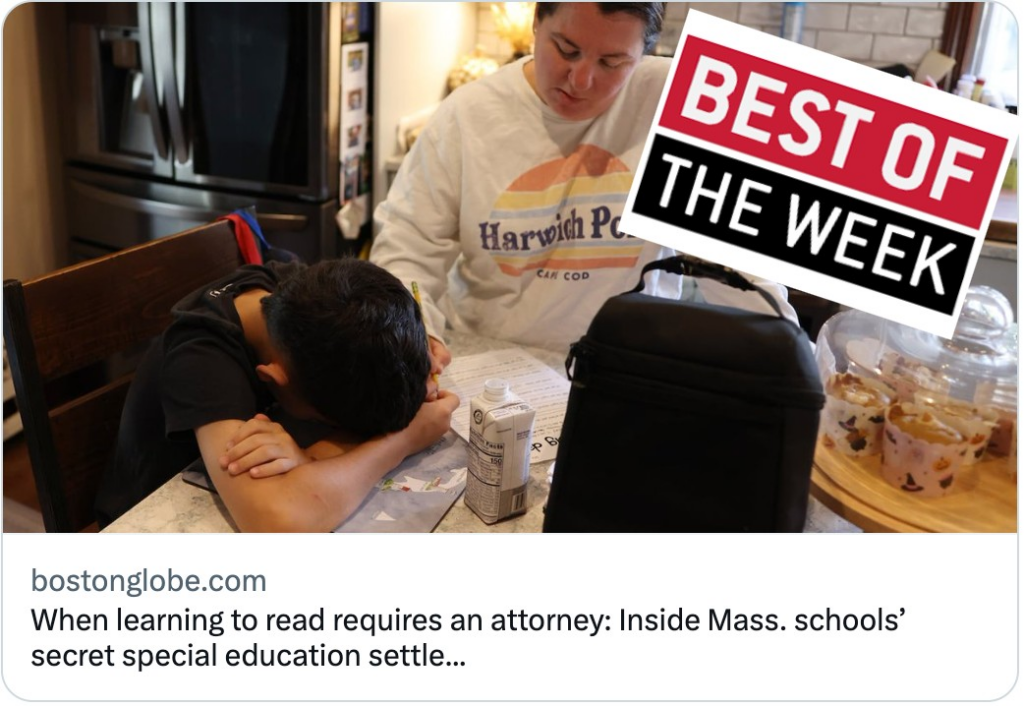
The best education journalism of the week is ‘I want to scream, but I can’t.’ The hidden world of special education settlements in Mass. by the Boston Globe’s Mandy McLaren and Neena Hagen.
The duo offer a rare, data-driven look behind the “thick pall of secrecy” surrounding districts’ confidential placements for students with special needs. Their analysis finds that families who can afford a lawyer typically negotiate six-figure, “life-changing placements” for their kids at specialized public and private schools, while those without means must watch their kids languish in under-resourced district schools.
It’s a remarkable piece of investigative journalism, starting with its breadth: McLaren and Hagen get their hands on more than 2,600 settlements showing that families can come away with as little as $4,600 or as much as $210,000. (Readers can download documents reaching back to 2013.)
The secrecy and inequality of the system are both made clear. A weary suburban mother laments the “tedious and maddening back-and-forth” that ends with a secret agreement for $40,000 in annual tuition payments at a private school. “The way this is set up, it’s made to break you,” says a father who doesn’t have the resources to fight the district.
There’s also a great solutions sidebar showing what the state could do. For more on how NDAs are used in schools to hide settlements and sexual predators, see here and here.
Other education stories we liked: one Alabama school system’s efforts to serve immigrant kids (AL.com), rightward shifts in suburban school board races (Baltimore Banner), Lucy Calkins back for more after “Sold a Story” (The Atlantic), and a 13-year-old with autism arrested after his backpack sparked fear (WPLN and ProPublica).
CHOICE UNDER TRUMP
Our latest columns and commentary
I don’t believe that private school choice warrants as much national attention and heavy-handed media skepticism as it receives. The vast majority of American kids still attend public schools. Parents who seek alternatives to the public system do so for legitimate reasons.
But I understand that the spread of private school choice programs is important, and I learned a lot talking to ProPublica’s Eli Hager about his extensive coverage.
He justifies coverage of an approach that can change large numbers of kids’ lives and seeks to produce human-centered, non-ideological coverage.
“We don’t want to do stories that are just ideologically critical,” says Hager.
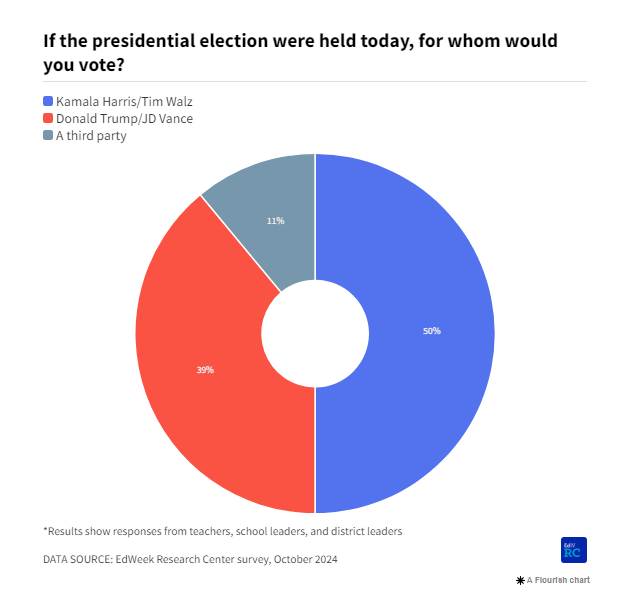
Above: Only about 50% of educators supported Harris in last week’s election, according to a pre-election EdWeek survey. And a whopping 49% of younger educators favored Trump/Vance.
PEOPLE, JOBS, & EVENTS
Who’s going where and what’s happening
📰 To leave or not to leave: It’s becoming more and more fashionable to leave Twitter/X. But I’m not so sure it’s the right move, especially in the immediate aftermath of Trump’s win. Former WNYC education reporter Beth Fertig says she’s leaving for Bluesky, but also remaining on Twitter “because it is useful and it seems wrong to give up because of a bully.” Thoughts? If you are leaving for Bluesky, or just curious about what it’s like over there, check out this helpful article about how to migrate over without losing your followers. (H/t Pamela Colloff.)
📰 Sound-off:
- “The Atlantic piece is too generous to Calkins and too critical of Hanford,” says author Mark Seidenberg.
- “Just to be clear, now that WaPo and NYT and many other publications are jumping on the train, (Inside Higher Ed’s) Katherine Knott had the ‘what if Trump shuts down the Department of Education’ story way before everyone else,” tweets the Chronicle of Higher Ed’s Sarah Brown.
- “National news writers, I beg you: Please link. We all need the love,” tweets Chalkbeat Chicago’s Reema Amin.
- “The mainstream media was carrying Kamala Harris’s water’,” says a young white high school teacher in this NYT piece on young, undecided Trump voters. “We need a check on the president to have a healthy democracy. If Kamala Harris was elected, there wouldn’t be a check on her.”
📰 Career moves: Former education reporter Aallyah Wright, who covers rural issues for Capital B News, was named an IRE 2025 Chauncey Bailey Investigative Reporting Fellow. Former WNYC education reporter Beth Fertig is joining Press Pass NYC as deputy director, helping schools launch student newspapers.
📰 Job openings: The San Antonio Report is hiring an education reporter. California-based EdSource is looking for a higher education editor, an East Bay-based reporter, and a director of operations. And EdSurge is hiring a temporary news editor.
THE KICKER
We saved the best for last
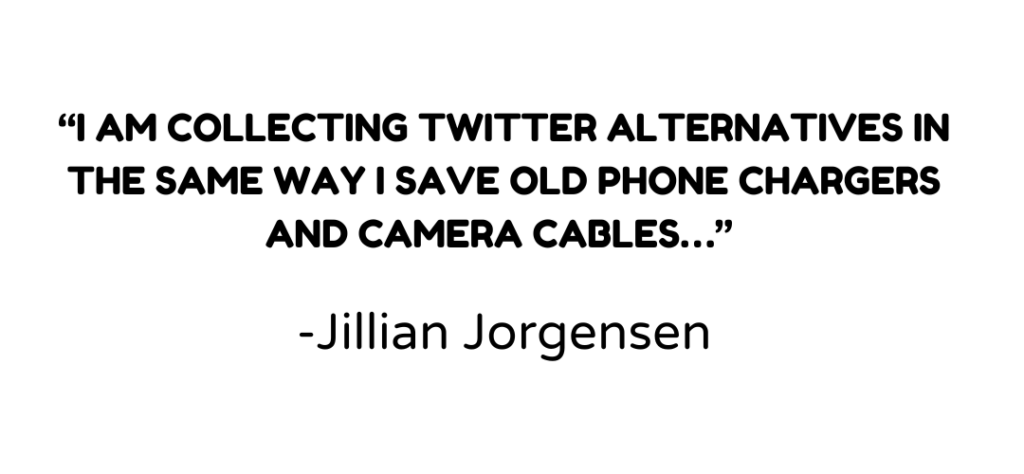
NY1 education reporter Jillian Jorgensen on her “Millennial” urge to collect things whether or not she’s ever going to use them.
That’s all, folks. Thanks for reading!
Reply to this email to send us questions, comments or tips. Know someone else who should be reading Best of the Week? Send them this link to sign up.
Using Feedly or FlipBoard or any other kind of news reader? You can subscribe to The Grade’s “feed” by plugging in this web address: http://www.kappanonline.org/category/the-grade/feed/.
Read more about The Grade here. You can read all the back issues of The Grade’s newsletter, Best of the Week, here.
By Alexander Russo with additional writing from Colleen Connolly.