Research has shown that U.S. adults know little about education policy and practice. This should worry us.
Understanding what the U.S. population thinks, experiences, and believes related to our education system is critical to supporting children. Adults’ beliefs about education inform politicians’ platforms; local, state, and federal elections; the development and passage of legislation; and district operating decisions.
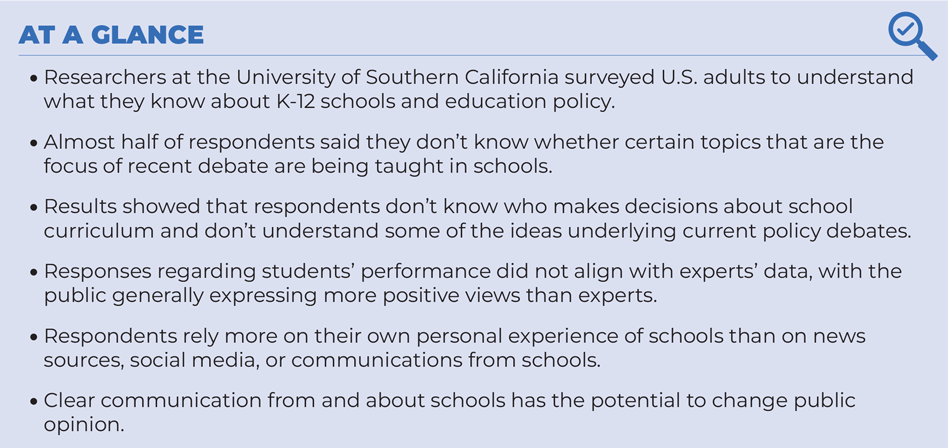
For the past four years, our research team at the University of Southern California has surveyed U.S. households about many education-related topics. We’ve asked about children’s experiences during and after COVID-related school shutdowns. We’ve asked about children’s mental and physical health and parents’ attitudes toward school-based strategies to support student health. We’ve also surveyed the U.S. public as a whole — including families with and without K-12 children — regarding their attitudes and beliefs about the purposes of education, what is and should be taught in schools, who should have control over curriculum decisions, and the privatization of education.
Our respondents come from the Understanding America Study (UAS) survey panel (https://uasdata.usc.edu). The UAS’s more than 13,000 members are selected and recruited using address-based sampling. Our samples include more than 1,600 households with K-12 children (all households with current children in the UAS) and a random subset of 2,000 households in the UAS that do not have K-12 children currently living in the home. Our results are representative of the U.S. population by gender, age, household income, and level of education.
Our findings shed light on a key question: What do adults know about U.S. education? Specifically, what do they know about what is taught, who makes decisions, the role of parents, and the belief systems driving education policy? Our results have important implications for how we might support children and improve the education system.
What do adults know about what is happening in schools? Not a whole lot.
Our data repeatedly have shown that adults know less than we would expect (or hope) about important education issues. This is true even among parents of children currently in school.
Almost half don’t know what is and isn’t taught
In 2022, we asked respondents whether a series of 24 high-level topics were currently being taught in schools across the country (Polikoff, Silver, Rapaport, et al., 2022). These topics included those related to civics (e.g., voter rights, pathways to citizenship, getting involved in local politics); race (e.g., causes and effects of racial inequality in the U.S., history and consequences of slavery in the U.S.); LGBTQ issues (e.g., marriage equality; lesbian, gay, and bisexual orientations); and sex education (e.g., consent, safe sex practices, sexually transmitted diseases).
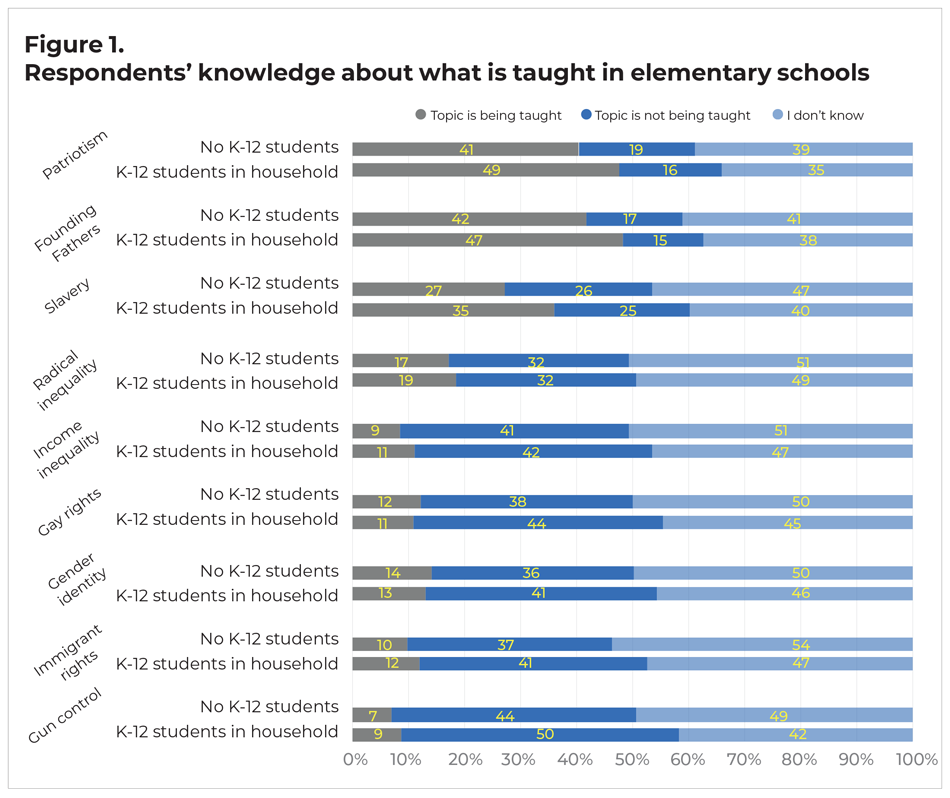
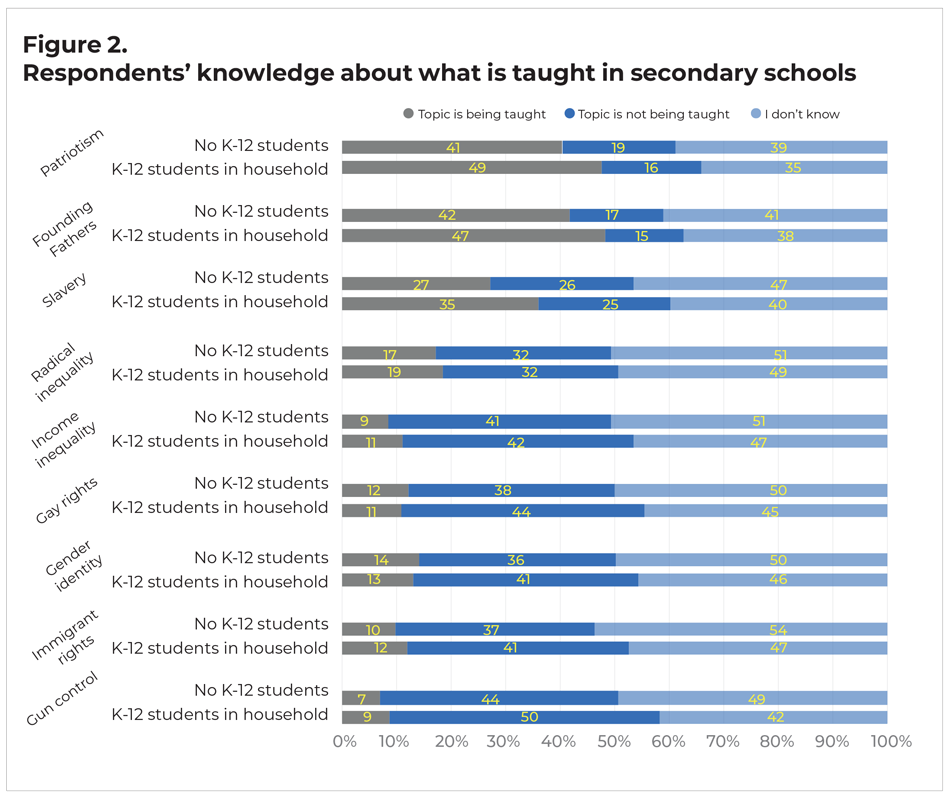
Figures 1 and 2 show results for a selection of items at the elementary level (Figure 1) and the secondary level (Figure 2), broken down by those who do and do not have K-12 students at home. On every item, almost half of our sample (46% on average) answered “I don’t know.” The same pattern held whether asking about elementary or secondary schools. The only topics that more respondents said they knew were being taught than said they did not know were “patriotism” and “contributions of the Founding Fathers” at both school levels and “slavery” at the secondary level. Americans were confident these topics were being taught.
Remarkably, results were not much better among households with children currently in schools than households without school-age children! Further, our results could be an underestimate of respondents’ lack of knowledge, because it’s reasonable to suspect some respondents would hazard a guess of yes or no when they actually didn’t know.
The topics we asked about were the subject of quite a bit of news coverage, controversy, and political contention. And the terminology we used was broad enough to encompass a variety of lessons and approaches. In this context, we expected a clear majority of adults would have a general sense of whether these topics are currently taught in school. And we certainly thought this would be so among parents with children in school.
Americans are unsure who influences what is taught
In 2022, we also asked adults to rank six different groups (parents, local school boards, teachers, school and district leaders, state leaders, and national leaders) according to how much influence they believe that group has over what is taught in public schools. Despite there being no single “correct” answer, the pattern of results suggests that respondents don’t know who has the most control.
Each of the six groups was ranked at the top by 10-20% of respondents. If we combine those ranked at 1 and 2 into a “high influence” category, 3 and 4 into a “moderate influence” category, and 5 and 6 into a “low influence” category, we still find no agreement about the relative influence of these groups (see Figure 3). Households with school-age children show the same pattern.

Americans admit not understanding issues that influence school policy
Public opinion about education policy can drive decision making, but members of the public do not always understand the issues under discussion. Our surveys show this dynamic at work in two issues that have received considerable attention in the news and among policy makers: school privatization and critical race theory.
Privatization of education
Privatization of schools is a policy issue with meaningful financial and practical implications. One might expect adults to have strong opinions about it, especially when it comes to whether the federal government should direct funds to improving public education or to increasing competition by supporting private school payments (e.g., through vouchers or federally supported education savings programs). While this trade-off is a common topic for debate on the political stage, and many polls cite partisan differences in support for vouchers, charters, or privatization, we wondered whether people really understood the arguments for and against these initiatives.
In 2024, we presented a series of questions about potential benefits and downsides of privatization, seeking to tap into adults’ underlying belief systems that, reasonably, might underlie their preferences for privatization, vouchers, or other such positions (Saavedra et al., 2024). We asked respondents to indicate their level of agreement with three statements that suggested the benefits of privatization (for example, “Competition for students ultimately makes public schools better”) and three statements that suggested the downsides (for example, “If students leave public schools for other types of schools, the quality of public schools will get worse”).
We were looking to see if responses reflected the same level of partisanship that polls detect when asking about policies related to the underlying belief. In other words, we wanted to know if Republicans would be more likely to agree with pro-privatization beliefs, and if Democrats would be more likely to agree with pro-public school questions.
What we did not expect to find was a high level of individuals reporting “I don’t know” rather than taking an agree or disagree position. Approximately one in five (18-24%) respondents answered “I don’t know” to these statements, conveying a lack of positioning on one or the other side of these important beliefs about education. The average percentage of respondents saying “I don’t know” was similar for households with (21%) and without (19%) K-12 students.
Critical race theory
In 2022, debate about critical race theory (CRT) in schools drove the passage of nearly 200 bills across 41 states (Young & Friedman, 2022). At the time, public opinion polls — both ours and others — showed massive philosophical disagreement by race and political affiliation about how the histories of Black Americans are taught in American public schools and about how much CRT permeates the teaching of these topics (Rogers et al., 2023). Yet when we asked in 2022 if respondents knew what CRT was, 36% answered that they had never heard of it, and another 15% acknowledged they had heard the term but did not know what it meant. That is, 51% of our nationally representative sample admitted they did not know what this hotly debated topic, influential to school policy, even was.
If respondents reported that they had some knowledge of CRT, we asked a series of eight follow-up questions about whether a series of statements “aligned” with critical race theory — a knowledge check of sorts. Fewer than 60% of the sample answered any of the items correctly. For example, almost two-thirds of respondents (62%) incorrectly believed that color-blindness is a core tenet of CRT, when in fact the opposite is true. Only 5% of respondents answered seven or eight of the questions correctly. This despite the fact that CRT was being covered endlessly in the news media at the time.
Again, respondents with a school-age child in the household performed no better on this knowledge task than those without children in school, with percentages getting each statement correct typically within 3 percentage points for the two groups.
Americans’ perceptions of student progress don’t align to experts’ analyses
We have repeatedly found disconnects between what parents say about their own children and what education experts are reporting about a given topic. Among our nationally representative sample of households, children likely have academic experiences that mirror national trends. But what we hear from our respondents does not track along with these national trends.
- Despite unprecedented learning losses in recent years that experts have shown in various ways (Kane & Reardon, 2023), our sample of households with K-12 children showed a sharp decrease in concern about academic performance in 2021, and that concern has stayed low ever since (Silver et al., under review).
- Despite state and national data showing 30% of students were chronically absent in 2021-22 and at nearly twice the pre-pandemic average in 2022-23 (Saavedra, Polikoff, & Silver, 2024), only 5% of our households reported absence rates that place their child on pace to be “chronically absent” by the end of the year (i.e., missing 10% or more instructional days).
- Among those parents whose children were on pace to be chronically absent, less than half (47%) expressed concern about it. Experts, on the other hand, consider the chronic absenteeism rate a “crisis” (Hess & Malkus, 2024).
We held in-depth conversations with a subset of 40 families in our panel to understand caretakers’ concerns, or lack thereof, about their children’s school progress (Polikoff et al., 2024). We consistently heard concern for “other people’s kids,” but not so much their own. For example, an elementary school parent said things were “worse for middle or high schoolers.” And a high school parent expressed the opposite sentiment, telling us, “Older children are a little bit more resilient just because the younger ones, their attention span is much, much less.”
One caregiver of a child living in a rural area said they thought learning loss would be worse “in bigger cities.” A parent of a student in a private school thought the problem was “worse in public schools.” Three upper-income households believed learning loss was more of an issue for students who were from lower-income families or attended less well-resourced schools. One caregiver who was able to work at home felt learning loss was worse for families in which caregivers worked outside the home. One caregiver of a native English speaker suggested learning loss was worse for children learning English.
In each of these ways, results from a nationally representative sample of adults are misaligned to what hard data are showing. How can we expect adults to have meaningful and useful input on education policy decisions if they do not have an accurate pulse on current trends in public education?
How adults learn about education issues
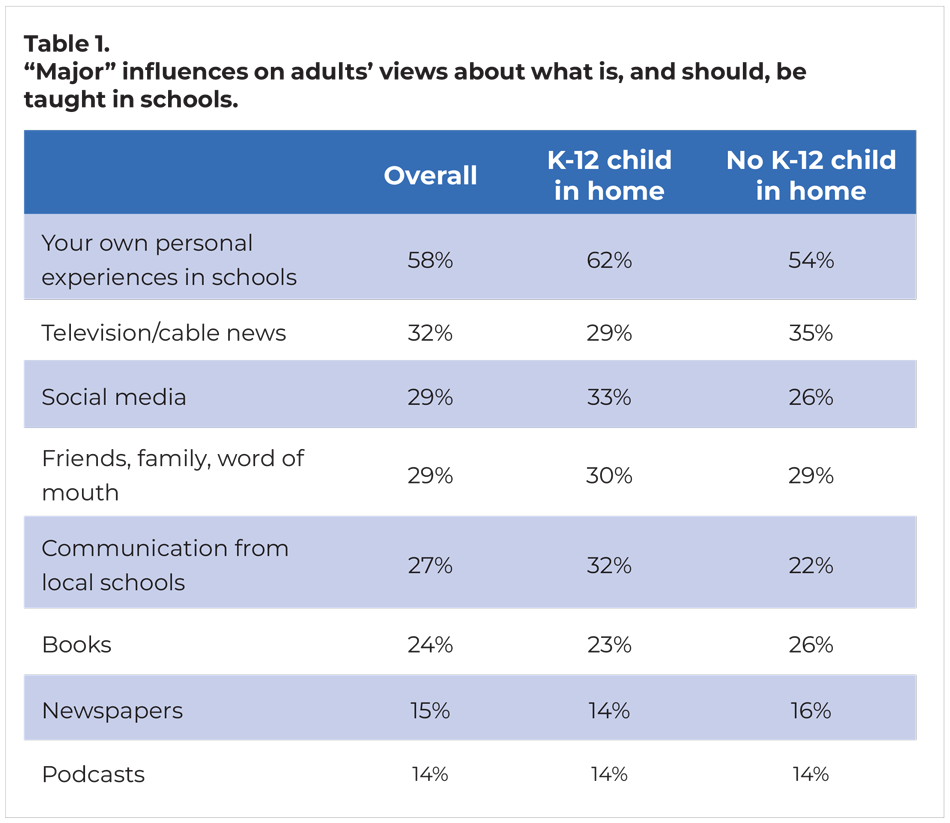
We were surprised that “your own personal experience” was the only influence — from a list of eight — that a majority of respondents (58%) acknowledged as a “major” influence on their views about educational topics” (Table 1). No other source of information was reported by more than one-third of respondents as being a major influence, not television/cable news (32%); newspapers (15%); books or podcasts (24% and 14% respectively); or even social media (29% overall).
Even more surprising, only 32% of households with a K-12 child in the home reported that “communication from local schools” is a major influence on their views and beliefs about the school curriculum! This was only slightly more than households without a K-12 child (22%). While these results help explain the lack of adult knowledge about education topics, where does this leave us?
We cannot expect parents — or adults more generally — to encourage, direct, guide, or lead children to needed supports and services if they are not receiving (or paying attention to) credible information. We cannot expect U.S. adults to push for the improvement of educational systems and programs if they aren’t aware of existing gaps in services or unmet needs in schools. Schools, educators, and the education system at large have a wide-open opportunity to communicate, educate, explain, and message. Knowledge is at (what seems like) a floor.
The power of information
Our research has shown that it can be quite easy to move people’s opinions and intentions about school-related issues simply by providing additional information. In one demonstration (Saavedra et al., 2024), we presented respondents with a hypothetical situation in which a parent wants to opt a child out of a history lesson “that contains content they disagree with.” The parent asks the teacher to find another activity for the child to do during the lesson. We asked respondents whether the teacher should provide a different activity for the child or whether the child should participate in the lesson.
We presented half of our sample with that description of the scenario, and 57% said the teacher should provide a different activity for that child. For the other half of the sample, we presented a few additional sentences, stating that learning about content they might not otherwise encounter helps children learn new perspectives and to think critically and that it can be hard for a teacher to accommodate every parent’s wish for every lesson for every child.
Schools, educators, and the education system at large have a wide-open opportunity to communicate, educate, explain, and message.
Among those receiving the additional information, only 41% agreed that the school should honor the parent’s request — a 16 percentage point reduction. Results did not differ depending on whether the respondent had a K-12 child living in their home, respondent partisan identification, or whether the hypothetical child was in 3rd or 10th grade.
A few years earlier, we demonstrated effectiveness of a similar light-touch information manipulation (Polikoff, Silver, Garland, et al., 2022). Among a subgroup of participants who were unsure about sending their child back to in-person school for the 2021-22 school year, presenting additional information about schools’ COVID-mitigation strategies and safety protocols significantly increased the tendency for caretakers to consider returning their child to in-person learning.
We must improve communication
Improving communication about what’s happening in schools is critical to the future of public education, which is itself critical to a healthy democracy. Parents and non-parents must be part of the conversation. Schools must provide clear and accurate information about the curriculum schools are using and children’s progress. Schools, policy makers, and researchers must establish a common language, simplify messaging, and leverage the power of visuals to communicate relevant information to parents and non-parents alike.
Parents and other adults have their role to play in cooperative, non-antagonistic communication with educators and during school board meetings. They need to be willing to listen to others, seek to understand differences in beliefs, and work productively toward compromise. The same norms for productive discussion we seek to develop in children also apply to adults, including educators and parents.
The responsibility for better communication does not lie solely with parents or solely with local schools. To improve our public education system, reduce academic achievement gaps, recover from COVID learning losses, and prepare students for a productive life, we need an educated voting public. To vote for school board leaders and state and national representatives who will best serve children’s needs, the public needs an accurate understanding of public education. Greater knowledge and awareness of what’s happening inside our school buildings is key to this understanding. And, just as we seek to teach our children to judge the credibility of information they encounter, so too must adults consider the pervasiveness of misinformation currently invading our world.
Filling the knowledge vacuum
Without clear knowledge, humans will make assumptions to fill in the gaps and make decisions accordingly. Social psychologists and behavioral economists have for decades researched cognitive processes that lead humans to make irrational judgments. For example, people tend to place greater value on something of their own compared to a similar item that is not theirs, or they tend to favor members of their own group over those outside of it. Such biases can easily explain the PDK Poll’s repeated finding that U.S. adults rate their own schools more highly than public schools in general (PDK International, 2022).
If we do not receive, review, and digest valid information about our local schools, it should be no surprise that we continue to favor “our” schools and “our” teachers, despite a general suspicion that the education system needs improvement overall. Widespread lack of knowledge, ongoing misinformation, and disconnects between the public and educators’ understanding of educational reality will ultimately limit the amount of time, money, and other resources the public will invest in its schools.
References
Hess, F.M. & Malkus N. (2024, February) Chronic absenteeism could be the biggest problem facing schools right now. American Enterprise Institute.
Kane T. & Reardon S., (2023, May 11). Parents don’t understand how far behind their kids are in school. The New York Times.
PDK International. (2022). The 54th annual PDK Poll: Local public school ratings rise, even as the teaching profession loses ground.
Polikoff, M., Rapaport, A., Saavedra, A.R., & Silver, D. (2024). The kids are all right? What parents really think about how COVID affected children. University of Southern California.
Polikoff, M., Silver, D., Rapaport, A., Saavedra, A., & Garland, M. (2022, October). A house divided? What Americans really think about controversial topics in schools. University of Southern California.
Polikoff, M.S., Silver, D., Garland, M., Saavedra, A.R., Rapaport, A., & Fienberg, M. (2022). The impact of a messaging intervention on parents’ school hesitancy during COVID-19. Educational Researcher, 51 (2), 156-159.
Rogers, J., Kahne, J., Ishimoto, M., Kwako, A., Stern, S., Bingener, C., Raphael, L., Alkam, S., & Conde, Y. (2022). Educating for a diverse democracy: The chilling role of political conflict in blue, purple, and red communities. UCLA’s Institute for Democracy, Education, and Access.
Saavedra, A.R., Polikoff, M., & Silver, D. (2024). Parents are not fully aware of, or concerned about, their children’s school attendance. Brookings Institution.
Saavedra, A.R., Polikoff, M., Silver, D., Rapaport, A., Garland, M., & Scollan-Rowley, J. (2024, February). Searching for common ground: Widespread support for public schools but substantial partisan divides about teaching potentially contested topics. University of Southern California.
Silver, D., Polikoff, M., Garland, M., Rapaport, A., Saavedra, A., & Fienberg, M. (under review). The evolution of caregiver concerns, child wellbeing, and availability of school-based recovery interventions during the COVID-19 pandemic. AERA Open.
Young, J. & Friedman, J. (2022). America’s censored classrooms. PEN America.
This article appears in the September 2024 issue of Kappan, Vol. 106, No. 1, p. 8-14.

ABOUT THE AUTHORS

Amie Rapaport
AMIE RAPAPORT is a research scientist and co-director of the Center for Applied Research in Education at the Dornsife Center for Economic and Social Research, University of Southern California.

Anna Rosefsky Saavedra
ANNA ROSEFSKY SAAVEDRA is a research scientist and co-director of the Center for Applied Research in Education at the Dornsife Center for Economic and Social Research and the director of research for the EdPolicy Hub at the Rossier School of Education at the University of Southern California .