In this week’s newsletter: Budget cuts and school closings. The rise and fall of Brockton (Massachusetts) High School. A look back at Chicago’s massive 50-school closing campaign. A long-awaited admission from the New York Times on pandemic school closings. And a pleasant thrift store surprise for NOLA.com’s Patrick Wall.
END OF ESSER + ENROLLMENT LOSSES
The big story of the week
The big education story of the week is the announcement of budget cuts, layoffs, and school closings due to the wind-down of federal COVID funding and longstanding enrollment losses.
School districts nationwide are confronting budget shortfalls (Sahan Journal, Mlive, WBUR, NPR, Houston Landing, OPB, News10, Shelburne News, San José Spotlight, Napa Press Democrat, Tacoma News Tribune).
In Ann Arbor, Michigan, officials must trim $25 million next year (Free Press, Michigan Public Radio). In Minneapolis, they’re grappling with a deficit of at least $110 million, largely due to the expiration of federal pandemic funds in September (Minnesota Public Radio). But after parents loudly complained, Minneapolis Superintendent Lisa Sayles-Adams reversed a plan to cut language programs for Somali and Hmong students (Sahan Journal).
Other big education stories of the week — and what makes them so important:
📰 SCOTUS ON SOCIAL MEDIA (AND SCHOOL BOARDS): In a case that arose in part from a San Diego-area school district, the U.S. Supreme Court ruled unanimously on March 15 that critics can sue public officials for blocking them on social media (Chalkbeat, S-D Union Tribune, EdWeek, KPBS, New York Times, NPR, Washington Post). School board trustees in Poway, California, had blocked online comments from a couple with children in the district. The case and others forced the high court to confront competing free-speech rights of public officials and their constituents. I’m curious what effect the ruling will have on officials blocking journalists.
📰 SCHOOL OFFICIALS LEFT UNCHARGED: Prosecutors in the Ethan Crumbley school shooting case are defending their controversial decision not to charge school officials despite having charged the shooter’s parents (Detroit Free Press, WXYZ Detroit, Detroit News, NBC News). The victims’ parents have called for school officials who failed to isolate the shooter or search his bag to be held accountable — though school officials other than SROs have not been charged in other recent cases like Uvalde and Parkland for reasons that may have something to do with a legal protection called “qualified immunity” (Outlier Media, The Atlantic).
A CLOSER LOOK AT A STRUGGLING SCHOOL
The best education journalism of the week
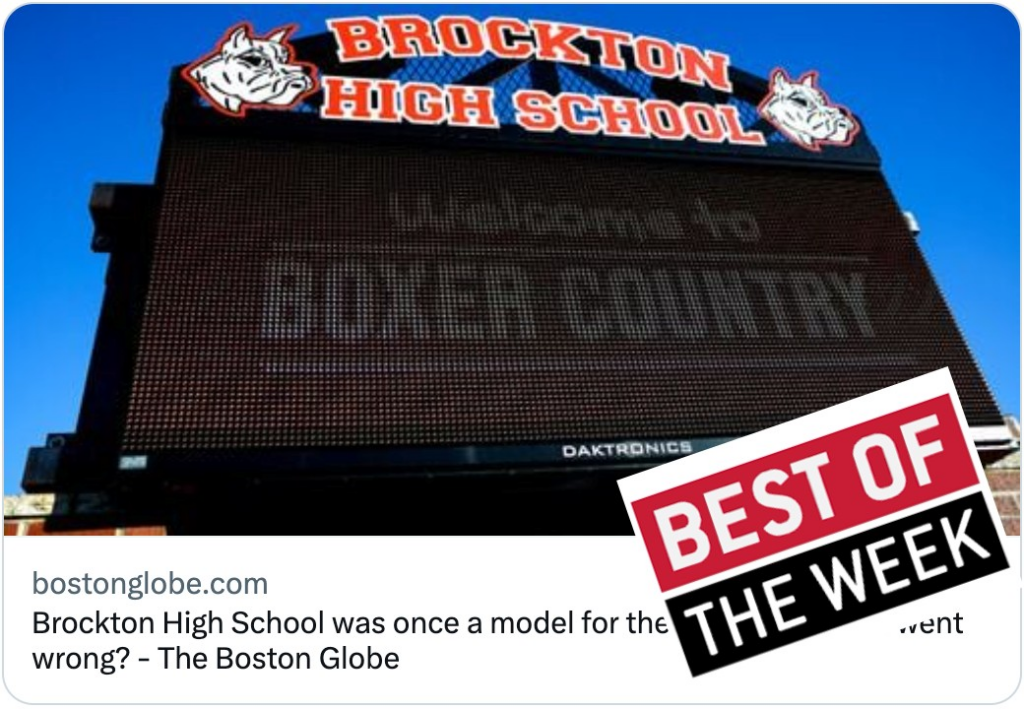
The best education journalism of the week is Brockton High School was once a model for the nation. So what went wrong? by Deanna Pan of the Boston Globe.
The piece tracks Massachusetts’ Brockton High School — once hailed as a national model in urban education — from its remarkable turnaround in the early 2000s to its present status as symbol of the public school system’s failings: a chronically understaffed and under-attended school where fights break out regularly.
The story’s chief merit is that it doesn’t dwell on the current media-fueled image of Brockton. Instead, it takes a step back to appreciate the school’s past accomplishments and asks what led to its current situation and how it could return to being a safe place for kids and adults.
Several successful programs from the past — including a schoolwide literacy initiative and a demerit system for dealing with poorly behaved students — eroded or were altogether abandoned with changes in school leadership.
Though it’ll no doubt be difficult, Pan makes a case that if Brockton studies those successes, it can rise out of its current struggles. As members of the Brockton community argue, remembering those halcyon days can be motivating. “We’re gonna get back there,” a local advocate said at a recent town hall organized by community groups. “We must get back there.”
See also this television piece on Brockton from WBZ-CBS Boston and our newsletter from a few weeks back, where we featured another Brockton story from Pan and her colleague Christopher Huffaker.
Other great stories of the week — and why we liked them:
🏆 Hannah Natanson and Susan Svrluga poll college counselors, policy professors, and young college applicants in this multi-layered report on the return of standardized college admissions testing and the variety of responses it has elicited, from anxiety to skepticism to thanks (Washington Post). Who knew that bringing back a mainstay would be so challenging and stressful?
🏆 In a story that’s comfortable raising more questions than it answers (and admirably so), Troy Closson zooms in on one New York City school to examine two big demographic challenges that sometimes collide: declining school enrollments and an influx of immigrant students (New York Times).
🏆 In this lucid breakdown of a wonky but important topic, Carolyn Jones assesses California’s decade-old experiment in decentralized school funding, highlighting its successes and offering solutions to the inequities that persist — for example, updating the state’s method of measuring poverty (CalMatters).
🏆 We hear long quotes from frustrated students and overburdened resource staff in this troubling Lisa Kurian Philip radio piece about how tough it can be for Illinois undergrads to get the on-campus mental health support they need (WBEZ).
🏆 Its tone is playful, but this Erica Breunlin story about the survival of snow days in Colorado despite the prevalence of virtual schooling offers some profound lessons about the importance of letting kids play — at least every once in a while (Colorado Sun).

CRIME BEAT & SCHOOL CLOSINGS
Our latest columns and commentary
On Monday, we published an interview with the Newmark J-School’s Cheryl Thompson-Morton (above left) about lessons for the education beat from rethinking the crime beat.
“Sometimes, the coverage might not be helpful because it oversimplifies complex problems, promotes certain agendas or biases, or ignores the voices and perspectives of the people most affected by the issues,” says Thompson-Morton, who among other things co-leads Poynter’s efforts to help newsrooms rethink their coverage.
On Wednesday, we published a first-person piece from the Chicago Sun-Times’ Lauren FitzPatrick (above right) about becoming a rookie education reporter when the district was implementing a massive school closing initiative.
“I was newly assigned to the education beat. I had zero insider sources. I was also pregnant with my first child,” recollects FitzPatrick in the latest of our new series on covering school closures.
Did you know that The Grade is on LinkedIn, Facebook, and Reddit?
PEOPLE, JOBS
Who’s going where and doing what
🔥 Sound-off: For years, freelance writer Audrey Watters warned of what she considered the empty promises of ed tech. After writing a book, she’s mostly on to other things these days, publishing a nutrition/exercise newsletter. But Watters took the time this week to lodge a satisfying “I told you so” about one-time ed-tech darling Udacity, which in 2015 was valued at $1 billion but sold recently for an undisclosed sum and was valued at about $100 million. A good follow by Watters in a sector where few bother to do so.
🔥 Civic Engagement: Kudos to Megan Menchaca at the Houston Chronicle for writing this basic but helpful explainer for people who want to speak at HISD board meetings. Among her tips: “Speakers must be ready to speak when their name is called, and they must stay on topic and refrain from naming specific people, especially students, according to HISD.” Good stuff. Also: Check out this helpful Washington Post interactive on how to file a Freedom of Information Act request with government agencies. It’s clear, concise, and fun to read. Nice job by a small team led by Nate Jones and Emily Joynton.
🔥 Impact: Nieman Lab profiles the “robust” five-year-old Sahan Journal, including extra efforts its journalists undertook — like partnering with community television and going on Facebook live. The article specifically calls attention to a Becky Dernbach story about a pioneering charter school that was set to close. Also: Dernbach shares “how community pressure + the power of journalism” came together to convince Minneapolis Public Schools to reverse cuts to heritage language programs.
🔥 Expansion: The Baltimore Banner plans an expansion into the Maryland suburbs with education part of its planned coverage, according to Axios. The Banner’s staff is now 125 strong, with the newsroom alone nearly doubling from 45 at launch to 80 today. Paid subscriptions are also roughly doubled, according to CEO Bob Cohn.
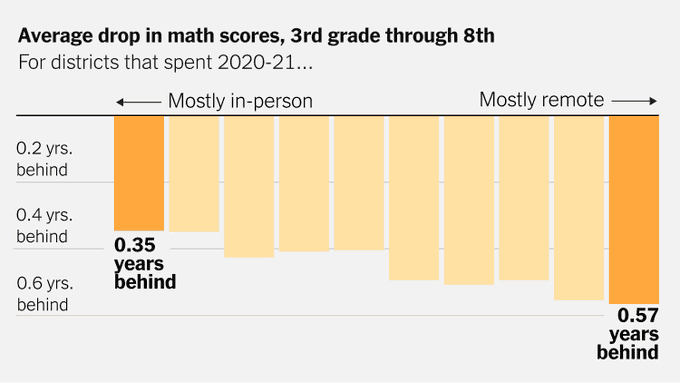
Above: “The more time students spent in remote instruction, the further they fell behind,” explains the New York Times. “And, experts say, extended closures did little to stop the spread of Covid.”
APPEARANCES, EVENTS, & NEW RESOURCES
What’s happening and new research
⏰ Segments, podcasts, & appearances: Riffing on the Times’ story (above), CNN’s Jake Tapper ran segment on the school shutdown debacle. After more than a year, a condensed version of Emily Hanford’s “Sold a Story” is now available in Spanish, also featuring a conversation with Hanford about Spanish-speaking children learning to read English in school. (Univision is set to post it to their site and their Noticias Univision podcast feed this weekend.) And NPR’s Throughline explores The Great Textbook War in a 47-minute segment.
⏰ ICYMI events: NBC’s Mike Hixenbaugh appeared in Grapevine, Texas, on Thursday to promote his new book They Came For The Schools.
⏰ New Research: Intensive tutoring helps academics and attendance, according to a new study written up by Chalkbeat’s Kalyn Belsha. Another new study unearthed by freelance reporter Laura McKenna finds that mindfulness programs that are costing schools a lot of money do not improve teen’s mental health. In response, The Atlantic’s Caitlin Flanagan shared a book that comes to a similar conclusion. Hechinger’s Jill Barshay covers a new IES study that finds only one in four federally funded i3 education innovations benefited students. At U.S. News, Steven Ross Johnson finds that health issues keep about 6% of K-12 students out of school, according to a new analysis.
THE KICKER
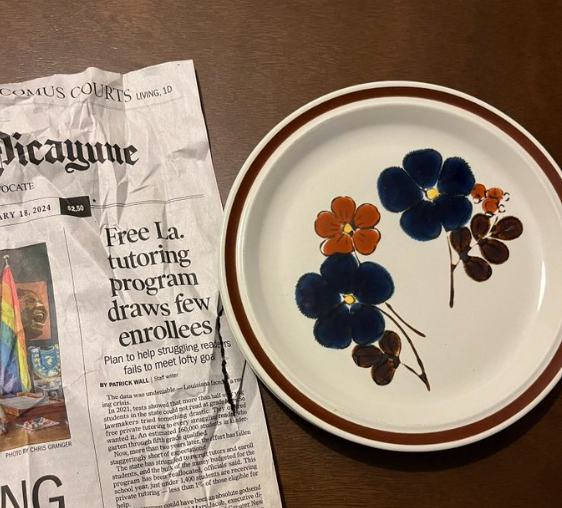
“Bought these plates at the thrift store today and the cashier wrapped them in newspaper,” writes NOLA.com’s Patrick Wall. “I’m going to assume they read it first 🤣”
ABOUT THE AUTHOR

Alexander Russo
Alexander Russo is founder and editor of The Grade, an award-winning effort to help improve media coverage of education issues. He’s also a Spencer Education Journalism Fellowship winner and a book author. You can reach him at @alexanderrusso.
Visit their website at: https://the-grade.org/