Covering reading instruction is tough — but you should still do it. And we can help!
By Naomi Martin, Boston Globe
When I first listened to the podcast “Sold a Story” by journalist Emily Hanford, I was blown away by her reporting on the pervasive discrepancies between what researchers know about how we should teach kids to read and how kids are actually taught.
As an education reporter at The Boston Globe, I figured we should investigate whether schools in Greater Boston were failing students in reading.
I naively thought it would be easy and straightforward. Ha!
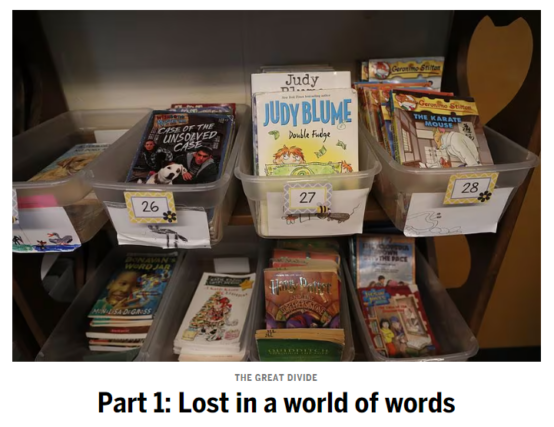
In January, 10 months after embarking on the project, my reporting partner Mandy McLaren and I published our full series, “Lost in a World of Words.” It explored flawed reading instruction in Massachusetts and the harm it causes families. Among the facts we revealed: more than half of Massachusetts third graders don’t meet the state’s proficiency benchmark for reading. Almost half the state’s school districts used reading curriculums last year that experts and the state itself deem “low quality.” The state’s wealthiest school districts are more likely to use low-quality curricula and often have larger reading achievement gaps than less affluent districts. And nearly 80% of teenagers who fall short of the state’s bar for 10th Grade English-Language Arts proficiency are from low-income families.
This was tough reporting and writing, but it’s the most rewarding thing I’ve done in my nearly 15- year career. After all, as parents repeatedly told us, what’s the point of school if you can’t read?
We’ve already seen some impact: Gov. Maura Healey announced a five-year plan to improve reading instruction, starting with a $30 million budget proposed for next year to boost teacher training. And parents in some school districts we spotlighted are pushing with renewed vigor for changes to reading instruction, prompting officials to signal they’re taking these complaints more seriously now.
However, discerning the key elements of low-quality literacy instruction was much more complicated than I had expected. Here’s what I learned — along with some resources that you might find helpful in your work. But first: Deep breaths. There’s no need to feel intimidated or overwhelmed.
It’s the most rewarding thing I’ve done in my nearly 15-year career.
I thought it would be simple to distinguish between high-quality and low-quality reading instruction. Turns out, teaching reading is mind-bogglingly complex. We decided to use Massachusetts’s own labels for low-quality reading curricula. (If your state doesn’t create such labels, you could use EdReports.)
Nearly all schools incorporate some phonics, so you can’t rely on phonics alone to be the differentiator. And we found many schools with low-quality reading curricula also employed supplemental high-quality phonics programs, so we had to clarify what was wrong with that.
Additionally, we heard over and over that curriculum matters, but it isn’t the only factor that affects reading proficiency. Other key factors include teacher training, lower educator expectations for disadvantaged kids and kids of color, school understaffing, inadequate reading interventions, and disparities in kids’ home lives — such as whether their parents could afford private tutors.
Another difficulty arose once we received school districts’ responses on what curricula they used. We wondered whether schools using low-quality reading curricula would have lower test scores or higher achievement gaps than others. But the data didn’t support that. One explanation: many schools using curricula that were not considered low-quality were still teaching guessing habits and other techniques similar to those from the low-quality curricula. Also, some districts that had purchased highly rated curricula had done so recently, and it can take years to shift teacher practices and see the results in third-grade test scores.
And while lots of research has shown how the brain learns to read, there aren’t great studies pointing to which curricula work best.
Through interviews with teachers, parents, students, and experts, we distilled three key problems happening in classrooms using low-quality curricula: some teachers were essentially prompting kids to guess at unfamiliar words rather than sounding them out; lessons weren’t building kids’ vocabulary and background knowledge of real-world topics enough to help them understand texts; and schools were often spending too much time on independent reading (sometimes called “workshop”), which was unhelpful for struggling readers.
We also had to repeatedly persuade hesitant sources to stay in stories. Many didn’t, but enough did. The biggest point we made to them was that sharing their personal stories could help bring about changes that help future generations of kids.
We had to repeatedly persuade hesitant sources to stay in stories.
Reporting wasn’t just about tackling challenges. We enjoyed exciting moments, too, like watching kids learn using lively classroom curricula. During one literacy lesson focused on pollinators, two girls earnestly planned a butterfly garden for the school courtyard. I also found it helpful to sit and listen to a 17-year-old practice reading aloud articles about vintage cars, his favorite topic. He misread so many words that foiled his understanding. That scene ended up being a key part of our story on teens who’d been failed because it showed just how hard it was for him to read. And it was wonderful to hear in January, after his parents had fought for years, that his school district finally agreed to pay for the specialized private tutoring an expert said he needed.
Here are some tips to help more journalists cover literacy. We found Google form surveys to be powerful ways of collecting potential sources and information. We distributed our Google forms for parents and teachers by posting on various Facebook groups and handing out fliers with a QR code on it at playgrounds, school dismissals, and literacy conferences. The fliers told people the Globe was interested in people’s experiences with reading instruction.
We found Google form surveys to be powerful ways of collecting potential sources and information.
Some sources, tools, and techniques that helped us:
- Local reading researchers, literacy professional development organizations, and reading specialist associations — not just talking to them about their work, but also what they’re seeing in their own kids’ schools.
- Teachers whom we allowed to remain anonymous so they could speak freely.
- EdReports, a website that rates curricula and explains why they’re deficient and how.
- Facebook groups for parents in specific towns and cities.
- Facebook groups for parents of dyslexic children and children in special education.
- A Google form survey that Mandy smartly made for school district superintendents to fill out to tell us what reading curricula they used. We said if they didn’t reply we would file a public records request and got nearly all to respond. We found a list of all superintendent emails on their association’s website.
- Another Google form survey for parents and teachers.
- Another Google form survey for parents of dyslexic children, which we posted in their statewide Facebook group (Decoding Dyslexia MA), circulated on district special education parents’ listservs and got tons of responses.
- More ways we found families:
- We visited playgrounds and schools at dismissal and talked to parents of early elementary students.
- School districts’ special-education parents’ groups.
- Special-education lawyers.
- Lawyers with legal aid groups that represent low-income students and students with disabilities and work to disrupt the school-to-prison pipeline.
- Posted prolifically on Facebook groups.
- Asked everyone we talked to whether they knew anyone else.
- Tutors and reading programs connected us to some of their participants.
- Groups for literacy and dyslexia.
I’m grateful to Mandy, a former teacher who investigated reading instruction in Kentucky before joining the Globe, for being the absolute best teammate I could’ve asked for. We’re happy to help journalists covering this complex issue. If you have any questions, you can reach us at naomi.martin@globe.com and mandy.mclaren@globe.com.
Naomi Martin was until recently a reporter on the education team at the Boston Globe. She is now an editor in the Globe’s Business section. You can see her work here.
MORE FROM THE GRADE
What’s next for literacy coverage in 2024? (Karen Vaites)
Why reporting on literacy is so hard — and tips for making it easier (Mandy McLaren)
A new effort to promote high-quality literacy coverage (Emily Hanford)
A low grade for literacy coverage (Susan Neuman)
Why reading went under the radar for so long (Alexander Russo)
How I missed the phonics story (Patti Ghezzi)
How to report on whether district reading programs are any good (Colleen Connolly)
Beyond “Sold A Story” (Natalie Wexler)
Cracking the code on reading instruction stories (Holly Korbey)
ABOUT THE AUTHOR

Alexander Russo
Alexander Russo is founder and editor of The Grade, an award-winning effort to help improve media coverage of education issues. He’s also a Spencer Education Journalism Fellowship winner and a book author. You can reach him at @alexanderrusso.
Visit their website at: https://the-grade.org/