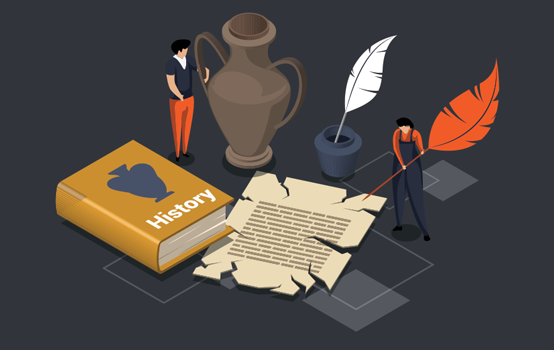
Beneath the current turmoil over book bans, Advanced Placement history courses, and teaching about race and slavery, there lurks a sobering fact about historical knowledge: History is not only about what happened in the past (its substance) but also about how we know it (its method). Understanding history means grasping both. Like the wings of an airplane, neither works alone.
Learning to make evidence-based claims and to evaluate the claims made by others — pundits, textbook authors, presidents, teachers — is the overarching purpose of teaching history in school. But studying history also centers on finding out what happened in the past. That’s where the two wings, substance and method, join: knowing what happened and knowing how we know it.
Evidence-based reasoning is the modern world’s go-to method for deciding between fact and fiction. We can interview eyewitnesses or examine primary and secondary documents and artifacts. We can make disciplined observations in labs and conduct experiments. Whatever facts are gathered, we double-check them and scrutinize competing accounts. This is corroboration. The methods are dedicated to error-seeking. The seekers, operating in good faith, are open to being proved wrong. The scientific method and democracy have this much in common.
When someone tells us an outrageous story, we ask, naturally, “How do you know that’s true?” Historical knowledge, never to be confused with memory, is disciplined by its method. If students are asked simply to memorize information about the past, rather than investigate it, then they have not learned to distinguish historical claims from myths, legends, and lies. As history education researchers Keith Barton and Linda Levstik (2004) note, students are then susceptible to any outrageous story they may be told.
Seeking truth
I was recently on a tour of Israel and Jordan where the two wings of history were in an endlessly fascinating mashup. My travel mates and I often asked one another, Did this event (substance) really (method) happen? We may have been looking at Moses’s tombstone in Jordan on a hill overlooking the Promised Land. Or at the ruins of Mary and Joseph’s home, now beneath a church in Nazareth. From a religious standpoint, the answer is a matter of faith. But from a historian’s standpoint, it’s a matter of empirical method. Historians seek evidence and then hold it up to public inspection so it can be sourced, fact-checked, and corroborated. Students learn these methods from their history teachers.
Historians seek evidence and then hold it up to public inspection so it can be sourced, fact-checked, and corroborated. Students learn these methods from their history teachers.
This kind of reasoning doesn’t come easily. History education researcher Sam Wineburg (2001) calls it an unnatural act because it requires you to see events and human beings from the past on their own terms, in their own time and circumstances, not yours. Doing the opposite, called presentism, is ubiquitous today in everyday life and in politics, on both the left and the right. As historian Katherine Epstein (2023) says, this tendency represents a failure to set one’s own ego aside in order to see the world through someone else’s eyes. It is, at heart, a kind of narcissism.
Which takes us to former President Donald Trump. When Trump said after his recent surrender to Georgia officials in one of his court cases, “I did nothing wrong, and everybody knows it” (McKay & Queen, 2023), he was making two claims. The first — “I did nothing wrong” — is questionable, obviously, and its truth needs to be determined. That’s what a trial will do, help us get at the facts. Judgments about those facts are needed, too; that’s why there’s a judge and jury. Trump’s second claim, after the comma, is plainly wrong. Everyone reading this knows somebody who believes Trump did something wrong. In other words, there’s plenty of evidence that “everybody knows it” is false.
We should recognize that Trump represents each of us in at least one way. Without the skills and habits of historical reasoning, our thinking becomes unschooled and undisciplined. Our minds become places where anything goes, rules be damned. We view the past through the lens of the present. And we speak from the gut rather than reason, caution, and humility.
Thank you, history teachers
Because historical reasoning is difficult, we teach it in school. Any decent school system’s K-12 curriculum documents will display the scope-and-sequence plan. And we expect college students to study it further. Why? People who cannot think historically cannot know the past nor the present, nor themselves, let alone sustain a democracy and help it thrive. A democracy has recognized procedures and shared criteria for determining what’s true, or else it doesn’t last.
So, thank you, history teachers. Thank you for teaching young people the rules of evidence; to compare multiple accounts; to dig deeper into who wrote them, why, and in what context. These methods require thinking. And thinking, let’s be frank, is hard for humans. We are biased and have already made up our minds, we have egos, we are anxious, and we are easily seduced by demagogues who appeal to these inherent frailties.
But history teachers, you work to help us do otherwise, to be disciplined and sensible, to think. Please, stay strong.
References
Barton, K. & Levstik, L. (2004). Teaching history for the common good. Routledge.
Epstein, K. (2023). Scholarship and the future of society. Liberties Journal, 3 (4).
McKay, R. & Queen, J. (2023, August 25) Trump’s mug shot released after booking at Georgia jail on election charges. Reuters.
Wineburg, S. (2001). Historical thinking and other unnatural acts. Temple University Press.
This article appears in the February 2024 issue of Kappan, Vol. 105, No. 5, p. 66-67.
ABOUT THE AUTHOR

Walter C. Parker
WALTER C. PARKER is professor emeritus of social studies education at the University of Washington, Seattle. He is the author of Education for Liberal Democracy: Using Classroom Discussion to Build Knowledge and Voice .