In this week’s newsletter: Districts report a surge of positive test score results. Lower enrollments threaten school closings. Schools struggle to catch kids up without overwhelming them. Inadequate coverage of literacy remains a problem. And the LAist ed team shows the rest of us how a group selfie should be done.
BRIGHT SPOTS
The big story of the week
The big education story of the week is the surge of promising test score results being reported by districts including Denver, Chicago, Clark County (Las Vegas), and Massachusetts — a surprising bright spot to take into the new school year (Denver Gazette, Chalkbeat Chicago, Las Vegas Review Journal, Boston Herald, WBUR, Boston Globe).
“It’s not all doom and gloom,” writes AL.com’s Trish Crain, who reported one of the stories featured in the innovations section below. “There are actually a lot of bright spots. It just depends on which lens you’re using.”
To be sure, scores aren’t up a lot, in both math and reading, or everywhere. In many cases, they aren’t yet back up to where they were pre-pandemic and won’t be anytime soon without a big push in 2023-24 (Oregonian). “At the rate of improvement seen from 2022 to 2023,” notes the Globe, “it would take eight more years for students to fully recover to their pre-pandemic achievement levels.”
More big stories of the week:
📰 LOOMING SCHOOL CLOSINGS: With falling enrollment becoming a widespread problem for districts across the country, officials are — reluctantly — considering closing schools (San Francisco Chronicle, Texas Tribune, San Antonio Report, EdSource). Expiring federal funding isn’t helping (NY1). But it’s not all bleak. After years of declining enrollment in Chicago Public Schools, the district announced enrollment is now stable — in part due to the influx of migrant students (Chalkbeat Chicago, Sun-Times). And at least some small schools are holding on, despite dwindling enrollment (SF Chronicle).
📰 STUDENT BEHAVIOR SOLUTIONS: Educators have been sounding the alarm on an increase in student behavior problems since the pandemic, and the problem hasn’t gone away this school year (Post and Courier, LA Times). But some schools are finding better ways to deal with it and help students. In New Jersey, schools are trying things like cell phone bans to prevent cyber bullying after two suicides last year (NJ.com). In Minnesota, a former principal created a program for students and teachers to help emotionally isolated kids who are prone to acting out violently (MinnPost). And in Seattle, one school has started the year with anti-violence workshops (Seattle Times) — a story that’s one of our top innovation picks further down.
📰 FL VOUCHER EXPANSION: This week’s most surprising story is that the growth in the Florida voucher program turns out to have been less than many predicted — “an expansion, not an explosion,” according to one headline (Miami Herald, WJAX, WUSF). However, the growth has been substantial and some parents have yet to see voucher money from the state (Tampa Bay Times).

A TRICKY JOB AHEAD
The best education journalism of the week
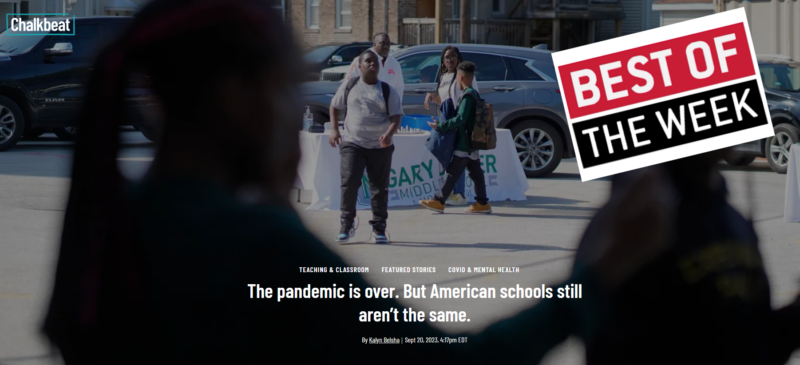
The best education story of the week is Kalyn Belsha’s The pandemic is over. But American schools still aren’t the same, which features vivid classroom reporting and a nuanced storyline.
“On a recent Friday at Gary Comer Middle School in Chicago, you had to squint to see signs of the pandemic that upended American education just a few years ago,” writes Belsha. But “beneath the surface, profound pandemic-era consequences persist.”
Some examples from the Chicago middle school that is the focus of the piece: 7th graders are reviewing 4th-grade math. Sixth graders aren’t being docked for spelling and grammar mistakes. Fridays are reserved for elective courses.
Full of firsthand observations of classroom learning, this story gives the larger pandemic recovery overview and provides relevant statistics. But its strength is the classroom details and dialogue. Stories like these illuminate the challenges and successes going on in schools and make readers hungry for more in-school education coverage. Big thanks to Belsha and her editors!
Other great education stories this week:
🏆 This S.F. public school has only 11 students. Here’s why SFUSD hasn’t closed it (SF Chronicle)
🏆 These Wisconsin programs are cracking the code on lowering preschool suspensions, expulsions (Journal Sentinel)
🏆 Thousands of migrant kids are starting school in NYC. Is the system prepared? (NPR)
🏆 ‘I Literally Cried’: Teachers Describe Their Transition to Science-Based Reading Instruction (EdWeek)
🏆 After more Oregon students failed classes during the pandemic, state takes another look at ‘equitable grading’ (Oregonian)
🏆 In Virginia, a battle over history standards ends in compromise (Hechinger)
🏆 Drugs in Schools: Beyond Punishment (Palabra) From Sept. 4
🏆 The Agony of the School Car Line (The Atlantic)

SLO-MO LITERACY COVERAGE
Our latest columns and commentary
“I’m thrilled that ‘Sold a Story’ has had the impact that it has, but the fact that it hasn’t yet moved the needle for my own kid’s school is really disappointing.”
That’s NYC parent Lee Gaul, whose daughter Zoe was featured in the blockbuster podcast, but whose school still uses balanced literacy. As you’ll see in this week’s interview — the third installment in our current series on the need to improve literacy coverage — Gaul has been deeply frustrated by what he sees as a lackluster NYC media response to the crisis.
“I think that the education of children and their ability to read is one of the most profoundly important topics anyone should be interested in,” says Gaul. “If you view it in that context, I think it’s been deeply under-reported.”
Next up: Essays from APM Reports’ Emily Hanford, the Boston Globe’s Mandy McLaren, and NYU literacy education professor Susan Neuman.
LONGER DAYS = BETTER MATH SCORES
Coverage of promising school innovations & signs of progress
💡 This clearly written, data-driven piece tells how Piedmont City schools improved math scores by lengthening the school day so that teachers could spend more time analyzing student progress and delivering small-group instruction (AL.com/Education Reporting Collaborative).
💡 With vivid quotes and memorable characters, the warehouse floor of a vocational school in Colorado comes to life in this story about a model for equipping autistic students with job skills that takes fuller stock of their abilities than programs of the past (Colorado Sun).
💡 Produced by a pair of health journalists, this story combines student anecdotes, a careful research rundown, and a political narrative into an engaging and informative report about a promising approach to improving girls’ mental health (Side Effects Public Media/WFYI).
💡 This detailed profile of a first-of-its-kind high school in Colorado that doubles as a day clinic for students with serious mental illness walks readers through everything from the school’s political approval process, its joining of two systems — education and health — and the therapeutic aspects of its physical design (Colorado Public Radio).
💡 Set within an anti-violence training program at a Seattle-area high school, this short piece presents an alternative to more threatening ways of enforcing campus safety (like metal detectors and more security guards) and describes the emotional state of teenagers as they enter their fourth school year since the pandemic started (Seattle Times).
Read more about the importance of covering promising innovations and preliminary successes.

PEOPLE, JOBS
Who’s going where and doing what
🔥 Career moves: Yana Kunichoff is leaving the education beat and the Arizona Republic — not the Star as I mistakenly reported last week 🤦♂️— to cover the Senate race for Arizona Luminaria. Longtime Chicago education journalist Maureen Kelleher has a new job as editorial director at FutureEd. Known for his education investigations, the New York Times’ Brian Rosenthal is joining the Times’ national investigations desk. (His recent marriage also got the NYT treatment.) And EWA has announced two new additions to the team: former Teach for America editor-in-chief Steph Smith as content director and former Open Campus higher ed reporter Naomi Harris as content manager.Congrats to all!
🔥 Soundoff: Decaturish’s Dan Whisenhunt talked to us recently about the difficulty of covering local school boards, despite the importance: “Covering the meeting is a real hassle. … It’s quite costly to have a reporter spend hours a day at a meeting that may produce only one or two stories.” Nonetheless, Whisenhunt has hired freelancer Jaedon Mason for the job in DeKalb County, and his first story, published last week, followed a nine-hour school board meeting.
🔥 EdWeek union: The EdWeek staff’s efforts to unionize got a write-up in LaborPress, where reporters Sarah Schwartz and Mark Lieberman said equitable pay, transparency in salary decisions, and family leave were some of the driving forces. In an X thread, Schwartz called the leadership response — including invoking the congresswoman Shirley Chisholm to discredit union efforts — “incredibly disappointing.” Recall that Chalkbeat management did not block attempts by its reporters to unionize.
🔥 Throwback: In honor of Hannah Dreier’s excellent new New York Times story about migrant kids working the night shift, take a look at this 2018 interview in which Dreier tells The Grade contributor Kristen Doerer about her careful approach to reporting on immigrant kids and the systems that are supposed to watch out for them.

APPEARANCES, EVENTS, & NEW RESOURCES
What’s happening and new research
⏰ Teen social media: Check out the splashy New York Times feature on what it’s like to be 13 in the age of social media. The Boston Globe has a similar interactive on teen life and Anya Kamenetz talked to 65 teens about how they feel about being online for New York Magazine’s The Cut. Meantime, some Massachusetts schools are restricting cell phone use during school.
⏰ Appearances: WBEZ Chicago’s Sarah Karp and the Chicago Sun-Times’ Lauren FitzPatrick were on the podcast “Notes from America with Kai Wright” (distributed on NPR) talking about the legacy of Chicago shutting down 50 schools 10 years ago. The AP’s Bianca Vázquez Toness was on Diane Rehm’s “On My Mind” podcast talking about the lingering effects of the pandemic on schools. CalMatters’ Carolyn Jones, ProPublica’s Nicole Carr, and others were on the “KQED Forum” podcast talking about the debate over whether parents should know if their children are trans. WFYI’s Dylan Peers McCoy was on WBUR’s “Here & Now” talking about the growing backlash to mental health care in Indiana schools. New York Times science and health reporter Apoorva Mandavilli was on Wisconsin Public Radio explaining how schools can avoid remote learning as seasonal viruses spread. And Chalkbeat national news reporter Kalyn Belsha was on EWA Radio, where she shared her big stories for the new academic year.
⏰ Movies, books, & documentaries: Former NYT education reporter and past contributor to The Grade Jenny Anderson is writing a book about the science of motivating teens. PBS recently debuted a two-hour “American Experience” documentary on “The Busing Battleground” in Boston, an event the Boston Globe says “continues to feed the notion that Boston … is fundamentally racist.” A new independent fictional film called “The Teacher’s Lounge” debuted at the Toronto International Film Festival and is described as “a sobering rebuke to the fantasy of inspirational teacher movies like ‘Dead Poets Society.’” Anyone seen it yet?
⏰ Upcoming events: The Baltimore Banner is hosting a live in-person event next week with Joyce Abbott, the teacher who inspired the hit show “Abbott Elementary.” Also next week, EWA is hosting a “lunch and learn” event in Washington, D.C., with members of the American Educational Research Association’s Postsecondary Division. Coming in October, the National NewsLitCamp and Report for America are leading a workshop for educators on how to integrate news literacy into their classrooms. EWA announced its 77th annual seminar, which will be held in Las Vegas in late May next year. And in case you missed it, Morehouse College screened “The Right to Read” documentary earlier this week for the Morehouse College Human Rights Film Festival.
⏰ Reporter resources: If you haven’t already, subscribe to Ballotpedia’s newsletter Hall Pass, where they’ll cover school board elections in 16 states in November. Covering AI in the classroom? Check out this Education Next report with an 8th grader’s review of Khan Academy’s AI-powered tutor, Khanmigo, for a unique perspective. And check out this EWA post about covering rural education issues, with great advice from the Hechinger Report’s Nichole Dobo and The Markup’s Tara García Mathewson.
THE KICKER

That’s all, folks. Thanks for reading!
Reply to this email to send us questions, comments or tips. Know someone else who should be reading Best of the Week? Send them this link to sign up.
Using Feedly or FlipBoard or any other kind of news reader? You can subscribe to The Grade’s “feed” by plugging in this web address: http://www.kappanonline.org/category/the-grade/feed/.
Read more about The Grade here. You can read all the back issues of The Grade’s newsletter, Best of the Week, here.
By Alexander Russo with additional writing from Colleen Connolly, Will Callan, and Greg Toppo.
ABOUT THE AUTHOR

The Grade
Launched in 2015, The Grade is a journalist-run effort to encourage high-quality coverage of K-12 education issues.