A survey of teachers reveals a surprising reason teachers consider leaving the profession and what school leaders can do to help.
News about teacher shortages is ubiquitous. Much of it focuses on issues of high stress, testing, pay, politics, and the myriad of other challenges teachers face (Schmitt & deCourcy, 2022). The pandemic drove many educators from the profession by changing the definition of schooling itself (Marshall, 2022). Whether learning took place online, in person, or some combination of the two, the job of being a teacher during COVID-19 became even more challenging than before.
However, the pandemic also revealed the qualities that have always kept great teachers in the classroom: connection, care, and growth. Beneath the shadow of very real concerns about shortages and turnover, the essential motivation among teachers remains firm.

Teachers weigh in
For three years, we interviewed more than 40 teachers and conducted a representative survey of more than 550 teachers in Alabama to understand what was driving attrition and shortages (Pendola, 2022). Our findings surprised us.
The conditions that lead to teacher turnover, such as inadequate resources, time, and support, have long been known (Nguyen et al., 2020). However, the choice to leave a job is rarely just about these kinds of workplace conditions. It also stems from a psychological sense of dissatisfaction (Hom & Kinicki, 2001). Narratives about teacher shortages often overlook how school conditions create value conflicts within teachers — tensions between what they hope to do in the classroom and what they feel they actually can do (Wang & Hall, 2019). That’s the story we found in our research. The Alabama teachers’ main source of unhappiness was not disappointment with material conditions, policies, or administration. Instead, it was that their abundance of care, heart, and hope for teaching had become painful when stymied.
Reframing teacher turnover from a problem of limitations (as in a lack of resources) to a problem of abundance (of teacher dedication) offers an important shift in understanding how to retain our best teachers. Instead of focusing on limitations that are often out of our control, we need to focus on motivation factors (Herzberg, 1966) to build on the existing abundance of teacher dedication — namely, by allowing teachers to devote their time to teaching. This can motivate great teachers, improve retention, and ultimately provide the best environment for student growth and success.
What motivates teachers to stay?
Many studies have considered what drives teachers to leave the profession, but so often, those conversations and questions center on readily identifiable problems (Madigan & Kim, 2021). These include unsupportive administration, lack of resources, student discipline problems, and planning time interruptions (Buck, 2023; Marshall et al., in press; Pressley, 2021). After talking with teachers at length about what was driving high levels of attrition, we got the sense that, while the standard litany of issues was certainly prevalent, something else was going on. So many teachers were hesitant, felt the need to apologize, or prefaced any negative statement with “I love my kids but…”
We decided to change the conversation by asking teachers what kept them in the classroom, even during the disruptions of the pandemic. Postures shifted and their responses came more naturally. For example, Cheryl, a 9th-grade language arts teacher in a predominantly low-income rural school stated:
I love my kids, and I really do work hard every day to make learning fun — I spend a lot of hours working after school and at home. But I do all this for those smiles and aha moments with my students, no matter what is going on. It’s worth everything in the world to me.
We then asked what was hard for her:
I’m doing the best I can with what I have, but there’s just not enough time. And I don’t want to spend it giving out a worksheet so I can fill out assessment report after assessment report. I want to spend it doing new lessons and games and helping and watching students find themselves. That . . . that part really gets to me.
Cheryl was not as bothered by what she didn’t have, in terms of material rewards, as much as she was by what she wanted to do for her students but felt she couldn’t.
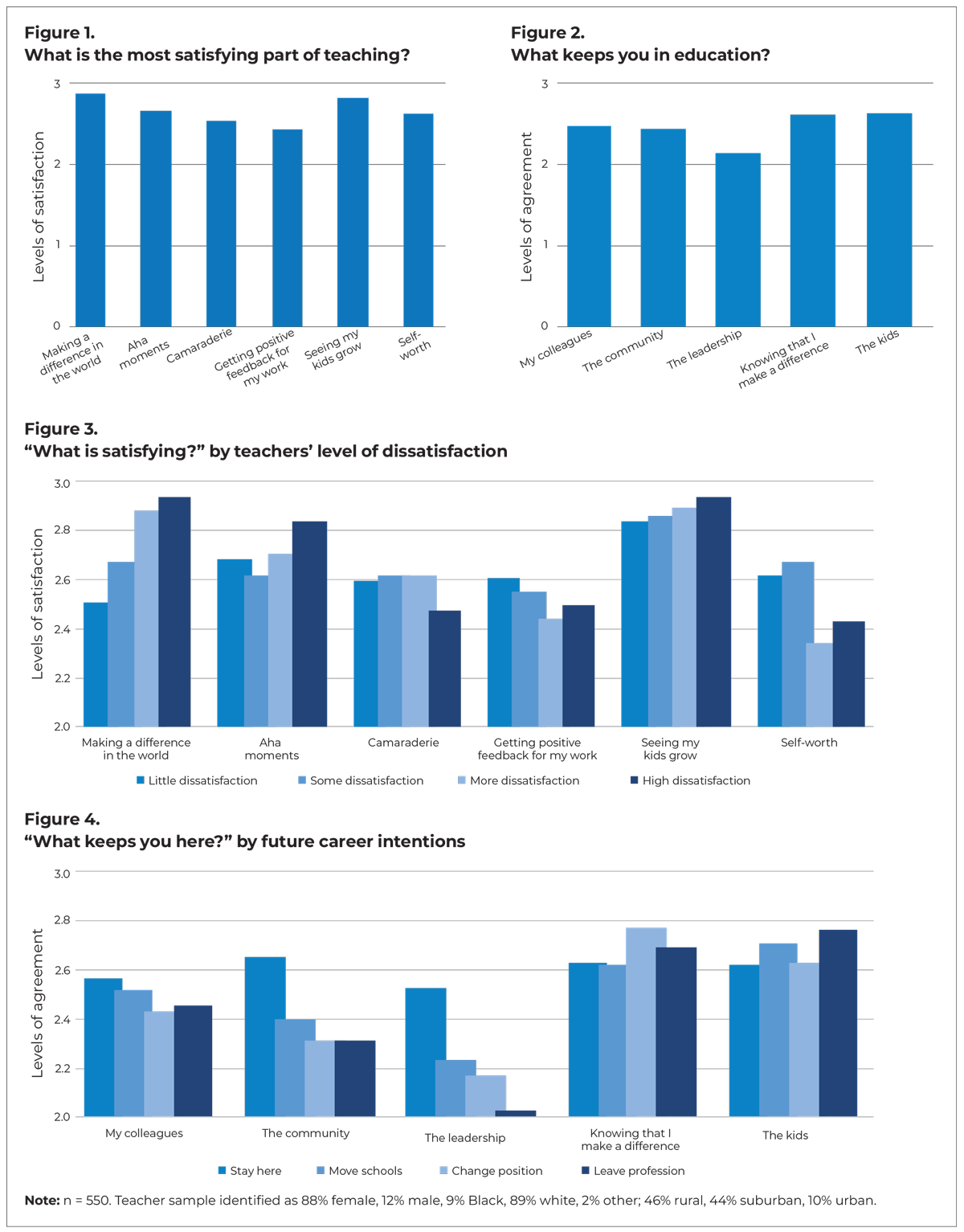
After our interviews, we surveyed about 550 teachers across the state to see if we were dealing with a problem of limitations or a problem of abundance. We first asked, “What is the most satisfying part of teaching?” The responses in Figure 1 show that the sense of “making a difference” was generally the most highly rated source of satisfaction, followed by “seeing others grow.” This trend was generally stable across teacher gender, race, and locale.
For example, 3rd-grade teacher Nicole answered that the most satisfying thing about her job was: “My students’ faces when they’re actively engaged, that’s the magic. I love hearing their thoughts and ideas. . . . The feeling right there, no money is going to buy that.”
Next, we asked teachers, “What has kept you in the classroom?” Teachers said that their students and “knowing that I make a difference” were the elements that most motivated them to stay in teaching, followed by colleagues, the community, and school leadership (Figure 2). Again, we saw a strong commitment to student relationships and to the feeling of making a difference. Douglas, a 6th-grade social studies teacher, responded:
I stay because I get to build these learners who are curious about the world and hungry to learn more. I just ran into a former student at the bookstore and know they still love reading. It’s like I get to pass on my own passions to the next generation, to build a better place here.
‘The more I care about my kids, the harder it gets’
We then looked at how dissatisfied each teacher was with their jobs using a standard measure of teacher job dissatisfaction (Lee, Dedrick, & Smith, 1991). We noticed that highly dissatisfied teachers were the ones who gained the most satisfaction from making a difference in students’ lives, having aha moments, and seeing their students’ growth (Figure 3). While these differences were not large, they do suggest that teacher dissatisfaction is not always about being disconnected from students. Instead, it comes from the conflict of wanting to do more for them.
To better explore this idea, we plotted the “What keeps you in the classroom?” responses by teachers’ future career intentions. Teachers indicated their plans to either stay in their current position, change schools but still teach, change positions but stay in education, or leave education entirely (Figure 4). Again, many differences were small. However, teachers planning on leaving teaching for a different position in education were the ones who were most likely to say that making a difference was what kept them in education, and teachers planning to leave the education profession were the ones who most often stated that students were what kept them in education.
While this may seem like a contradiction, it makes sense when we look at teacher turnover as a problem of abundance. Teachers who deeply care about making a difference and their students’ growth also may be more upset when they feel they can’t do the job. As one teacher stated in an interview:
I consider teaching a calling, but, like, the “job” part seems to be more interested in reports, meetings, making sure we comply with all these mandates instead of putting in quality time. I love my kids — love, love, love — and our leadership is trying, but it is this huge frustration. The more I care about my kids, the harder it gets.
Addressing the problem of abundance
The dominant narrative of teacher shortages has been concerned with the problem of limitations, framing schools as places with poor working conditions, overwhelming demands, and little reward (Griesbach & Lurye, 2022). While this may be true in part, there is a deeper and more hopeful story here. Many teachers are feeling the problem of abundance, where they want to do even more but feel unable to. In sum, there is no shortage of dedication.
What can we make of this? Actions to retain teachers – such as reducing certification requirements, increasing pay, renovating buildings, or improving retirement options (Crain, 2019; Moon, 2021) — tend to focus on addressing limitations. These actions are important, but they may be insufficient because they miss the mark of why many teachers leave.
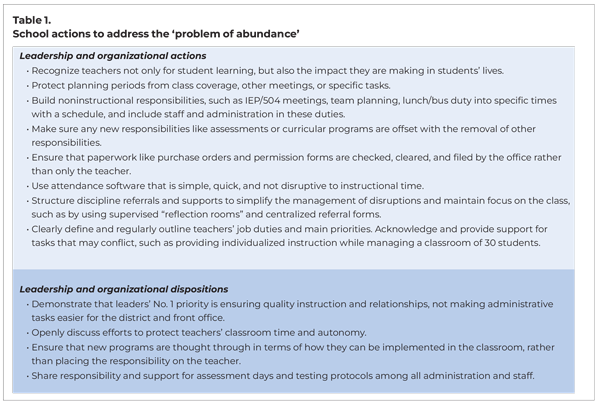
Our results suggest that teacher retention efforts should focus not only on addressing limitations, but also on facilitating purpose — protecting the core of teachers’ work so they can have meaningful, caring relationships. We asked teachers — both individually and in focus group sessions — what would help them do this, and we came up with a set of recommendations, shown in Table 1. Note what the teachers did not ask for: major policy changes, extra funding, or substantial district support. These small, building-level changes can be carried out in most schools.
Underlying the widespread concerns about the teacher shortage crisis is a narrative suggesting that the education system is fundamentally broken (Edsall, 2022). However, another narrative exists: Teachers are dedicated to connecting with their students, caring for their well-being, and facilitating their growth and development. There may well be aspects of education that need to be fixed, but the problem of abundance reminds us that the human element of education is not broken. It may not take a total overhaul to address the shortage, but merely the effort to recognize, appreciate, and support the devotion of teachers. It is time we let them do their jobs.
References
Buck, D. (2023, February 9). Soft-on-consequences discipline is terrible for teachers. Thomas B. Fordham Institute.
Crain, T. (2019). More pay, better retirement part of pitch to solve Alabama teacher shortage. AL.com.
Edsall, T.B. (2022, December 14). There’s a reason there aren’t enough teachers in America. Many reasons, actually. The New York Times.
Griesbach, R. & Lurye, S. (2022, September 12). Teacher shortages in Alabama, U.S. are real, but not for the reason you heard. The Associated Press.
Herzberg, F. (1966). Work and the nature of man. World Publishing Co.
Hom, P.W. & Kinicki, A.J. (2001). Toward a greater understanding of how dissatisfaction drives employee turnover. Academy of Management Journal, 44 (5), 975-987.
Lee, V., Dedrick, R., & Smith, J. (1991). The effect of the social organization of schools on teachers’ efficacy and satisfaction. Sociology of Education, 64 (3), 190-208.
Madigan, D.J. & Kim, L.E. (2021). Towards an understanding of teacher attrition: A meta-analysis of burnout, job satisfaction, and teachers’ intentions to quit. Teaching and Teacher Education, 105, 103425.
Marshall, D.T. (2022). COVID-19 and the classroom: How schools navigated the great disruption. Lexington Books.
Marshall, D.T., Neugebauer, N.M., Pressley, T., & Brown-Aliffi, K. (in press). Teacher morale, job satisfaction, and burnout in schools of choice following the COVID-19 pandemic. Journal of School Choice.
Moon, J. (2021, July 28). Alabama Department of Education launches campaign to recruit next generation of teachers. Alabama Political Reporter.
Nguyen, T.D., Pham, L.D., Crouch, M., & Springer, M.G. (2020). The correlates of teacher turnover: An updated and expanded meta-analysis of the literature. Educational Research Review, 31, 100355.
Pendola, A. (2022). We can keep them here: Value conflicts and teacher retention strategies. SocArXiv Papers.
Pressley, T. (2021). Factors contributing to teacher burnout during COVID-19. Educational Researcher, 50 (5), 325-327.
Schmitt, J. & deCourcy, K. (2022, December 6). The pandemic has exacerbated a long-standing national shortage of teachers. Economic Policy Institute.
Wang, H. & Hall, N.C. (2019). When “I care” is not enough: An interactional analysis of teacher values, value congruence, and well-being. Teaching and Teacher Education, 86, 102906.
This article appears in the September 2023 issue of Kappan, Vol. 105, No. 1, pp. 51-55.
ABOUT THE AUTHORS

Andrew Pendola
ANDREW PENDOLA is an associate professor of educational leadership at Auburn University, AL.
David T. Marshall
David T. Marshall is an assistant professor of educational research at Auburn University, Auburn, Alabama.
Tim Pressley
Tim Pressley is an assistant professor of educational psychology at Christopher Newport University, Newport News, Virginia.
Deja L. Trammell
DEJA L. TRAMMELL is a doctoral student studying educational psychology at Auburn University, AL.