In this week’s newsletter: It’s back to school in some parts of the country — what’s new or different? Two districts’ contrasting recovery strategies lead to dramatically different results. A veteran journalist learns some new tricks. And one education reporter goes on the air to help newbies prepare to see Beyoncé in concert.
BACK TO SCHOOL BEGINS
The big story of the week
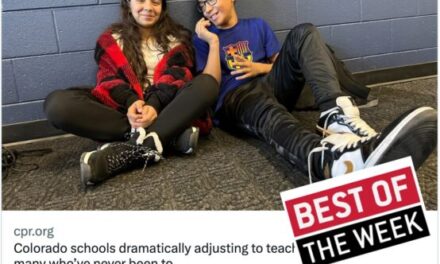
The big education story of the week is the beginning of back to school for some kids in some parts of the country. Among the wide variety of changes being reported, districts have added universal pre-K (Colorado Public Radio), bolstered emotional support for students (Chicago Sun-Times, Pittsburgh Post Gazette), cut tech budgets (Washington Post), changed schedules (Louisville Public Radio), added cops (Las Vegas Review-Journal), closed schools (Chalkbeat Indiana), banned cell phones (Orlando Sentinel), upgraded classroom ventilation (NJ Spotlight), and prepared for cyber extortion attempts (The 74).
Of course, changes being made vary widely — and how school starts in some places doesn’t mean it’s going to start that way in others. We should try and avoid overgeneralizing from a handful of school districts’ early experiences.
Other big education stories of the week:
📰 COMPLICATING THE NARRATIVE: Long a leader, New York is one of just a handful of states that haven’t taken action to improve literacy instruction (New York Times). Student test scores have improved in Chicago and Marietta, Ga. (Chalkbeat Chicago, 11 Alive). Despite many efforts, no state has yet banned drag shows for kids (NPR). Police data shows that tickets and arrests of teens didn’t increase when Denver schools reinstated SROs (Chalkbeat Colorado). And some districts like Dallas are seeing fewer teacher vacancies than in recent years (Dallas Morning News).
📰 TEACHER SHORTAGES: Speaking of teacher shortages, several districts — from rural California to North Dakota to the Florida Keys — are struggling to fill teacher positions as the new year begins (Miami Herald, Dickinson Press, LA Times). In some places, teachers are citing burnout — and principals and superintendents are leaving too (AP, Axios Atlanta, USA Today, EdNC). A program in Wisconsin is aiming to retain special ed teachers through coaching and mentorship (Wisconsin Public Radio). In Pennsylvania and Colorado, diversity is a key strategy in increasing the teacher workforce (Pittsburgh Post-Gazette, Rocky Mountain PBS). Meanwhile, some big efforts to combat teacher shortages aren’t working well (Chalkbeat, AL.com).
📰 POLITICS IN SCHOOLS: Politics are a big topic in some school board elections (Atlanta Journal-Constitution, Colorado Gazette, Tri City Herald – Washington). If parents’ rights play a central role in next year’s election, it’s likely to help the Republicans (Deseret News). Florida Gov. Ron DeSantis is paying a price with Black conservatives over the revised African African history course standards (Politico). For more on school board and election issues across the country, check out Ballotpedia’s weekly Hall Pass.

TALE OF TWO DISTRICTS
The best education journalism of the week
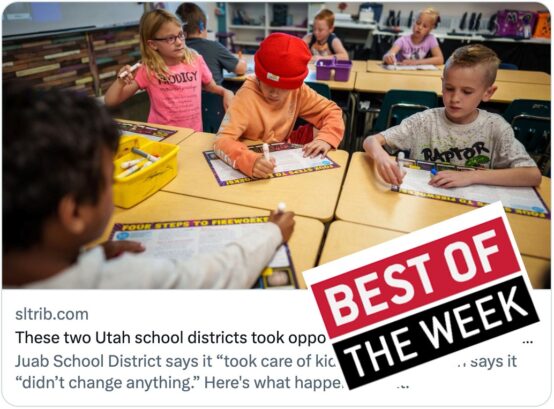
The best education story of the week is Carmen Nesbitt’s These two Utah school districts took opposite paths when the pandemic hit for The Salt Lake Tribune.
The piece explores the different recovery strategies and results experienced by two demographically similar school districts which — like many Utah districts — reopened relatively early compared to some other states. Juab focused on students’ emotional well-being, while Wasatch was able to keep the focus on academic learning.
The results, when it comes to test scores at least, are no surprise. Wasatch students gained two months of progress in math and reading while Juab students lost roughly a year in both subjects. However, each district leader thinks that they did the right thing for their kids given the circumstances.
No comparison is perfect — Juab experienced a lot of leadership turnover — and this story doesn’t include other metrics about students, like attendance, staff retention, or student well-being. But this kind of comparison is incredibly useful and seems like it should be a pretty standard thing for ed reporters to do. More, please?
Other noteworthy stories from the week:
🏆 Academic recovery has stalled, but MA schools still have over $1 billion to spend (Boston Globe)
🏆 New Oregon education leader aims to support students, hold schools accountable (OPB)
🏆 These NYC teens overcame school refusal and made it to graduation (Chalkbeat NY)
🏆 Promises kept? Akron school board questions I Promise School’s poor test scores (Akron Beacon Journal)
🏆 A teacher, a sexual abuse allegation and a botched investigation (Green Bay Press-Gazette)
🏆 How much money schools spent on legal fees last year (Cincinnati Enquirer)
🏆 Many Fresno students spend years becoming fluent in English. Why that’s a problem (Fresno Bee)
🏆 Chicago Public Schools’ aggressive tactics for removing principals under investigation (WBEZ)
RETHINKING COLLABORATION
Our latest columns and commentary
By reputation, newsroom collaboration is extremely challenging. And there’s a long history of intense competition between news outlets.
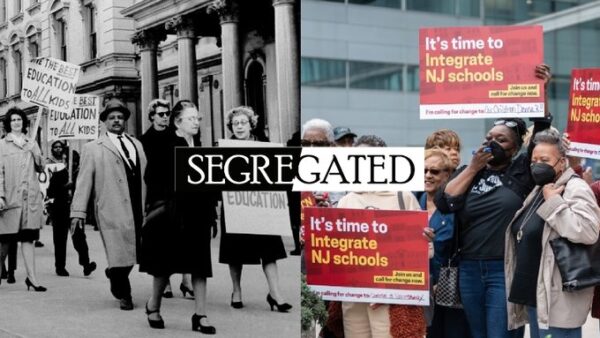
But NJ Spotlight’s John Mooney found much less frustration than he expected — and much more delight — in collaborating with a wide variety of New Jersey outlets on SEGREGATED, a look at racial and economic segregation in one of the most diverse and ostensibly liberal states in the nation.
The effort was more organic and less top-down than the traditional newsroom collaboration, reports Mooney — including a wide range of outlets and contributions from reporters who don’t usually cover education. And the resulting pieces take a wide variety of approaches and perspectives, showing how the familiar topic of segregation “plays out very differently in different communities.”
ICYMI: It’s not enough just to “add student voices” to traditional ed beat coverage, writes the Las Vega Review Journal’s Lorraine Longhi. It’s about producing stories based on students’ concerns.
ART CLASS THAT REMINDS YOU OF HOME
Coverage of promising school innovations & signs of progress
💡 This back-to-school story about California’s expansion of culturally reflective arts education contains evocative sound-rich scenes and features a family from Afghanistan who speaks convincingly about the importance of seeing their traditions in the classroom (NPR).
💡 Thanks to strong characters, plenty of historical background, and a focus on special education, this engaging story about recruiting non-traditional teachers into classrooms feels like it’s adding something new to the conversation (Sahan Journal).
💡 Context and transparency distinguish this thoroughly reported piece about the still-unproven success of a union-led community schools initiative that seeks to improve school performance by engaging students and their families with wraparound services (Chalkbeat Chicago).
💡 This piece details the successes and disappointments that followed a decision 10 years ago to merge two low-performing districts in southeast Michigan, offering a useful reminder of the complexity involved in assessing any massive overhaul (MLive).
💡 Teacher voices set the tone in this honest account of a decade-old restorative justice effort in Los Angeles schools that’s seen some clear success (such as an 80% reduction in suspensions), but also shortfalls, including weak teacher training and a disciplinary leniency that results in some kids feeling unsafe ((EdSource).
Read more about the importance of covering promising innovations and preliminary successes.
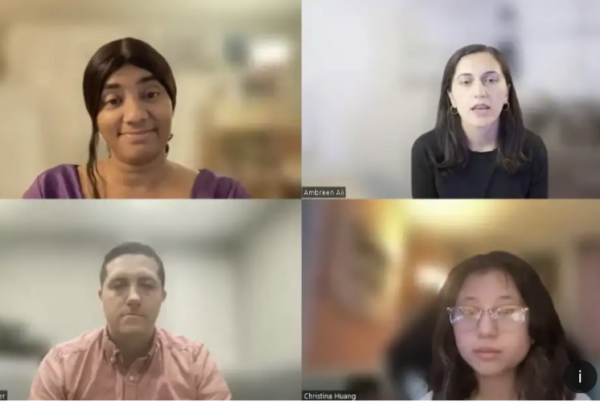
Above: Ambreen Ali (top right), author of New Jersey’s Central Desi newsletter, spoke with Asian American and Pacific Islander students, educators, and parents about what diversity and segregation mean to them.
PEOPLE, JOBS
Who’s going where and doing what
🔥 Awards: APM Reports’ “Sold a Story” was one of 11 stories to win recognition from the Third Coast International Audio Festival award. “School (in)Security,” Mark Keierleber’s newsletter for The 74, was named a finalist in the excellence in newsletters category of the Online Journalism Awards. ProPublica’s Aliyya Swaby and Annie Waldman were part of a team that received an Emmy nomination for their coverage of literacy tests and voting rights. Nice work, everyone!
🔥 Career moves: Chalkbeat national reporter Kalyn Belsha was promoted to senior reporter, appeared on WBUR’s Here & Now to talk about her investigation into the online tutoring company Paper, and was named in EWA’s new class of reporting fellows. Natalie Pate started her first week as OPB’s K-12 reporter. OpenCampus named six new HBCU Student Journalism Reporting Network fellows, who will cover their own campuses. And in case you missed it, the Solutions Journalism Network announced its second class of Complicating the Narratives Fellows last month. Congrats to all!
🔥 Recent follows: Education journalists we’ve begun following recently include the Colorado Gazette’s Nick Sullivan, EdSource journalism resident Mallika Seshadri, the Minnesota Reformer’s Deena Winter, the (West Virginia) Herald-Dispatch’s Sarah Ingram, the Arkansas Democrat-Gazette’s Cynthia Howell Oman, NBC News’ Janelle Fiona Griffith, Montclair Local’s Talia Wiener, Stateline’s Elaine Povich, freelancer Caralee Adams, and NJ Spotlight News’ Hannah Gross. “When I say I have a math background, people are often surprised,” former high school calculus teacher and newish New Bedford Light (Massachusetts) education reporter Colin Hogan told us in a phone interview. “But I really loved journalism for how it brought statistics to people.”
🔥 Job openings & opportunities: The Boston Globe is hiring a media reporter. WHYY is hiring an education reporter. The Wisconsin State Journal is hiring an education reporter. Open Campus is hiring a race and equity editor who will also lead the HBCU Student Journalism Network. And apply by Aug. 29 for the new Solutions Journalism Network HEAL fellowship, supporting journalists reporting on solutions to the youth mental health crisis.
🔥 Reporting tips: Reporting on solutions to teacher shortages? See this Hechinger Report opinion piece on the importance of interstate (and even inter-district) teacher transfers — an underreported topic. And Chad Aldeman has a reminder on this topic too: “The next time you read a story about labor shortages in education, remember that public education has the lowest job opening rate of any major industry in the American economy.” FutureEd has useful information for reporters and editors on how districts are using special COVID-relief funds to support homeless students.
APPEARANCES, EVENTS, & NEW RESOURCES
What’s happening and new research
⏰ Segments & podcasts: StateImpact Oklahoma education reporter Beth Wallis was on Morning Edition talking about the ACLU lawsuit to block what would be the country’s first religious public charter school. USA Today’s Alia Wong was on the outlet’s “5 Things” podcast talking about whether grad school is worth the big price tag and subsequent debt many students face. Michigan Radio’s Stateside podcast featured WXYZ Channel 7 reporter Heather Catallo talking about one family’s lawsuit against Ann Arbor Public Schools over withheld footage of a transportation company employee assaulting their 7-year-old special needs son.
⏰ Conferences & upcoming events: The Washington Post’s Laura Meckler released her tour schedule for her soon-to-launch book “Dream Town: Shaker Heights and the Quest for Racial Equity.” Go see her in person! ONA is coming up Aug. 23-26 in Philadelphia (and in late September online). Check out the schedule here. Were you at NABJ this week? EWA hosted two sessions featuring AL.com education editor Ruth Serven Smith and Atlanta Journal-Constitution education editor Eric Stirgus. Propublica’s Nicole Carr and the New York Times’ Nikole Hannah-Jones were among those scheduled to appear on a power panel about Black women reporting on political extremism.
⏰ Research: The Center for Global Development has a report out on how much reducing lead exposure can improve children’s learning. Education Next has an article out on universal education savings accounts. Chalkbeat Colorado reported on a study showing that school segregation in Denver has harmed Latinos and English learners. Denver’s superintendent also responded to the study.
⏰ Journalism resources: Poynter has a helpful Q&A out with Robin Kwong, who wrote a guide on newsroom project management. According to the Reuters Institute for the Study of Journalism, 43% of news avoiders avoid news about national politics and 41% news about social justice — higher than those who avoid celebrity news. What can education journalists take from this to get more eyes on their coverage?
THE KICKER

“Me trying to keep it together for once while talking about Beyoncé,” writes the Boston Globe’s Adria Watson about her recent on-air segment helping viewers prepare for the concert-going experience.
ABOUT THE AUTHOR

The Grade
Launched in 2015, The Grade is a journalist-run effort to encourage high-quality coverage of K-12 education issues.