In this week’s newsletter: More bad news on the NAEP front. Lack of urgency leaves struggling kids stranded. What to do about duplicative and conflict-focused regional education coverage? Climate educators — and some journalists — are trying to focus on “problem solving, not doom and gloom.” Ed reports on the move!
BAD NAEP
The big story of the week
The big education story of the week is the dismal new results for 13-year-olds on NAEP, featuring declines that began before the pandemic and have continued since.
Chalkbeat called it a “striking collapse in achievement scores since 2012, after decades of progress in math and modest gains in reading.” (AP, U.S. News, Wall Street Journal, Chalkbeat, Washington Post, New York Times, Axios).
“The math scores for the lowest performing students hit levels last seen in the 1970s,” noted U.S. News’ Lauren Camera. “While their reading scores were actually lower than the first year the data was collected, in 1971.”
Other big stories of the week:
📰 AFFIRMATIVE ACTION DECISION: The U.S. Supreme Court is on the cusp of deciding whether to end affirmative action in college admissions. Most experts expect they will. Reactions have ranged from celebratory to outraged to complicated, especially for those who have benefited from affirmative action in the past (New York Times). Admissions departments are likely to switch to emphasizing income and zip code instead to try to maintain or increase diversity (GBH Boston, Politico). Other impacts could be a possible boost in enrollment at HBCUs (Boston Globe).
📰 COVID CLIFF: Districts are spending like crazy with the last of their ESSER funds on things like increasing per-student spending, construction projects, and staffing (Colorado Politics, Chalkbeat Chicago). But what happens next — as the funding dries up and, in many cases, enrollment decreases — is still uncertain (LA Times, EdSource, District Administration).
‘COMPLACENCY & INERTIA’
The best education journalism of the week
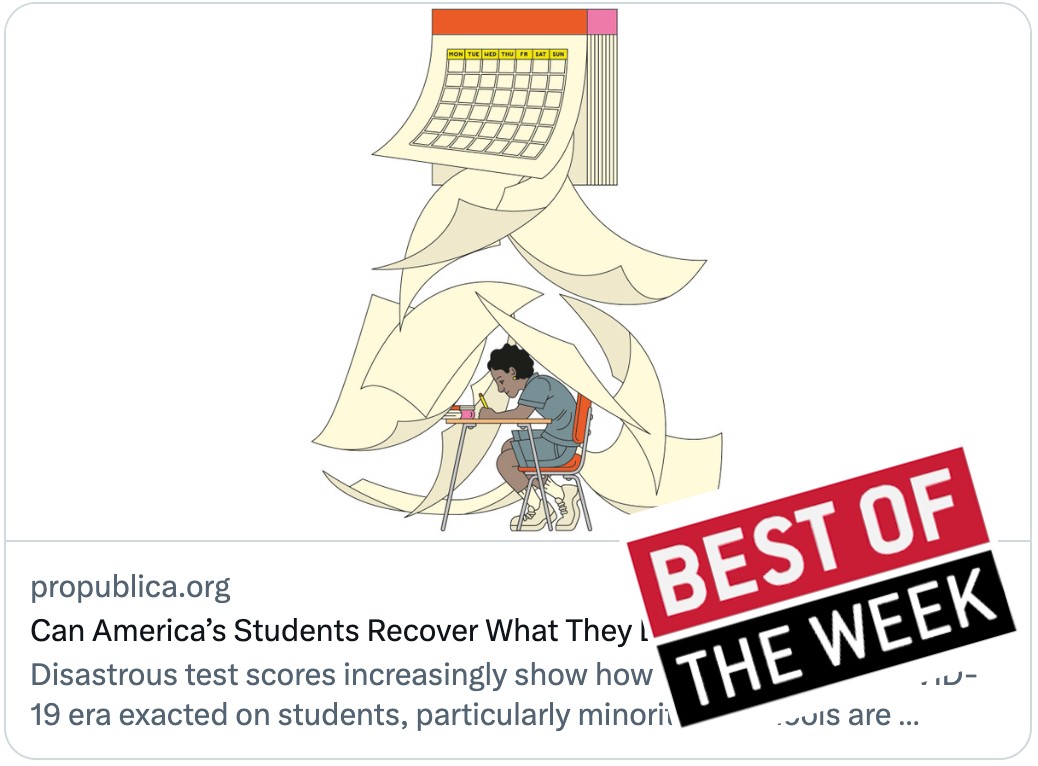
The best education story of the week is Alec MacGillis’ New Yorker/ProPublica story Can America’s Students Recover What They Lost During the Pandemic?, which tells the story of how inadequate learning recovery efforts have been for kids in places like Richmond, Va.
“Students suffered an unprecedented setback during the remote-learning era, sharply widening racial disparities that had been shrinking,” according to MacGillis. “But recovery efforts have been plagued by complacency and inertia.”
The effects on learning of the pandemic response are now clear for all to see — especially among kids who experienced remote instruction the longest. Lack of urgency around learning recovery and the many obstacles to extending the school year are sadly familiar at this point. AP wrote about Richmond’s struggles to lengthen the school year six months ago.
But this new piece adds some useful information and insights, including some eye-popping quotes questioning the concept of learning loss and an overview of district efforts to extend the day or year in places like Atlanta, LA, and Dallas. And the piece also features a powerful and under-discussed insight about how hard it has been for teachers (and other workers) to contemplate adding hours or days — and how little pressure schools have felt from parents who think their kids are doing OK to provide enhanced services.
Other great stories from the past week:
🏆 How PS 15 in Brooklyn Could Serve as a Model for NYC Schools (New York Times)
🏆 One of the poorest cities in America was succeeding in an education turnaround. Is that now in peril? (Hechinger Report/Belt Magazine)
🏆 How liberal Seattle created a powerful conservative influencer: Christopher Rufo (KNKX Public Radio)
🏆 Michigan could be close to eliminating student lunch debt (Detroit Free Press)
🏆 Migrant student finds strength in NYC school chess program (WNYC/Gothamist)
🏆 Providence teachers agree to extend length of school day (Boston Globe)
WHEN MORE COVERAGE ISN’T BETTER
Our latest columns and commentary
There’s lots of talk about staffing problems and lack of coverage of education, and indeed lack of staffing is a major problem. But let’s be honest. Sometimes the reporters are there and the coverage is being produced, but it’s just not as good as one might hope.
For example, a recent superintendent search process in DeKalb County, Ga., resulted in what contributor Will Callan describes in this week’s new piece as narrow, superficial, and overly conflict-focused coverage.
“The lesson here is simple, and one The Grade has touched on many times,” writes Callan. “Reporters shouldn’t let the search for controversy and division lead them to give hefty weight to the least representative person in the story.”
How can local education teams avoid duplicating each other’s efforts and producing superficial, conflict-focused stories? Pool reporting is one possible approach. The piece has generated thoughtful responses from Decaturish’s Dan Whisenhunt and parent Tracy Brisson.
CLIMATE SOLUTIONS IN NJ SCHOOLS
Coverage of promising school innovations & signs of progress
💡 This dispatch from a New Jersey elementary school pays careful attention to the various ways teachers are weaving instruction about climate change into their normal routine and states a maxim about climate education that could just as well be applied to education coverage: focus on “problem solving, not doom and gloom” (New York Times).
💡 Form is worth noting in this story about an NYC school that integrates special education students into the typical classroom: the piece continually refers back to the scene that it leads with, each time adding something new about how the school’s approach is benefiting students (Chalkbeat New York).
💡 In under 1,000 words, this piece about how a community college in southernmost California boosted enrollment packs a lot in — explaining how staff members recruit from middle and high schools and outlining an approach that other institutions might find replicable (EdSource).
💡 This profile of an 11-year-old Colombian chess player in an NYC school blends the education and immigration beats to tell a story about the district’s thoughtful attempts to engage and welcome asylum seekers (Gothamist/WNYC).
Read more about the importance of covering promising innovations and preliminary successes.
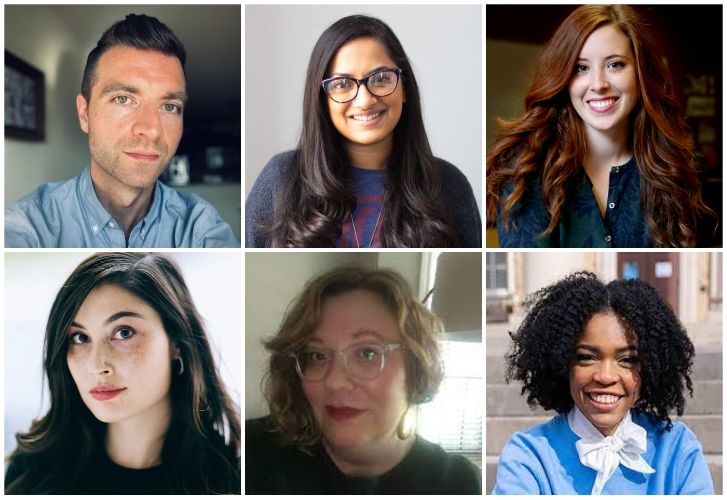
Above, clockwise from top left: Chalkbeat’s Patrick Wall and Reema Amin, OPB’s Natalie Pate, MPR’s Kyra Miles, ProPublica’s Jennifer Smith Richards, and the Boston Globe’s Deanna Pan.
PEOPLE, JOBS
Who’s going where and doing what
🔥 Career moves: After nine years on the beat including stints covering NYC, Newark, and national news, Patrick Wall is leaving Chalkbeat to freelance full-time. After five years with the New York bureau, Reema Amin is moving over to Chalkbeat’s Chicago Bureau. Natalie Pate is joining OPB as a K12 education reporter. Kyra Miles is the new early ed reporter for MPR. Jennifer Smith Richards is moving from the Chicago Tribune to ProPublica’s midwest bureau. And Boston Globe features reporter Deanna Pan, the author of last week’s pick for best of the week, tells us she’s been working with the Great Divide team for several months. Congrats to all!
🔥 Pro tips:
- “If you’re going to be a journalist, you need to understand the difference between what your community cares about and what the people who email the newsroom care about,” says freelancer Megan A. Taros. “I think sometimes we assume the vocal minority is the story when we should be questioning what we’re hearing.”
- “I resisted the urge to make the pushback seem bigger than it was,” says New York Times climate reporter Cara Buckley about her decision not to focus on those few people who oppose New Jersey’s new state mandate to teach climate change.
- “The book banning issue has basically no news value on its own,” opinion writer Kat Rosenfield told me recently. She recommends journalists focus on examining the books’ contents rather than on the controversy.
- “Experience is the difference between studying racial inequality and living through it, and Black experts have done both,” writes Anna Gifty Opoku-Agyeman in Teen Vogue, calling for more use of Black experts and sources.
🔥 Awards: The Oregonian’s multimedia project “The Safest Place,” about a school disproportionately affected by community gun violence, won a national Local Media Digital Innovation award. SPJ’s collegiate journalism award (the Mark of Excellence or MOEy) this year went to Mary Steffenhagen of the City University of New York for the podcast “Home Ed,” which examined the homeschooling movement in the U.S.
🔥 Job openings: The 74 is hiring an education reporter and a freelance reporter to cover Los Angeles schools. Chalkbeat is hiring a New York reporter to replace Reema Amin and a Michigan state policy reporter.
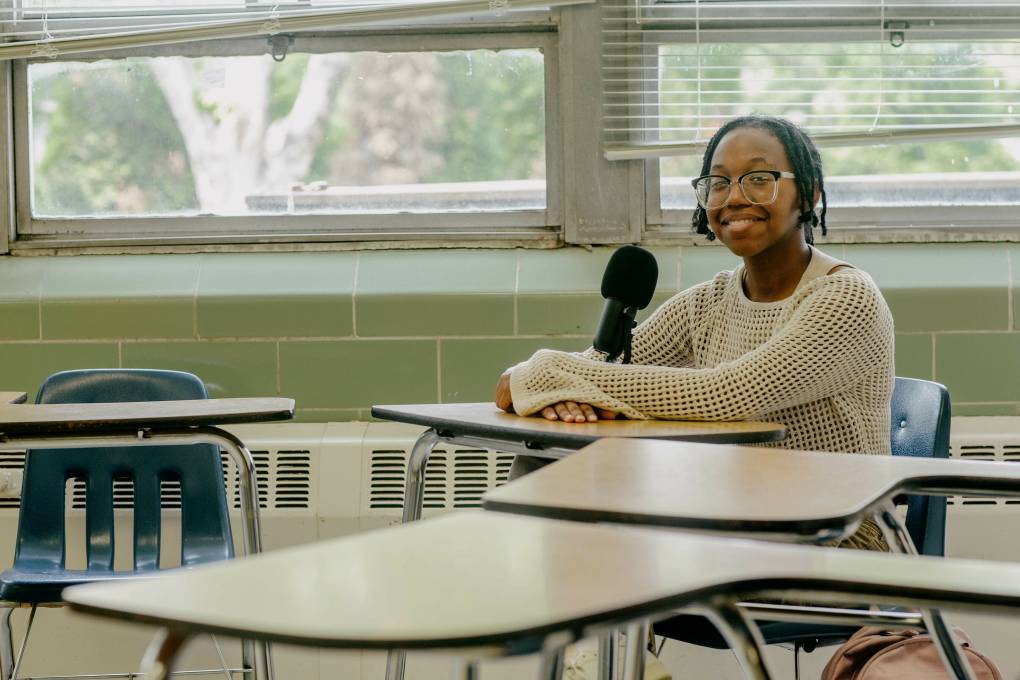
Above: High school student Georgianna McKenny won NPR’s high school student podcast challenge with a piece about how the water crisis in Jackson, Miss., impacted students.
APPEARANCES, EVENTS, & NEW RESOURCES
What’s happening and new research
⏰ Segments: ProPublica’s Alec MacGillis appeared on PBS NewsHour talking about his story on pandemic learning loss in Richmond. The NewsHour also produced a lengthy segment on how school boards have become battlegrounds for the nation’s divisions. NPR’s Debbie Elliott spoke with Peggy Carr, commissioner of the National Center for Education Statistics, about the drop in reading and math test scores. The Washington Post’s Hannah Natanson was on NPR’s Fresh Air talking about book bans. And the new season of “Miseducation” has launched, featuring a segment about high school journalism inequality.
⏰ New ventures: The few-months-old Brookline.News in Massachusetts is focusing heavily on education lately. Founding editor Sam Mintz tells us they will stand out for their long-term coverage of stories and consistent presence at school committee and subcommittee meetings. “We’re hoping, in general, that our presence and work will make Brookline a more civically engaged and informed town, and schools and education are absolutely an area where we believe we can have that effect.” Wonder what WBUR, GBH, and the Globe think about that!
⏰ Conferences & events: IRE is happening this weekend in Orlando, with some education panels on deck, like this one on investigating inequities in education and another on best practices for collaborations and partnerships, featuring the AP’s Chrissie Thompson and Bianca Vázquez Toness. The Aspen Ideas Festival also starts this weekend, and I spot at least one education reporter who will be there. The Solutions Journalism Network has two upcoming events: Building a solutions culture: Lessons from 5 newsrooms and Solutions Journalism 101 Webinar.
⏰ Research & reports: There’s no research consensus that mass shooting coverage creates copycat events, according to The Trace. A small percentage of teachers generates a large percentage of classroom discipline referrals, according to a new study in Phys.org. There are more than a million more English learners in U.S. schools than there were in 2000, according to an opinion piece in The 74. According to an article in The Atlantic about smartphone bans, “the research paints a murky picture, but perpetual hand-wringing says plenty about adult biases.”
THE KICKER
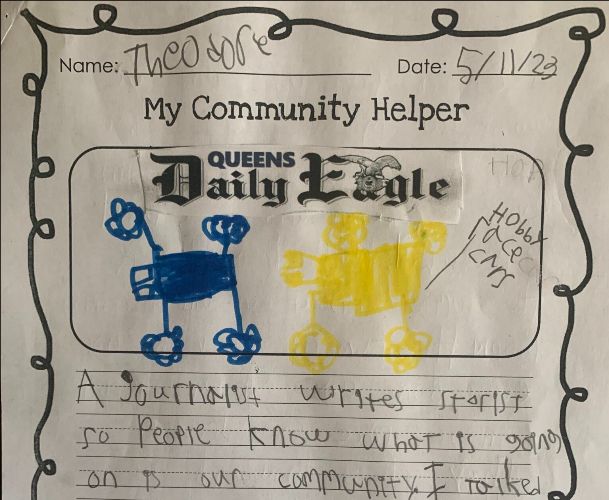
“A journalist writes stories so people know what is going on in our community.” – First-grader Theodore Merrefield, based on an extremely cute Journalist’s Resource interview with Queens reporter Ryan Schwach.
That’s all, folks. Thanks for reading!
Reply to this email to send us questions, comments or tips. Know someone else who should be reading Best of the Week? Send them this link to sign up.
Using Feedly or FlipBoard or any other kind of news reader? You can subscribe to The Grade’s “feed” by plugging in this web address: http://www.kappanonline.org/category/the-grade/feed/.
Read more about The Grade here. You can read all the back issues of The Grade’s newsletter, Best of the Week, here.
By Alexander Russo with additional writing from Colleen Connolly.
ABOUT THE AUTHOR
Alexander Russo
Alexander Russo is founder and editor of The Grade, an award-winning effort to help improve media coverage of education issues. He’s also a Spencer Education Journalism Fellowship winner and a book author. You can reach him at @alexanderrusso.
Visit their website at: https://the-grade.org/