Duplicative, conflict-amplifying coverage of the DeKalb County superintendent search suggests the need for a more creative and collaborative approach.
By Will Callan
In April, Atlanta Magazine ran a piece characterizing the region’s media landscape as riddled with coverage holes.
Dan Whisenhunt, editor of the 10-year-old news site Decaturish, is quoted saying that the DeKalb County School District, a system of 92,000 students, is “criminally underreported.”
The DeKalb district is the third largest of six school systems in metro Atlanta, and, like other districts, has recently struggled with declining enrollment and lackluster test scores, as well as school safety and dilapidated facilities.
The Atlanta Journal-Constitution covers these stories, sometimes in depth. But if you’re looking for consistent and detailed coverage of school board meetings, Decaturish is where you’ll most likely find it.
Interestingly enough, the very day the Atlanta Magazine piece came out, the DeKalb County school board was about to hire a new superintendent. And, for that week at least, DeKalb schools got more attention than usual.
More coverage, however, doesn’t always mean better coverage — especially if it doesn’t lead to a diversity of viewpoints. That’s what happened in DeKalb.
A review of the reporting from April (about two weeks total) shows how coverage of the hiring decision amplified the misleading notion of a school board in conflict, repeating the same dubiously sourced pieces of information.
The result was a duplication of efforts and a narrow view of the story that closed off other potentially fruitful reporting avenues.
The episode also raises important questions for Atlanta and other regions:
What’s the value of having many outlets covering the same story in much the same way? And whose voices warrant representation in coverage of school district politics?
More coverage doesn’t always mean better coverage — especially if it doesn’t lead to a diversity of viewpoints.

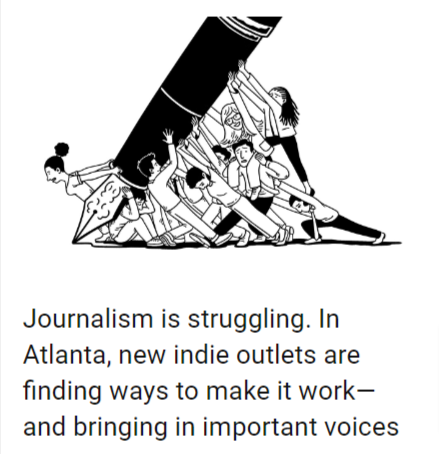
Above: The Atlanta Magazine story in which Decaturish editor Dan Whisenhunt describes DeKalb schools as “criminally underreported.”
A one-person “conflict”
Aside from being a big deal in its own right, the hiring of the new superintendent may have gotten extra attention because of the candidate’s background.
Devon Horton, until recently leading the much smaller Evanston/Skokie School District 65 outside Chicago, came under the national spotlight in 2020 when the Wall Street Journal profiled him and his decision to welcome marginalized students back to in-person school before others. There were also concerns about his personal finances, and the alleged awarding of no-bid contracts in Evanston/Skokie.
The DeKalb school district has a checkered past, too. Horton, whose contract was approved in May, is its seventh superintendent in 10 years.
So when news came that Horton appeared to be the candidate of choice, Decaturish, the AJC, and a host of other new organizations including WSB-TV, 11 Alive, and Fox 5 Atlanta were on it.
Critics, seeing that a controversial leader from a much smaller district was the only candidate being considered by a historically dysfunctional school board, demanded more options and transparency.
While these concerns were legitimate, they seem to have made reporters covering the story a bit too credulous when they heard stories of disagreement.
DeKalb board member Joyce Morley contacted the AJC and told them that during closed-door board sessions it had become clear the members were divided about Horton. She said her preferred candidate, interim supt. Vasanne Tinsley, deserved consideration.
The article’s key pieces of information — that the school board was split and that Tinsley had been ranked as a stronger candidate by a third-party search firm — were attributed to Morley alone. Attempts to corroborate met no success:
“The AJC contacted board chair Diijon DaCosta, as well as Horton and Tinsley, but did not receive a response by the time of publication. Board vice chair Deirdre Pierce said she cannot confirm or deny what Morley said.”
In short, there was nothing substantive to support Morley’s claim. The reporter took her word for it and articulated a narrative that would inflect much of the following coverage:
“The divide on the board over DeKalb’s next leader mirrors the split in the community. Some people think Horton’s fresh eyes will be a good thing for the state’s third-largest district. But others think Tinsley has demonstrated effective leadership already, and should stay in the role.”
WSB-TV ran a piece that also depended on Morley as its main source (“One board member told Channel 2′s Tyisha Fernandes this choice is a huge mistake,” went the digital story).
The coverage that followed focused almost entirely on disagreement among stakeholders:
- DeKalb NAACP rallies for more transparency from Board of Education (11 Alive)
- DeKalb County Schools superintendent finalist faces questions, criticism from parents (Fox 5 Atlanta)
- State schools chief Woods wants DeKalb to ‘pause’ superintendent hire (AJC)
Yes, even the state superintendent got involved.
The coverage that followed focused almost entirely on disagreement among stakeholders.
In the end, it might have surprised some people to learn that Horton was voted into office 6-1 by the school board. The only nay came from Morley.
I’m not suggesting that the community wasn’t divided. It obviously was — parents, a teachers union representative, and advocacy groups all voiced concerns — and the reporters on this story documented that solidly. But by leading with Morley’s claim, and then applying it broadly to everyone else with something at stake in the school board election, the coverage presented division as the core feature of the DeKalb school district, and the only one worthy of attention.
Maybe we need to retire using “community” as a generalization.
The lesson here is simple, and one The Grade has touched on many times: Reporters shouldn’t let the search for controversy and division lead them to give hefty weight to the least representative person in the story — especially when that person is making unsubstantiated claims.
(Note: Following Horton’s hiring, Decaturish reported that the school board formally accused Morley of violating the district’s ethics code by dishing to the AJC. Then the board publicly disavowed Morley’s statements. This came after Decaturish raised questions about the appropriateness of Morley’s actions.)
The coverage presented division as the core feature of the DeKalb school district.
Missed opportunities
With all the focus on the supposed board conflict, the reporters covering the story missed other angles such as whether Horton had plans to repair broken down facilities, and left out important voices, including parents who weren’t able to attend public meetings with the superintendent.
All the outlets at least acknowledged the claims about Horton’s past. The AJC talked to people from his old district. Decaturish went the furthest, publishing a piece by a Substacker in Evanston who had obtained records pertaining to consulting work Horton did for Chicago Public Schools while leading Evanston/Skokie School District 65 — a possible violation of Evanston/Skokie’s district policy.
Some readers, though, wish the outlets had dug deeper.
“As a parent or someone who was interested in it, you had to go back and read 10,000 news articles about him,” said Tracy Brisson, a DeKalb County parent. “There was no one in the media here who thought, ‘Oh, he’s the new guy, let’s investigate him.’”
(To be fair, the reporters were working on a tight schedule, and investigations may well be in progress.)
Also left out were voices that might have posed arguably more important questions about Horton’s plans for student mental health, declining enrollment, and other issues facing the district.
In its coverage of a town hall meeting with Horton, the AJC led with questions from the public about rumors that Horton had discriminated against white students in Evanston, while 11 Alive featured the DeKalb NAACP demanding more transparency from the school board.
The only reporting that gave substantial voice to anyone else came from Decaturish, which described concerns from the Latino community, crumbling facilities, school safety, and board conduct. It also gave Horton more of a chance to articulate his ideas.
Promising signs for future coverage
As valuable as they were, these tidbits could have used more of a deep dive. What would these parents like to see out of their likely (and now confirmed) new superintendent? What about the tens of thousands of parents who didn’t attend the meeting? What about the students?
Maybe these kinds of stories are on their way. However, in cases like this, it might make sense for newsrooms to join forces and assign a pool reporter to cover the obvious angle — the community division — while each outlet does a deeper take on a unique aspect of the story.
Those sorts of follow-ups will be valuable no matter what, but especially if, in addition to Decaturish, AJC, and the TV stations, they come from other players.
The Atlanta Magazine piece that raised the issue of DeKalb schools being undercovered spotlighted a bunch of other promising outlets, among them Atlanta Civic Circle, Capital B, and Canopy Atlanta.
A couple weeks after the board voted in Horton, Capital B published a piece about what parents think. The message might help temper the division narrative:
“DeKalb parents who spoke to Capital B Atlanta said that despite some of the deservedly bad press for the district in recent years, they’re willing to give that new leader a chance.”
I look forward to future K-12 work these organizations put out. Canopy Atlanta’s Documenters recently started covering school board meetings for Decaturish, according to the Atlanta Magazine piece. The outlet also just put out its South DeKalb issue and seems especially well situated to deepen coverage of Dekalb schools.
Will Callan is a freelance journalist based in Los Angeles. After freelancing as a print journalist in the Bay Area, he moved to Ann Arbor, Mich., and covered the first year of the pandemic at Michigan Radio. He’s since worked on podcasts, radio documentaries, and investigations at APM Reports. He can be reached at wacallan@gmail.com.
Previously from this author
Drama, characters, and ambiguity: key elements of high-quality school innovations coverage
Why the National Reading Panel report didn’t fix reading instruction 20 years ago
ABOUT THE AUTHOR

Will Callan
Will Callan is a freelance journalist based in Los Angeles. After freelancing as a print journalist in the Bay Area, he moved to Ann Arbor, Mich., and covered the first year of the pandemic at Michigan Radio. He’s since worked on podcasts, radio documentaries, and investigations at APM Reports. He can be reached at wacallan@gmail.com.