In this week’s newsletter: A debunked book ban leads to multiple media corrections. A worrying surge in chronically absent elementary school students. Will anyone speak up about the need to transform the beat at the EWA National Seminar in Atlanta this weekend? School cell phone bans look different when they’re happening at your kid’s school, says one former ed reporter. And LAist’s new K-12 reporter is “looping” up from the early childhood beat.
BOOK BAN CORRECTIONS
The big education story of the week
The big education story of the week is multiple corrections that have been issued about last week’s ubiquitous coverage of a Florida school that reviewed poet Amanda Gorman’s book.
In the days leading up to Memorial Day weekend, multiple outlets reported that Gorman’s book and three others had been banned based on the complaints of a single parent. You know who you are.
However, the school pushed back against this version of events, noting that the Gorman book had simply been relocated to shelves dedicated to middle school students — a restriction but not a ban. And at least two efforts to verify the narrative came down squarely on the school’s side of the story.
“Here’s the truth,” tweeted Snopes’ Jordan Liles, who looked into the matter. “A Florida school’s committee reviewed a parent’s complaint. They concluded Amanda Gorman’s poem had ‘educational value’ and ‘historical significance.’ It remains accessible to all students.”
A PolitiFact update on the story comes to much the same conclusion. The Post and Politico have both corrected their stories. “An earlier version of this article said that to read the book, an elementary school student would have to prove they read at a middle-school level,” notes the Post’s correction. “The student would have to prove they read at a fifth-grade level. The story has been corrected.”
More big education stories this week:
📰 RETURN TO REMOTE: A pre-summer heat wave has left students learning remotely in the final days of the school year in places like Pittsburgh, Pa., and Grand Rapids, Mich. (WESA, MLive, New York Times). In California, where heat waves have become all too frequent, lawmakers have advanced legislation that would require schools to find ways to cool down their outdoor areas such as by planting trees and removing asphalt (AP).
📰 LEFT OUT: Despite advocates’ best efforts, students with disabilities are still being left out when it comes to receiving the benefits they are entitled to — including having access to dual-language programs (Wisconsin Watch, St. Louis Public Radio, Hechinger Report). In Maryland, a disability rights group has sued the state for housing foster kids with complex behavioral needs in hospitals and denying them access to adequate education (Baltimore Banner).
📰 READING RAMPAGE: More than 25,000 Tennessee third graders took the state reading test this week for the second time — an attempt to avoid being held back under the state’s controversial retention policy (Chalkbeat Tennessee, The Tennessean, Tennessee Lookout). See this Stateline article from last month for an explainer on how reading retention policies can help — or hurt — students. Among the states with new laws and recommendations pushing the “science of reading” are Oregon, Indiana, and Minnesota (Oregon Capital Chronicle, Chalkbeat Indiana, Star Tribune). Meanwhile, columnist Nick Kristof touted Mississippi’s success in raising reading scores (New York Times), and former Milwaukee Journal Sentinel reporter and editor Alan Borsuk detailed how Milwaukee Public Schools is trying to make its own reading miracle (Journal Sentinel).
📰 SCHOOL SAFETY DEBATES: A little over half of teachers surveyed about school safety said arming educators would make schools less safe (EdWeek, USA Today). In addition to arming staff, some districts are debating the efficacy of school uniforms, weapon scanners, and returning police to campus to thwart gun violence (Texas Tribune, Tampa Bay Times, Henrico Citizen, Chalkbeat Colorado). Students are also speaking up about their fears and what would make them feel safer (Washington Post, Wisconsin Public Radio).
ABSENT OFTEN — AND EARLY
The best education journalism of the week
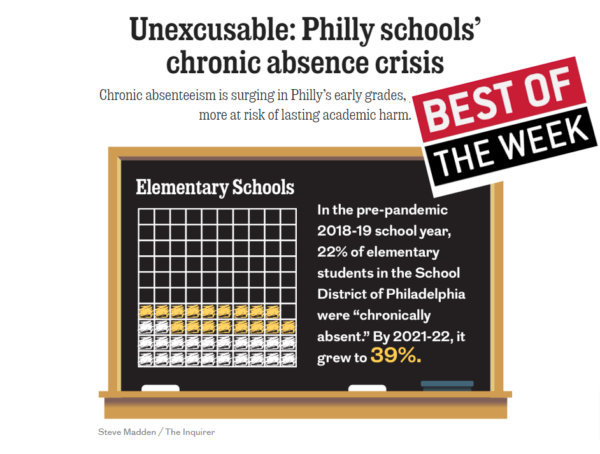
The best education journalism of the week is Unexcused: The Absentee Crisis in Philadelphia Schools, by the Logan Center for Investigative Reporting’s Julie K. Brown and the Inquirer’s Dylan Purcell and Kristen A. Graham.
Focused on the surging problem of chronic absenteeism among younger elementary school children, the package tackles what is arguably the biggest issue schools have faced this year.
Nearly half of Philly students were absent more than 10% of the time, according to 2020-21 data. The figure is nearly 40% for elementary students — up dramatically from before the pandemic despite an overall enrollment drop of nearly 10%.
Poverty, homelessness, COVID fears, and community violence all play a role. However, absent students also report that “they don’t believe that their school provides engaging instruction with reliable teachers.”
The official numbers don’t even include what some schools call “walkers” — kids who show up in the morning but spend most of their time in the hallways rather than in class. The current year data appear to be no better than the previous year.
While depressing, the series isn’t all data. It gives voice to individual students and educators and shows a variety of school efforts. It also features a look at how Los Angeles reduced absenteeism and an extremely useful piece on how Philly parents can tell if their children are attending school.
More great education stories from the past week:
🏆 The revolt of the Christian home-schoolers (Washington Post)
🏆 Why Seattle schools are more segregated today than the 1980s (Seattle Times)
🏆 Why one reading program is gaining the most traction under NYC’s new literacy mandate (Chalkbeat NY)
🏆 Troy School Board eliminates middle school honors math classes despite parent outrage (Free Press)
🏆 30,000 Orange County Children Experience Homelessness, Watchdog Estimates (LAist)
🏆 Inside the Christian Legal Crusade to Revive School Prayer (The New Republic/Hechinger Report)
🏆 Many Colorado districts bought Chromebooks to get kids through COVID. Now, thousands of computers are nearing their end. (Colorado Sun)
LEADING THE BEAT
Our latest columns and commentary
Efforts to revamp traditional journalism are everywhere these days, including much-needed changes to the crime beat and to political coverage.
But what would a transformed education beat look like — and how would the difficult process of change begin?
The need to revamp the education beat is clear. The elements of a reinvention are obvious. The only missing ingredients are education journalist leaders — you know who you are — willing to press for change.
Read all about it in my latest column: Candor, urgency, & action: how to transform the education beat. Then maybe start speaking up.
SUPPORT FOR HOMELESS STUDENTS
Coverage of promising school innovations & signs of progress
💡 In California, where student homelessness rose after the pandemic, highly skilled liaisons are using their neighborhood-level knowledge of school districts to identify homeless families and connect them with forms of help like hotel vouchers and family therapy (EdSource).
💡 In the last school year, Denver Public Schools welcomed nearly 1,500 immigrants and asylum-seekers by working one-on-one with their families (often visiting them in shelters and hotel rooms), offering interpretation in 20 languages, and training teachers to deal with student trauma (NPR/Colorado Public Radio).
💡 In order to kickstart bilingualism and biliteracy development in its majority Spanish-speaking student body, a school in southern Delaware gathers infants, toddlers, and their parents for a structured six-week program that involves reading, singing, and playing (WHYY).
💡 Students benefiting from San Francisco’s pioneering college fund program say that the money, though modest, has made them more hopeful about the future; and meanwhile, the city has hired a researcher to study whether the program has boosted college attendance rates (San Francisco Chronicle).
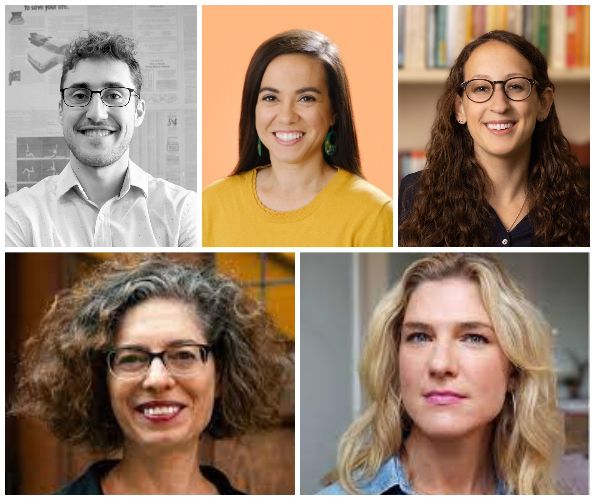
Above, clockwise from top left: The 74’s Asher Lehrer-Small, LAist’s Mariana Dale, Vox’s Rachel Cohen, former NPR education correspondent Anya Kamenetz, and the Hechinger Report’s Jill Barshay.
PEOPLE, JOBS
Who’s going where and doing what
🔥 Career moves: After three years, The 74’s Asher Lehrer-Small is moving on to cover schools for Houston Landing. But he’s going out with a bang, including this powerful new piece about schools reporting parents of children with disabilities in retribution for their efforts to secure services for their children. LAist early education reporter Mariana Dale will take over former K-12 reporter Kyle Stokes’ role. “I think it will be exciting to have an early childhood reporter follow the families we’ve covered into K-12,” editor Ross Brenneman told me. “If educators can loop, why not education journalists?” Congrats to both!
🔥 Three reporters give tips:
“It’s important to remember that a lot of parents are not prioritizing educational quality when they’re looking for somewhere affordable, safe, and welcoming to send their child while they’re at work,” says Vox’s Rachel Cohen, who recently published a story on Vermont becoming a leader in child care. Quality child care and quality education aren’t necessarily the same.
“Having a kid with a phone now myself, at a school with a ban, I am actually pretty sympathetic to the idea of classroom-level bans,” says former NPR education correspondent Anya Kamenetz, who wrote about the ins and outs of cell phone bans way back in 2018. “The key question is, how is the ban to be enforced?”
And the Hechinger Report’s Jill Barshay offers a word of caution when reporting on research: “We all need to be careful when we say ‘the research says….’ The research is rarely clear and there are generally disputes. This is not just a quantitative-qualitative divide, but even within each category of research.”
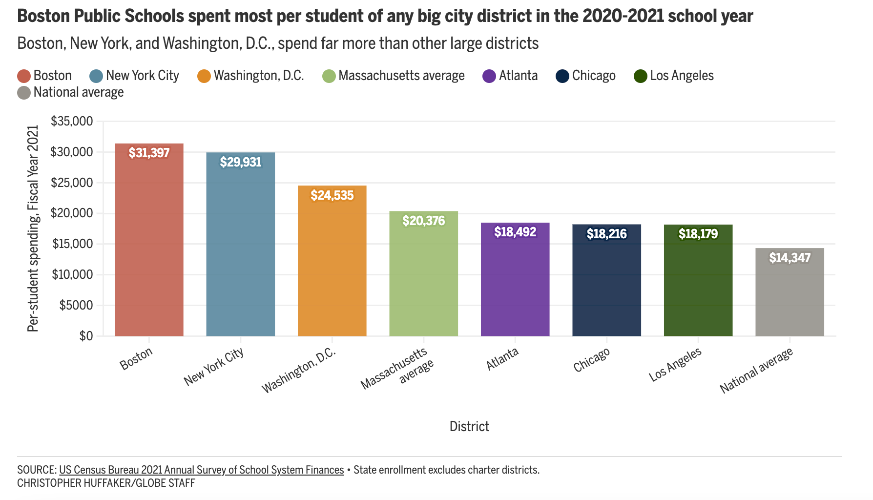
Above: The top per-student spending districts in the nation, according to a recent Boston Globe story. Note that Miami-Dade, Broward, and Clark County are not included here.
APPEARANCES, EVENTS, & NEW RESOURCES
What’s happening and new research
⏰ EWA National Seminar: It’s happening this weekend in Atlanta! I can’t be there this year, but some especially promising options include How to Broaden Your Sources, Covering Student Trauma, the Hows of Covering Literacy, America’s Missing Students, and The Chilling Effects of Politics. For veteran reporters, I recommend community member panels for a peek into how things look from the advocacy side. Go to the EWA organizational/board member meeting to find out how the organization plans to do things differently in the year ahead. Follow along at #EWA23.
⏰ Spotlight on school spending: The Boston Globe had a pair of great school spending accountability stories this week, one analysis showing that Massachusetts spends thousands more on school construction aid for white students than for students of color and another about Boston spending more per student than any other large school district — despite big drops in enrollment. Kudos to the Great Divide team!
⏰ ICYMI: The Hechinger Report’s Tara García Mathewson moderated a conversation about student mental health. Watch the replay here. PBS aired a segment on school systems considering reinstating police officers. (DC Public Schools recently backtracked on removing them.) APM Reports’ Sold a Story podcast got heaps of praise from This American Life’s Ira Glass. And WBEZ and the Chicago Sun-Times’ excellent investigation on the broken promises of Chicago’s school closures 10 years later was published on NPR!
⏰ Media criticism: “I sent interview requests to about a dozen Black reporters at white-owned outlets asking if they could talk to me about how supported they feel in their newsroom,” writes Word In Black’s Anissa Durham in a look back at the inadequate efforts to diversify journalism made in the aftermath of George Floyd’s 2020 murder. “One reporter after another declined to comment on the record. All of them said they were afraid of retaliation in their newsroom. Except one.” That one person willing to speak up was journalist Gabriel Schneider, co-founder of The Objective. Also, according to new research reported in The Guardian, young Black and Latino advocates report that national organizations downplay daily gun violence that impacts their communities in favor of high-profile mass shootings and school shootings. I’d argue media coverage plays a big role.
⏰ Research: The Hechinger Report’s Jill Barshay analyzed what the data says about the effectiveness of timed math drills. Denise-Marie Ordway rounded up the research on race-neutral alternatives to affirmative action in college admissions in The Journalist’s Resource. A new education working paper on public school employees in Oregon found that teachers — particularly gen ed ones — have the lowest turnover rates compared to admin, paras, and other staff. College enrollment has been declining in the past decade, spurred even more by the pandemic, according to federal data reported in the Wall Street Journal.
THE KICKER
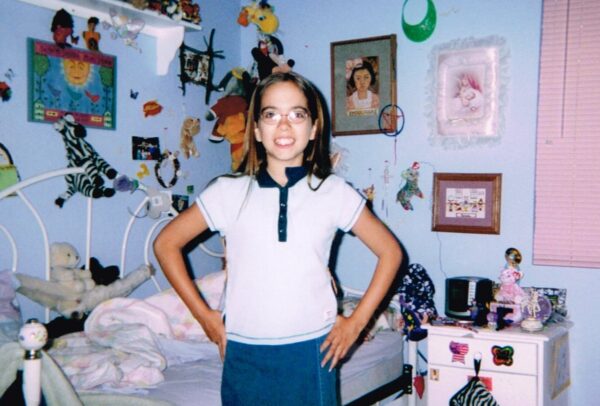
LAist’s new K-12 reporter Mariana Dale says she comes to the beat “with all the enthusiasm for learning as 11-year-old me.”
ABOUT THE AUTHOR
Alexander Russo
Alexander Russo is founder and editor of The Grade, an award-winning effort to help improve media coverage of education issues. He’s also a Spencer Education Journalism Fellowship winner and a book author. You can reach him at @alexanderrusso.
Visit their website at: https://the-grade.org/