The Washington Post’s award-winning school gun violence specialist describes why he focuses on children’s experiences and the strategies he’s developed to produce vivid coverage.
By Alexander Russo
Over the past several years, the Washington Post’s John Woodrow Cox has reported numerous stories about the young survivors of school gun violence.
While the media focus on school-based gun violence coverage is a concern for some observers — including me — Cox’s award-winning coverage is vividly detailed and intensely humane.
What’s it like producing so many of these stories, and what has Cox learned about how to produce them without retraumatizing his characters or traumatizing himself?
As you’ll see from the following interview, Cox has developed a number of specific methods to approach and interview vulnerable sources, including doing a lot of pre-interview reporting and being careful about which questions he asks his subjects directly.
Thoughtful, calm, and conscientious, Cox has turned out to be uniquely well suited to doing this kind of work. But he didn’t start out intending for the effects of gun violence on children to be his beat.
“I just had kind of an ease with writing about children who had endured some form of trauma,” says Cox. “So I just kept doing it.”
I just had kind of an ease with writing about children who had endured some form of trauma.
This interview has been edited for length and clarity.

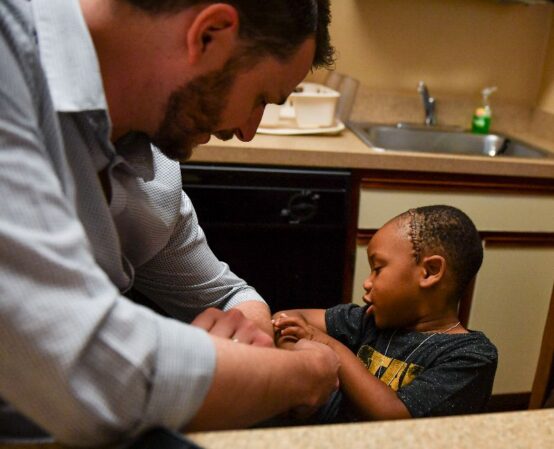
Above: A 2017 image of John Woodrow Cox (left) and Cleveland gun violence survivor Carter Hill, then 4, pointing out the freckles on the reporter’s arm. Image used by permission. Credit: Ricky Carioti.
How would you describe the beat that you’ve crafted?
JWC: In the most basic of terms, it’s trying to reveal the impact of gun violence on children in America with a focus on giving voice to the children. Historically when you read stories about children in proximity to shootings or being shot themselves, it’s almost always told through parents or teachers or officials or therapists. Very rarely is it told through the eyes of the children who were actually involved.
How did you end up taking this on?
JWC: When I first came to the Post, my editor, Lynda Robinson, was running a project called “Children of the Fallen,” about children whose parents had been killed in the war in Afghanistan. I took on a few of those along with several of my colleagues and I just found it kind of easy to interview children. I just had a kind of an ease with writing about children who had endured some form of trauma. And then going into 2017, my editor had an idea about maybe doing a project about how children are impacted by violence more broadly. The first story that I wrote was about Tyshaun McPhatter, who became one of the two subjects of my book.
What was so eye-opening about that first story?
JWC: What was so revelatory about the experience of reporting on Tyshaun in his school in Southeast DC was that that all these children had been impacted by gun violence, but none of them had been physically harmed. None of them had ever been shot, but they had all known someone who’d been killed. They’d been on a playground when somebody opened fire. They’d seen dead bodies on their way to school. It just shaped every aspect of their life. And through the reporting of that story, I realized that I needed to focus specifically on how children were being affected by gun violence in all the different ways that surface in their lives. The more I did, the more I felt like I had to say. I’m not sure how much I have left at this stage, but every year when I debate stepping away, I feel like I have a little bit more to do. So I just kept doing it.
Every year when I debate stepping away, I feel like I have a little bit more to do.
What are the top three things that you tell journalists who are doing this kind of work?
JWC: The first one would be to do as much pre-reporting as you can. That serves a bunch of different purposes. One is that you understand what areas not to get into with a kid — if a kid is extremely sensitive to a certain subject or a certain question, if something might be triggering, then you want to know that before you sit down. Talk to the parents, talk to teachers, talk to anybody you know, siblings — anybody you can get access to around that kid before you talk to that kid. Pre-reporting also allows you to not have to ask the kid every single question.
What kinds of pre-reporting questions should reporters ask?
JWC: I always suggest that reporters ask the people around the kid what questions that child has been asking. Because I think there is no better way to understand what a kid is thinking, the anxiety they’re dealing with, than the questions that they’re asking. If you ask a kid of almost any age how they’re doing, they’ll almost always say, ‘I’m okay.’ ‘I’m fine.’ It’s not a useful question. But if you find out what they’ve been asking, it tells you where their mind is. So, you know, Tyshaun was a good example. He was asking who the shooter was and why the shooter did what he did. If his dad had been carrying a gun, if the shooter was going to come after him too.
Pre-reporting allows you to not have to ask the kid every single question.
What do you recommend when you finally get to interview the student?
JWC: When you actually get to the interview with the kid, it’s really important to explain who you are and what you do, to show them stories that you’ve written — not necessarily to have them read them, but just take out your phone and show them this is what this will look like. And then you tell them that they’re in charge, that you are not an authority figure — that they don’t have to answer any questions that they don’t want to answer. Unlike other adults who can tell them what to do and when to do it, with me, they get to decide what they want to say and when they want to say it.
Especially with younger kids, I try to sit on the floor, you know, get their eye level above mine just because it’s all about trying to create a space where they feel in control.
Is there anything else that you do to protect your sources?
JWC: I pretty carefully take people I interview through every detail in these stories. I never give people editing power. I never give them a copy of the story. But I take them through it carefully. Almost no one I write about has ever had any media exposure. The primary purpose of that conversation is to make sure that I have everything right. But it also allows people to get a full understanding of what is going to be said about them or their child. And it gives them a chance to say, ‘This would be incredibly embarrassing for my kid when they turn 18, can you leave that out?’
It’s never a situation where I’ve given them that authority, but I give them the chance to raise it. And then I can say, ‘Okay, well, let me have a discussion with my editor about that.’ Journalists have historically given too much editing power to sources, but as long as you’re careful and you strike that balance, I think that’s really important.
There’s no better way to understand what a kid is thinking than the questions that they’re asking.
What about self-care?
JWC: You know, I’ve not come up with a perfect way to take care of myself. I find that talking through the details of the reporting nearly every day with my editor is really important and cathartic to kind of get it out of my system. When I have difficult reporting days, I share what I saw and heard through a journalistic lens – ‘Here’s what happened, let’s talk about how to use it in the story’ – but it’s also an important process for me, personally.
Also, I can’t really carry — I can’t collect people, right? I can’t continue to keep up with them forever. Now, if somebody ever reaches out to me, then I always respond. But when a story is done, in most cases, I’m not checking in with people because I just can’t carry that. For me to be able to do the next one, I have to let go of the last one.
What about therapy?
JWC: I’ve always preached to people that if they feel like they need therapy, they ought to get it. I had a pretty difficult response to the Uvalde shooting and, and after years of my wife and my editor prodding me to see a therapist, I’ve started doing that.
It’s easy to be dismissive of your own feelings, right? Because you think the people you are talking to, their situations are worse. But at the same time, the way I try to think of it is that if we as journalists don’t take care of ourselves and treat ourselves the right way, then we’re doing a disservice to those people. We can’t do the job the right way.
It’s easy to be dismissive of your own feelings, right?
How has your practice changed over time? Is there anything that you did in the early years that you wouldn’t do now?
JWC: I think that I wish in the beginning that I had done more preparation, more research into how to interview traumatized kids. And I wish that I had done more research into that kind of specific area. And I don’t think it cost me in the end, I think I got kind of lucky that it worked out and that I just kind of happened to make the right choices.
What is an example or a situation where your instincts were correct, but you weren’t necessarily acting based on what you now know are best practices?
JWC: About a year into this reporting, I heard at a journalism panel about a therapist’s advice that if you take people into a really dark place in the course of conversation you have to bring them back out. You can’t leave them in that place. And that’s a thing that I do very intentionally now. I write two or three questions in the back of my notebook so that if it’s gotten really hard and I’m sort of blank I can reference those at the end of an interview to bring that kid back to a good place. And I do the same thing with adults. It’s a technique I use all the time. That’s probably the sort of thing that a therapist who specializes in this work could have told me.
Have you changed the way you pick sources and decide whom to focus on?
JWC: I would now be a bit more cautious about the stories that I was willing to spend a lot of time on. I think that sometimes if the red flags are really prominent in the beginning then you should seriously consider whether it’s worth it because I’ve been in some situations where I’m weeks or months into something and the reporting just becomes nearly impossible. It’s typically not anybody’s fault. People’s lives are chaotic and you’re not their priority. But I think sometimes if you sense from the beginning that it’s going be really hard to reach this person consistently, then the reporting just may not be worth it. You need to consider that.
Do you think that you’ll ever stop doing this kind of journalism?
JWC: I do view what I do as a real privilege. It really is a privilege to get this sort of access into people’s lives and to get to share their stories with a wider audience. That is something that I don’t take for granted. I’ve devoted over six years to this, and don’t know how much longer I’ll do it, but this time in my career has been a gift.
Previously from The Grade
‘If you need to cry, cry.’ 6 education reporters’ advice on covering school shootings
The case against focusing on school gun violence
Covering trauma in schools (Lee Romney)
First, do no harm — but how? (Danielle Dreilinger)
‘Incredibly dangerous’: How gun violence coverage focused on mass school shootings is misleading the public (Lois Beckett)
School shootings aren’t crime stories, they’re public health stories (Greg Toppo)
ABOUT THE AUTHOR
Alexander Russo
Alexander Russo is founder and editor of The Grade, an award-winning effort to help improve media coverage of education issues. He’s also a Spencer Education Journalism Fellowship winner and a book author. You can reach him at @alexanderrusso.
Visit their website at: https://the-grade.org/