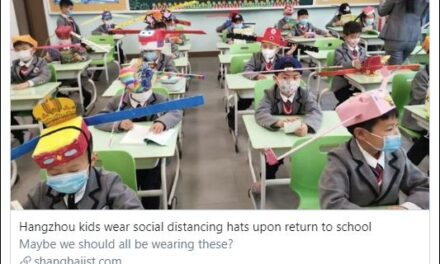
In this week’s newsletter: Tragedy in Nashville. The hidden lives of unaccompanied migrant children. Pushback on reading. Much-improved coverage of school shutdowns. How to find and interview a school culture warrior — and turn it into a viral story.
NASHVILLE TRAGEDY
The big story of the week
The big education story of the week is the tragic school shooting at a private school in Nashville, during which — for reasons currently not entirely known — a former student shot and killed students and adults before being killed by police (Tennessean, ChalkbeatTN, Associated Press, NYT, NPR).
Horrifying and enraging as these events are, I’ve come to believe that school gun violence coverage as currently practiced by most outlets plays an unintentionally toxic role. It unnecessarily terrifies parents and students, misleads policymakers, traumatizes survivors and journalists — and it likely contributes to copycat attempts. And, despite its abundance and journalistic quality, this kind of coverage has failed to produce dramatic changes in gun control or manufacturer liability.
We need to find another way.
Other big stories of the week:
📰 SCIENCE OF READING PUSHBACK: While many districts have now embraced the “science of reading,” others — educators and teachers unions among them — are beginning to push back against state proposals that would mandate it (EdWeek, The 74, OPB, Chalkbeat NY). Meantime, California districts report wildly varying literacy rates for English learners (EdSource). There’s so much activity on this front — and SO. MUCH. room for more literacy coverage, especially from big national outlets like the New York Times, Washington Post, AP, and NPR.
📰 SPRING EDUCATION ELECTIONS: In Chicago, former CPS CEO Paul Vallas and Chicago Teachers Union organizer Brandon Johnson are facing off in the mayoral runoff with starkly different visions of K-12 education (The 74, Chalkbeat Chicago). In Denver, 22 candidates are running for mayor, with some pushing for more power over the state’s largest school district (Chalkbeat CO, Denver Gazette) and another looking to put an end to the school-to-prison pipeline (Mother Jones). At least five states are holding school board elections as well (Ballotpedia), including in suburban Chicago where conservative candidates have turned the races into fiercely political battlegrounds (Chicago Tribune).
📰 HEATED HILL HEARINGS: The House Select Subcommittee on the Coronavirus Pandemic held a hearing Tuesday about the consequences of school closures, with freelance journalist David Zweig as a witness (The Hill, Silent Lunch). At a separate event, House Republicans grilled Merrick Garland about the FBI referring 6 of 22 threats against school board members to state or local law enforcement (USA Today, CNN).
📰 PUNISHMENT DYNAMICS: Lawmakers are pushing to bring back student expulsions, sometimes at the behest of teachers unions (Chalkbeat). At the same time, Education Secretary Miguel Cardona called out states where corporal punishment is still legal in schools (US News, Atlanta Journal-Constitution). At least one state may soon outlaw it (CPR).

HIDDEN LIVES
The best education journalism of the week
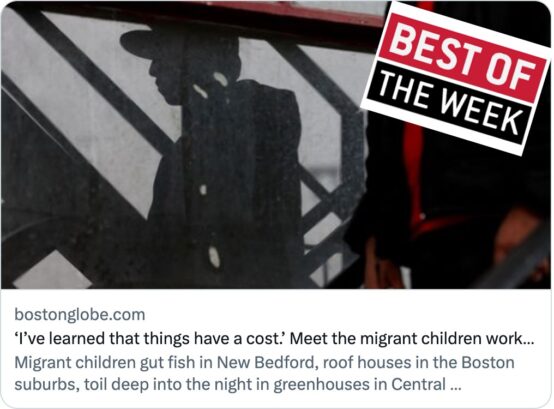
This week’s best education journalism is Meet the migrant children working long hours in factories and fish plants by the Boston Globe’s Katie Johnson.
One teenager works the overnight shift at a plastics factory. Others process fish, roof houses, pack food, or work in restaurants. Many are unaccompanied minors under immediate pressure to help with rent and send money home.
It’s not a school-based story; it’s not even really an education story. But that’s sort of the point. It reminds us that kids have lives outside of schools that affect how much they can participate in their own education — and that journalism can find and depict their lives in important, powerful ways.
Migrant children who work often struggle to continue their education. Many schools aren’t prepared to serve children with jobs or to provide language and literacy training. Some drop out and return to their home countries — or try and pursue a GED. Said one 19-year-old high school senior through a translator: “Sometimes I just feel like there is no way forward.”
We need more journalism that takes readers into vulnerable students’ lives, makes real the challenges they face, and helps clarify how schools can help.
BONUS STORIES
🏆 The Catch-Up: LAUSD Bets on Tutoring for Post-Pandemic Recovery, but Progress at Many Schools Is Slow (Palabra)
🏆 Here’s why Arizona students still aren’t going to school post-COVID-19 (USA Today)
🏆 Long Island teacher misconduct: More than 100 educators resigned after allegations (Newsday)
🏆 In Pajaro, children and teens grapple with displacement after flooding (LA Times)
🏆 Poverty and Education are Inextricably Linked (Voice of San Diego)
🏆 Berkeley High was once Cal’s biggest feeder school but not anymore (Berkeleyside)
🏆 32 states and counting: Why parents bills of rights are sweeping US (Christian Science Monitor)
INCLUSIVE SHUTDOWN COVERAGE
Our latest columns and commentary
Food distribution. Childcare. Lost shifts — and missing SPED services. I really appreciated what seemed like a broader, more family-inclusive approach to covering last week’s LAUSD school shutdown — as well as the chance to talk with education editors, including the LA Times’ Stephanie Chavez and LAist’s Ross Brenneman.
If and when schools shut down again — for whatever reason — I hope that the recent LA coverage will serve as a new, more inclusive model.
SMALL GROUPS IN STOCKTON
Coverage of promising school innovations & signs of progress
💡 Stockton’s largest school district saw higher graduation rates after implementing a summer school program that blends self-paced online coursework with small-group instruction (Stockton Record).
💡 As New York state reconsiders graduation requirements, a group of NYC high schools that’s been forgoing the year-end Regents exams for two decades — and whose students have posted better college outcomes than their peers — is getting attention from policymakers (Chalkbeat New York).
💡 After replacing a discredited but still hugely popular literacy program with a more systematic approach, a Bay Area elementary school has seen significant gains in reading achievement (EdSource, March 8).
💡 A partnership between a D.C. school and a local university allows students to pursue their high school and college degrees simultaneously, offering one solution to the city’s poor college achievement record (Washington Post).
Also: See here for tips on how to embrace solutions journalism and a free training from the Solutions Journalism Network on April 11 (register here).
Read more about the importance of covering promising innovations and preliminary successes.

PEOPLE, JOBS
Who’s going where and doing what
Above: Star reporter Jill Barshay, who writes the Hechinger Report’s Proof Points.
Spotlight: The Hechinger Report’s Jill Barshay is a star on the beat and a regular presence in this newsletter. Her latest is an excellent piece about high school graduation rates rising — even as fewer students are projected to graduate from college. “As I cover pandemic fallout,” she writes, “I am constantly struck by the grim academic toll — and how oblivious so many families are to their children’s predicament.”
Awards: Congrats to the latest crop of Spencer Education Fellowship winners: Inside Higher Ed’s Susan D’Agostino, CalMatters’ Joe Hong, the Hechinger Report’s Jackie Mader, and NPR fellow Seyma Bayram. Great projects, great picks. Check them out. Kudos also to ProPublica’s Jodi Cohen and Melissa Sanchez, recipients of Chicago media’s highest honor, the Studs Terkel award.
Career moves: The Atlanta Journal-Constitution’s newest ed reporter is Martha Dalton who comes from WABE Atlanta, where she reported on education and immigration. The paper also named a new editor-in-chief: Leroy Chapman Jr., who managed the paper’s coverage of the 2009 cheating scandal. And congrats to new dad Michael Elsen-Rooney, who is going on parental leave from Chalkbeat New York for a few months.
Reporter reflections: For The 74, NYC education writer Alina Adams reflected on her humbling education in what families really want from their kids’ schools: transportation, safety, afterschool, special needs, and academics. And Poynter’s Kelly McBride looked back on her decade of covering crime, reflecting that she wasn’t giving readers useful information but “telling juicy stories.” Any ed reporters willing to reflect on their work? Hit us up. We live for this stuff.
APPEARANCES, EVENTS, & NEW RESOURCES
What’s happening and new research
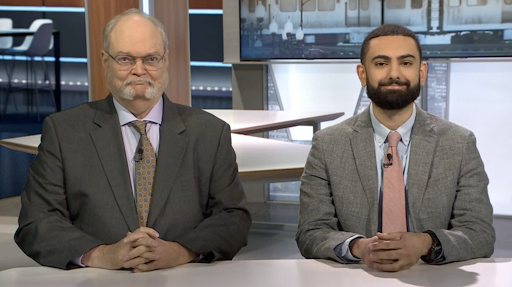
Above: The Chicago Sun-Times’ Nader Issa, right, on WTTW’s “Week in Review.”
Appearances: Chicago Sun-Times education reporter Nader Issa was on WTTW’s “Week in Review” talking about next week’s mayoral runoff. OPB education reporter Elizabeth Miller was on WBUR Here & Now talking about her story on students with disabilities and their “uphill battle” to get equal access to education. WBUR’s Carrie Jung was on Radio Boston talking about whether changes to the forms educators use to get students special education services will lead to improvements. And CommonWealth magazine’s Jennifer Smith talked about whether Massachusetts should grant teachers the right to strike on the outlet’s podcast. (There’s also a helpful writeup from Smith on the issue here.)
Upcoming: The aforementioned Jill Barshay is moderating panels on equity and academic recovery on April 4 and high dosage tutoring on April 18. Georgetown’s Edunomics Lab is hosting its Certificate in Education Finance residency in Los Angeles April 12-13, but you can get a preview of what Edunomics honcho Marguerite Roza has to say in this recent column she wrote about “messy” times ahead for school district budgets (and how to cover them).
Research & reports: The CDC released a report last week showing that autism is being diagnosed more frequently among Black and Hispanic kids than white kids (AP, Minneapolis Star Tribune, USA Today). In the aftermath of the Nashville school shooting, The Journalist’s Resource updated its collection of research on the impact of school shootings on survivors and schools, including declining student achievement and enrollment drops. And the New York Times’ Ellen Barry wrote about a new study showing that “hospitalizations for pediatric suicidal behavior increased by 163 percent over an 11-year period.”
THE KICKER

“My willingness to pick up the phone and cold-call someone is my one remaining advantage over younger, better journalists,” says Slate’s Dan Kois (left) about his viral interview with a conservative Florida charter school board chair (center) upset when parents weren’t warned their children would be viewing Michelangelo’s David (right). “Don’t tell them.”
ABOUT THE AUTHOR
Alexander Russo
Alexander Russo is founder and editor of The Grade, an award-winning effort to help improve media coverage of education issues. He’s also a Spencer Education Journalism Fellowship winner and a book author. You can reach him at @alexanderrusso.
Visit their website at: https://the-grade.org/