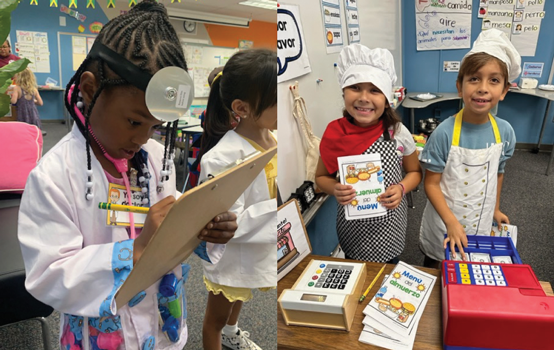
Ed Hidalgo brought his World of Work K-12 curriculum to California’s Cajon Valley Union School District, which starts career exploration in kindergarten.

Ed Hidalgo
PHI DELTA KAPPAN: What does career awareness in the early grades look like?
HIDALGO: When we talk about career-related learning, what’s interesting is that much of the CASEL [Collaborative for Academic, Social, and Emotional Learning] framework of social-emotional learning aligns beautifully with the work that we’re doing. When we talk about career, it’s really about the individual understanding who they are and where they might fit in the world. In a broader sense, we’re helping to build identity for young people: a personal identity of strengths, interests, and values, so they know there’s a place for them in the world. It can start in the early grades, and kids love it. They love knowing that there’s a connection between who they are and a place in the world for them. It’s not about tracking or locking them into a pathway. It’s about a process of exploring themselves and understanding the world around them. It works because kids like talking about themselves and learning about the world.
In the early grades, we rely on self-reporting; teaching the language of interests; and building out the idea of strengths, interests, and values. We celebrate interest change daily, weekly, monthly, yearly. We know kids are going to change. Their interests are going to change as they have experiences. But in this process of exploration, students get to build a better understanding of themselves and the world. They also identify those highlights where they see themselves fitting best. That doesn’t happen through assessment; it happens through experience. Our teachers are giving students the experience of exploration of self, within content areas, with special speakers, field trips, and internships. They’re doing the work to understand themselves. The common language helps them land the plane and be able to articulate “who I am and who I think I want to become.” It all works together. And that’s why it’s a human process.
KAPPAN: Can you talk about the World of Work curriculum?
HIDALGO: The World of Work is a truly a massive tool set that we created. The essence of the work is John Holland’s framework. It is the common language of career that all teachers learn. They learn how to integrate it into their classrooms and their content areas and apply to the things that they’re already doing. Classroom jobs are connected to the RIASEC. Students may apply for classroom jobs based on their alignment with the interest themes that they claim. Teachers will say they never thought of integrating that before, and it all starts with the common language. And then from there comes the other elements of WoW.
Students attend career fairs based on RIASEC. If a student leads with social, what environment would make them feel socially useful? How about a hospital? They can start their journey during the job fair with the recruiters from the hospital and see how their interests align to that experience and that work environment. After that, we can reflect: Did it feel right to you? Did it get your core interested? Those types of reflections and that type of processing are important for students because career development is a human process, and it’s best processed between adult and student, and adult and adult. It’s a conversation and a collaboration. Through that common language, those types of experiences are being realized. And quite frankly, it works. Research tells us these are the best ways to be doing career development. We’ve just operationalized it.
What’s fun is that students are so comfortable and confident with the language. It doesn’t take long for an elementary school teacher to understand the themes of their students. And the teacher doesn’t have to remind the students of their interest themes. The students own it, and when they own it, it becomes real. The Beable platform helps to accelerate this process because not only does it improve students’ time on task in relation to building literacy skills, but you have career-related learning interwoven into the process.
KAPPAN: What concepts are introduced to younger students about careers?
HIDALGO: When students, littles as I’ll call them, leave the home in the morning, they tend to see some community helpers. It may be a police officer or firefighter. They could be visiting the dentist or a doctor, or maybe seeing a nurse. It’s very common for them to be interacting with the world of work. So why wouldn’t we talk to young people about our community helpers? Why wouldn’t we talk about stereotypes associated with workers and workplaces and who do you see here and who don’t you see here? And do you think this could be for you? Why or why not? What do you think of the talents and the giftings of the people in these roles? Would you have an interest doing this type of work?
These conversations really build up a child, build up their spirit, helping them recognize that they have giftings that are needed in the world. When you build that foundation, you can start to think about some of these more complex roles like a cybersecurity engineer, electrician, or genetic counselor. Starting in those early grades with those community helpers is really powerful, and it supports why this work is important. It’s not about tracking a child to a specific job. It’s about opening their eyes to those community helpers and the world of work, something that they’re going to be a part of in the not-too-distant future.
With the younger students, there’s quite a bit of self-reporting that takes place. Teachers invite students to identify their top themes as they learn the language. Teachers will employ rotation stations, where students will rotate and participate in activities aligned to the theme areas. And at one of those stations, the teacher is talking about one of the themes and building the language with the student. Once you build that common language, you can start talking about characters you are reading about. What are their themes? What do we think about Charlotte’s Web? Do we think Wilbur is enterprising or social? There’s no right or wrong. It’s students being invited to voice their opinions. Those are things that teachers are already doing in the classroom. We’re just tying it back to that common language, that connection back to career, and that’s when it becomes a consistent language that you can see and hear daily.
Career learning can start in the early grades, and kids love it. They love knowing that there’s a connection between who they are and a place in the world for them. It’s not about tracking or locking them into a pathway. It’s about a process of exploring themselves and understanding the world around them.
The outcome of those foundational experiences and skills is that they begin to identify their own interest themes, and they identify and understand the unique themes of their classmates. Through that process, students then begin to form collaborative teams for projects. Instead of homogenous theme groupings, now they realize, “my team is better when I have different themes on my project team because I’m the enterpriser, but you’re the great artist. I want you to come in and bring the art theme.” And it’s amazing to watch it roll out. Kids are building their own well-rounded teams. Kids learn how to do that on their own — what an essential skill that is. You can’t do everything on your own. You need to have complementary gifts on teams. And together, we’ll get across the line and be successful.
KAPPAN: What training and support did teachers receive to do this work?
HIDALGO: Teachers are the heroes of this integration success. The mastery that many possess has made all the difference in helping students access this new form of learning. I have been so impressed with the craftsmanship and artistry, especially in the early grades, that has been demonstrated by the Cajon Valley teachers.
When we first started out, I visited with more than 900 teachers at all the school sites, and I introduced them to this process that would allow them to experience their strengths, interests, and workplace values. For many of them, it’s something they’ve never contemplated. As we’re thinking about the benefit to young people with this program, there’s also a benefit to the adults because they’re in their careers. They should be considering and thinking about their strengths, interests, and values. How is it that I do my best work through my strengths? What are my interests, my true interests? Am I in the right role? Is this where I’m supposed to be? Why is it that I come here every day? Why does this work matter to me? Do I feel fairly compensated for the work that I’m doing? Is this where I’m supposed to be at this stage in my career? We had those heavy conversations.
Some people were really interested and lit up by the work, and some people wanted no part of what I was talking about. It’s been six years, and I’ve seen the early adopters. I’ve seen those who arrived a little bit later in the journey, some who were recruited by those early adopters. For others, it just took a little bit longer to hear the messaging and understand why we were doing this. It’s not about having young people select the jobs they’re going to do. It is about building an identity, a career identity. It’s about building hope and possible selves for every child and helping every child discover their strengths, interests, and values, and seeing themselves in the world. We’ve gotten a lot of folks on board along the way. And it’s been good.
KAPPAN: How did the Cajon Valley parents react?
HIDALGO: In Cajon Valley, families speak Arabic, Pashto, Farsi, Swahili, and Spanish, among others. The district has a significant population of Syrian and Iraqi refugees. It’s a resettlement destination for many people living and dealing with crises in other parts of the world, especially Syria, Iraq, and Afghanistan. What do these families want? They want their kids to be happy. When they come to this country, they only articulate doctor, lawyer, and engineer as the job they want for their kids. As they process this idea of well-being, happiness, strengths, interests, and values, the parents completely switch their thinking. They say, “I want my child to do the work that they were meant to do, to be in a place where they can do their best work and make a difference in the world or solve that problem they’re most interested in.”
So, we have a wonderfully diverse population of students and families. Some are very low socioeconomic status (SES). Some are very high SES. Both sets of parents tell us the same thing: “I wish I would have had this when I was my child’s age.” I’ve not had one parent who said, “I don’t want this for my child.” Parents will come up to me and say, “Mr. Hidalgo, is my child going to get this next year too? I want them to keep getting this thing.” I love working with the parents. It’s a new language for them as well. But once they understand it, they see their kids through a different lens. And that’s powerful.
KAPPAN: Why is it important to include the youngest students in these discussions?
HIDALGO: You always hear teachers asking, “How do I create more relevance in my content area?” This is the ultimate relevance connection. For example, take Martin Luther King Jr. Day. Could you ask for a better example to bring relevance into the classroom? What do we think were Martin Luther King’s top themes? Do you think he led with social? Was he a social helper? Was he an enterprising persuader? Let’s look at one of his most important speeches. You watch the speech and then you ask the students, “How many of you could see yourselves doing the same thing? Or how many of you have interest themes that might align with King, and which themes are those? Can you see yourself one day giving a speech in front of a lot of people? What are the themes that you claim?”
Our teachers are giving students the experience of exploration of self, within content areas, with special speakers, field trips, and internships. They’re doing the work to understand themselves.
We talk so much about personalized learning. Is what we do in school really personalized? Is it really personal? Do we really understand the child? Do we really involve them in an agentic process of understanding themselves? The beauty of Holland’s work is the simplicity. Even the youngest students can have these conversations. Once they learn the language, the payoff for a teacher is engaged students who understand themselves and understand each other. Longer term, it helps to build a language that will be useful in middle school and high school for students, perhaps connecting to CTE pathways, dual enrollment pathways, classes, activities, after-school functions. You’re setting the stage in the earliest grades for a child’s future possible self, and that’s why we should be doing it in the early grades.
Adults don’t spend a lot of time in that reflection process. We don’t think about our strengths, interests, and values. We’re the ones who navigate around careers. Are we on a conveyor belt of career? Or are we taking an active role in experiencing the opportunities that might be in front of us? When we stop to understand who we are, and maybe consider what we’re doing and what we want to be doing, we might have richer lives for ourselves as adults. And if we can do that for the adult humans, there’s a greater chance that when they go into their classrooms, they’re more willing to give that to our little humans or adolescent humans. Everyone can win together.
This article appears in the March 2023 issue of Kappan, Vol. 104, No. 6, pp. 29-33.

ABOUT THE AUTHOR

Kathleen Vail
Kathleen Vail is editor-in-chief of Kappan magazine.
Visit their website at: https://pdkintl.org/