A national survey shows suburban superintendents face more political tensions than leaders in other districts.
The song, “Little Boxes,” made famous by Pete Seeger in 1963, is a political commentary on the perceived lack of diversity and conformist attitudes within suburbia. The satirical lyrics describe “little boxes made of ticky tacky,” as well as a shared middle-class affinity for golf, summer camp, and dry martinis. Each stanza concludes with some variation of “And they all look just the same.”
These lyrics may have been accurate in the 1960s, but the suburbs in the 21st century are no longer so homogenous. The suburbs have become more economically, racially, and politically diverse, a trend that has accelerated since the onset of the pandemic (Chang & Atkins Stohr, 2022). According to U.S. Census data, within every major racial group, the majority now live in suburbs; and the majority of youth in suburban areas are now students of color (Frey, 2022). Additionally, people fled high-population-density areas during the pandemic. As work arrangements became more flexible, suburban regions saw “explosive growth” (Chun et al., 2022; Henderson, 2022).
Diversification of the suburbs has also shifted their political allegiances. Rural areas are reliably Republican, and urban areas overwhelmingly vote for Democrats. The suburbs have become swing districts with actual swing voters (Sosnick, 2022). More specifically, suburban areas with higher population density are more likely to host competitive political races (Montgomery & Florida, 2018). Strategists in both major political parties recognize the political value of these areas, often targeting campaign advertisements toward suburban voters (e.g., Chinni & Zitner, 2020; Mutnick, 2022). Politicians such as Virginia Gov. Glenn Youngkin and Florida Gov. Ron DeSantis have brought the fight for suburbia’s vote into our public schools (Cohen, 2022; Gabriel & Igielnik, 2022; Milligan, 2021).
Tension over culture wars
Public schools have become the de facto barometer of national emotion, taking center stage for many of the ongoing culture war debates. These debates include pandemic policy disputes and the supposed teaching of critical race theory (CRT) in schools. More broadly, the disagreements are about how educators should be teaching about our nation’s past; if and how educators should address diversity, equity, and inclusion; and the acceptability of certain curricular materials (Kumashiro, 2021; Malin & Lubienski, 2022).
Over the past two years, we have seen numerous incidents of school officials being threatened and school board meetings erupting into chaos (Reilly, 2022). Indeed, such disputes were so intense that, in September 2021, the National School Board Association appealed to federal policy makers to act “regarding threats and acts of violence” against public school district officials, educators, and school board members. Even this step proved to be contentious — illustrating the difficulty of balancing the need to ensure the safety of school officials and staff with the imperative to empower parents to voice their opinions on how their children are educated.
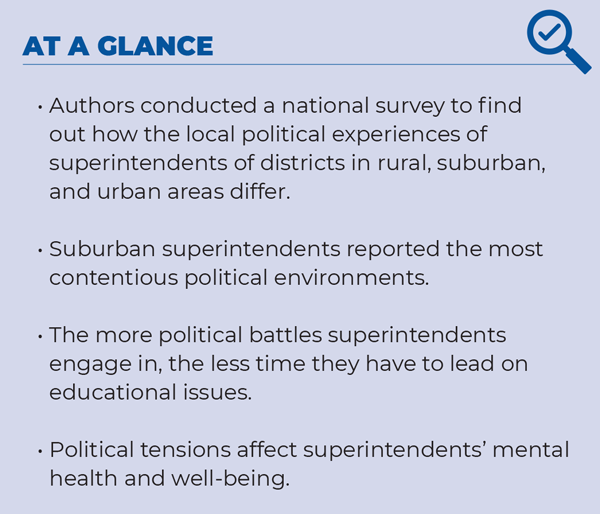
We recently conducted a nationwide survey to learn more about the experiences of superintendents as they attempt to lead districts through these contentious times. We sent the survey to approximately 12,500 K-12 public school superintendents and included questions focused on local politics and school board relations, mental health, and leadership lessons. Our goal was to explore the following question: How do the local political experiences of superintendents of districts in rural, suburban, and urban areas differ?
Our response rate was approximately 8%, comparable to other national superintendent surveys. In all, 944 superintendents agreed to participate, and 872 completed the full survey, including 316 (about one-third) who indicated their district was suburban. Although no publicly available national superintendent demographic data are readily available, when we compared our respondents to those of a national database on superintendent gender (White, 2022) and reports from AASA, The School Superintendents Association, we saw close alignment on most dimensions. Therefore, we suggest our results can be cautiously generalized to the broader population of U.S. superintendents.
Suburban superintendents reported having significantly more experience as a superintendent than rural and urban superintendents and were significantly less likely to be serving as interim or acting superintendents. Additionally, suburban superintendents as a group are more gender and racially diverse than rural superintendents, but less so than urban superintendents. Suburban superintendents are more likely to identify as Democrats, particularly when compared to rural superintendents.
Our survey has the potential for respondent bias, particularly because it was voluntary. Superintendents who took the survey may have certain experiences, beyond their demographics, that made them more or less likely to volunteer to participate. Those experiences may not be representative of the full population. They do, however, give us a sense of how political contentiousness is affecting the work of many suburban superintendents.
Different place, different politics
Superintendents in our survey indicated that contentious political issues are pervasive in their districts. However, superintendents from rural, suburban, and urban districts had significantly different perceptions of local school board relations, the contentiousness of local politics, and community support and respect. We found a statistically significant relationship between superintendents’ district location type and the extent to which:
- Their most recent school board elections were contentious.
- They were concerned about what the most recent school board election may mean for their district.
- They were concerned about the platform or agenda of at least one candidate for school board.
- Their school board meetings have become more contentious, and attendance at the meetings has noticeably increased.
- There has been a substantial increase in the number of Freedom of Information Act requests their district received.
- They have felt or been threatened and are aware of at least one school board member who has felt or been threatened.
- They are concerned about the spread of inaccurate information related to their schools and/or decision-making processes and potential lack of support for their decisions from parts of the community.
- They feel they are being misunderstood and misrepresented.
- They have grown concerned about the mental health and physical well-being of their administrators, faculty, and staff.
Suburban superintendents reported the most contentious political environments on more than two-thirds of the survey questions. Overall, suburban and urban superintendents have significantly higher scores on a composite measure of political contentiousness, compared to rural superintendents.
The statistically significant relationship between superintendents’ district location type and these measures is propelled by differences between suburban and rural superintendents, and, in some cases, differences between urban and rural superintendents. For example, 47% of suburban and 46% of urban superintendents reported being or feeling threatened, compared to 34% of rural superintendents. Similarly, 65% of suburban superintendents agreed or strongly agreed that school board meetings have become more contentious, compared to 55% of urban superintendents and 47% of rural superintendents.
Ramifications of increasing contentiousness
What is the human toll of political contentiousness on superintendents? We were struck that 63% of superintendents shared that over the past two years, they (or people close to them) have grown worried about their personal mental health and well-being. Superintendents across district types (62% of rural, 64% of suburban, and 67% of urban superintendents) shared this concern.
The more political battles a superintendent must engage in, the less time they are able to spend engaging in the work that brought them to the position: providing the best education for students in their community. If superintendents cannot do this work in their district, they may consider moving on — either to another district or to another profession altogether. With this in mind, we also asked superintendents whether they had sought out a new position within the last two years, and 26% indicated that they had.
Rural superintendents had the highest proportion of job seekers (29%), followed by suburban (23%), then urban (21%) — though differences across district type were not statistically significant. We find no statistically significant differences in seeking out new positions — overall or within location types — based on gender, race, or political leanings. These figures are startling given that, for much of this decade, the superintendent turnover rate hovered around 14%. During the pandemic, the national superintendent turnover rate increased to 17% (White, 2022). As such, these figures may reflect a surge of superintendent turnover in the future.
The more political battles a superintendent must engage in, the less time they are able to spend engaging in the work that brought them to the position: providing the best education for students in their community.
Perhaps surprisingly, we did not find any significant correlations between superintendents’ intent to look for new positions and the survey questions focused on contentiousness. However, our questions concerning trust and respect may provide some insight into what keeps superintendents in their jobs. Superintendents were significantly less likely to seek out a new position when they reported high levels of trust and respect between themselves and their board; positive relations with their board president; and trust among administrators, faculty, and staff.
Networks of support
Overall, our results paint a bleak picture about the stresses of the superintendency, which aligns with recent findings from University of California, Los Angeles (UCLA) that focus on increasing stress among principals and teachers (Rogers et al., 2022; Woo et al., 2022). Regarding superintendents, those in suburban districts reported the most contentious and political environments relative to many of the dimensions we measured. This highlights the need to “invest in systems of support” for educational leaders who, in the context of the COVID-19 pandemic and a time of racial reckoning, have recently “led through the hardest moments of their careers with little to no relief” (Cooper, 2022, p. 73). If we do not find ways to support superintendents and ease an increasingly politicized school environment, we could see serious harm to the superintendency. If school leadership suffers, so will public schools and students.
Superintendents are described as the CEOs of school districts, projecting an image of a leader surrounded by a few trusted advisers, but largely working alone. Their responses to qualitative, free-response questions suggest that the past two years have taught school leaders how essential it is to authentically engage with their communities — emphasizing transparency, communication, and listening to diverse perspectives. Many superintendents used terms such as “controlling the message” and “constant and repetitive communication.” One superintendent emphasized “the degree to which people feel seen and heard is critical to securing buy-in and commitment to approaches that they may not actually agree with.” Another superintendent articulated the importance of documenting rationale for decisions, stating that “failure to be specific about the reasons for a decision opens the leader(s) and district up to increasing levels of criticism.”
When it comes to garnering support, it is not enough to simply develop a social media presence or hold a community forum every so often. Leaders need to be committed to building networks and to authentic forms of leadership and community engagement. Particularly in the rapidly diversifying suburban communities, authentic community engagement requires strong relationships with diverse stakeholders (Ishimaru, 2013). Developing strong networks can help superintendents work toward community goals and sustain their work in the face of both internal and external challenges (Auerbach, 2009).
How can we, as a nation, engage in critical and respectful self-governance in service of our nation’s schools — an incredible public good?
This work is not easy, of course, especially in a polarized political environment. Universities can lend their support and expertise by creating training opportunities that prepare aspiring superintendents to lead effectively through crises and political turmoil. Conflict resolution, cultural proficiency, and capacity-building are among the skills that could benefit future district leaders. For current superintendents, developing professional and personal networks of support that extend throughout and beyond their districts is imperative (Boudreau, 2022; Cooper, 2022).
Finally, this work should not all fall on superintendents alone. The current wave of increased political engagement related to K-12 public education is energy that can and should be harnessed. Dissent plays an important role in the strength of a democratic society. However, in many places, particularly suburban communities, some dissent has been threatening and even violent. How can we, as a nation, engage in critical and respectful self-governance in service of our nation’s schools — an incredible public good? Likely, such an effort begins one person at a time, actively embracing that, unlike in the “Little Boxes” lyrics, we are all not the same, but we are all human — including our district leaders.
References
Auerbach, S. (2009). Walking the walk: Portraits in leadership for family engagement in urban schools. School Community Journal, 19 (1), 9-31.
Boudreau, E. (2022, May 3). Stressed superintendents in a time of COVID: What district leaders need after a few tough years. Usable Knowledge.
Chang, J. & Atkins Stohr, K. (2022, February 2). The growing diversity in America’s suburbs. WBUR.
Chinni, D. & Zitner, A. (2020, September 9). Trump is targeting the suburbs, but they’re not all alike. The Wall Street Journal.
Chun, Y., Haupert, T., Roll, S., Foxi-Dichter, S.R., & Grinstein-Weiss, M. (2022, May 23). Did the pandemic advance new suburbanization? Brookings Institution.
Cohen, R.M. (2022, November 4). How education culture wars have shaped the midterms. Vox.
Cooper, J.M. (2022). Authentic leadership lessons from leading through a pandemic: Suburban superintendents share their stories (Publication No. miami1649455305196921). [Doctoral dissertation, Miami University of Ohio]. OhioLINK Electronic Theses and Dissertations Center.
Frey, W.H. (2022, June 15). Today’s suburbs are symbolic of Americas’ rising diversity. Brookings Institution.
Gabriel, T. & Igielnik, R. (2022, December 13). Despite modest G.O.P gains, Democrats maintain grasp on suburbs. The New York Times.
Henderson, T. (2022, May 26). Suburban areas saw pandemic population boom. The Pew Charitable Trusts.
Ishimaru, A. (2013). From heroes to organizers: Principals and education organizing in urban school reform. Educational Administration Quarterly, 49 (1), 3-51.
Kumashiro, K. (2021). Understanding the attacks on teaching: A background brief for educators and leaders. www.kevinkumashiro.com/attacksonteaching.
Malin, J.R. & Lubienski, C. (2022). Information pollution in an age of populist politics. Education Policy Analysis Archives, 30 (94), 1-23.
Milligan, S. (2021, October 26). Youngkin, McAuliffe tangle over education in bid for suburban Virginia voters. U.S. News.
Montgomery, D. & Florida, R. (2018, October 5). How the suburbs will swing the midterm election. Bloomberg.
Mutnick, A. (2022, November 2). GOP super PAC targets blue House seats in Illinois, New York. Politico.
Reilly, K. (2022, March 23). Culture wars could be coming to a school board near you. Time Magazine.
Rogers, J. & Kahne, J. with Ishimoto, M., Kwako, A., Stern, S.C., Bingener, C., . . . & Conde, Y. (2022). Educating for a diverse democracy: The chilling role of political conflict in blue, purple, and red communities. UCLA’s Institute for Democracy, Education, and Access.
Sosnick, D. (2022, March 21). America’s suburbs: Ground zero in 21st century politics. Politico.
White, R.S. (2022). National longitudinal superintendent dataset (2019-20 to present). [Unpublished data set].
Woo, A., Wolfe, R.L., Steiner, E.D., Doan, S., Lawrence, R.A., Berdie, L.,. . . & Schwartz, H.L. (2022). Walking a fine line — Educators’ views on politicized topics in school: Findings from the State of the American Teacher and State of the American Principal Survey. RAND Corporation.
This article appears in the February 2023 issue of Kappan, Vol. 104, No. 5, pp. 6-10.

ABOUT THE AUTHORS

Rachel S. White
Rachel S. White is an assistant professor of K-12 educational leadership at Old Dominion University, Norfolk, VA.
Michael P. Evans
Michael P. Evans is an associate professor in the Departments of Educational Leadership and Teaching, Curriculum & Educational Inquiry at Miami University, Oxford, OH.
Joel R. Malin
Joel R. Malin is an associate professor at Miami University, Oxford, OH. He is the co-editor, with Chris Brown, of The Role of Knowledge Brokers in Education and The Emerald Handbook of Evidence-Informed Practice in Education .