Pedagogy of the Oppressed
By Paulo Freire (Continuum, 1970)
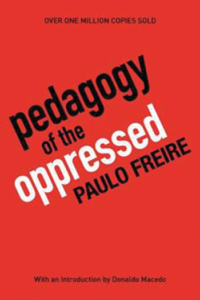 As the name suggests, Paulo Freire’s Pedagogy of the Oppressed advances a theory that seeks to inspire the creation of an education system for the oppressed, with the oppressed, so the oppressed can become free. Central to its arguments is the need for education to elicit critical consciousness or conscientização in learners, enabling them to recognize their oppression and inspiring their commitment to their own liberation. According to Freire, liberation involves praxis, the dual process of critical reflection and action.
Although Friere’s arguments often are viewed as idealistic and even radical, the book has been influential to the field of education, my own critical consciousness, and my research into how principals are being prepared to enact leadership practices for marginalized groups of students. In a society where raising critical awareness through dialogue and reflection about oppressive systems is currently being stifled behind critical race theory bans, there is a need for principals in particular to be critically conscious and for principal preparation programs to facilitate the development of this consciousness. Reading (or rereading) this book could help educators — school leaders and teachers — “to perceive social, political, and economic contradictions [within our education system], and to take action against the oppressive elements of reality” (p. 35).
This article appears in the February 2023 issue of Kappan, Vol. 104, No. 5, p. 69.

ABOUT THE AUTHOR

Mario Jackson
Mario Jackson is a doctoral student in the education evaluation and policy analysis program at North Carolina State University, Raleigh.