Though much more is needed, recent pieces from the Courier Journal and Ed Post show how to broaden literacy coverage.
By Natalie Wexler
In part five of her recent six-part podcast series, “Sold a Story,” education journalist Emily Hanford talks about a struggling young reader who bounced around reading levels seemingly at random: level B in kindergarten, J in first grade, back to E in second.
One reason reading levels aren’t reliable, Hanford explains, is that “a child’s ability to read a particular book has a lot to do with their background knowledge.”
A struggling reader who knows a lot about baseball might do fine with a level C book on that topic. “But,” Hanford says, “give her a Level C book about something else, like farming, and she’s lost.”
This was an opportunity to ask whether there’s anything more that schools could do to build the background knowledge that fuels reading comprehension. Instead, the podcast returns to the topic that has also been the primary focus of Hanford’s four previous hour-long audio documentaries on reading: schools’ failure to teach phonics effectively.
Hanford, a gifted storyteller and investigator, deserves enormous credit for focusing public attention on that issue over the past four years. I disagree with the 58 educators, including Lucy Calkins, who claimed in a letter to the editor of the Hechinger Report that Hanford has reduced reading to phonics; she’s acknowledged that comprehension is also important.
I do, however, agree with the educators that the story Hanford tells is incomplete. We just disagree on what’s missing.
The story Hanford tells is incomplete.
The educators say Hanford ignores stories of “incredible success” from schools that are using other “comprehensive approaches to reading instruction.” Given that Calkins is one of that group, they appear to be endorsing the approach to teaching comprehension that her materials and most other reading programs support.
My position is that, as I argued three years ago in a piece for The Grade, Hanford and most others covering reading instruction continue to overlook the grave problem with that approach: its failure to equip children with the knowledge that will enable them to understand what they’ll be expected to read in the future.
The good news is that a couple of recent news stories have gone beyond phonics to address a lack of content in the elementary curriculum that leaves many students unable to comprehend complex text.
I hope that more reporters, including Hanford, will follow their lead. If they don’t, educators, policymakers, and the general public may mistakenly believe that just changing our approach to phonics is enough to enable all children to become fully literate.
Educators generally see reading comprehension as the product of a set of skills and strategies, like “finding the main idea.” The focus is on those skills rather than on building kids’ academic knowledge and vocabulary, Subjects like social studies and science are often marginalized to make more time for comprehension practice, especially in schools where test scores are low.
But evidence from cognitive science shows the key factor in comprehension is how much relevant knowledge and vocabulary the reader has. Many kids reach upper grade levels without having had systematic exposure to subjects like history or science or to any complex text. The gaps in their knowledge make it hard for them to understand grade-level material.
Even Hanford’s 2020 audio documentary What the Words Say — ostensibly devoted to comprehension—only skims over the issue. We hear from a cognitive scientist who explains that reading comprehension requires both the ability to understand language and the ability to decode or recognize words.
Hanford also notes that children from low-income or non-English-speaking families generally enter school knowing fewer words, and she describes the experience of a woman who could decode words but couldn’t understand the vocabulary in books she was expected to read in high school. But that’s about it for discussing comprehension
Hanford isn’t the only journalist who has overlooked problems with comprehension instruction. Education-focused news outlets and mainstream publications including the New York Times and Time magazine have done so as well. But Hanford’s extensive reporting on the reading crisis has largely sparked this coverage, and it’s been influential in framing the issue as one of deficiencies in decoding instruction alone.
Hanford isn’t the only journalist who has overlooked problems with comprehension instruction.
Journalists may believe that the research on the relationship between comprehension and knowledge isn’t that clear. There’s plenty of evidence that people who have more knowledge also have better reading comprehension. But there’s relatively little experimental data showing that building knowledge will boost scores on standardized reading tests.
One reason is that the test passages are on random topics unrelated to the specifics of what kids learn in school. It can take years for students to acquire enough general academic vocabulary to do well on such tests, and few studies last that long.
Nevertheless, some recent rigorous studies of approaches that combine literacy and content instruction have found statistically significant results. I’ve written about two of them here, and information on two others is here and here..
A HUGE STORY THAT ISN’T GETTING ENOUGH COVERAGE
Several elementary curricula that combine literacy instruction with rich content and complex texts have been developed in the past five or six years, and an increasing number of schools and districts are adopting them. That’s a huge story that isn’t getting enough coverage.
Above: Mandy McLaren in The Courier Journal
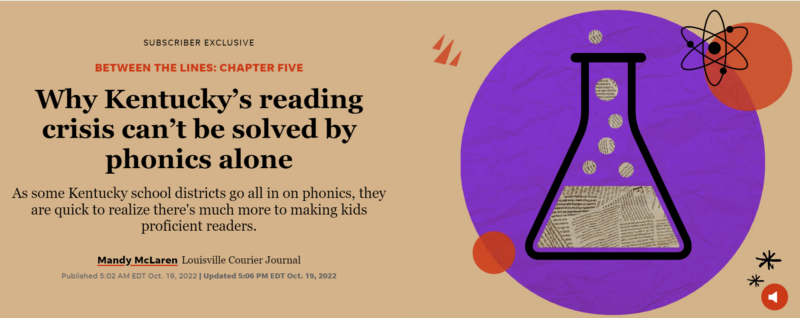
I’d love to see more stories like the last chapter in Mandy McLaren’s five-part series on reading for the Louisville Courier-Journal, titled “Why Kentucky’s reading crisis can’t be solved by phonics alone.” McLaren highlights a rural school where students in the early elementary grades are absorbing vocabulary like exaggeration, sorrowful, and willful.
They’re learning these words, McLaren explains, because teachers are reading aloud texts that are “two and three grade levels above [the children’s] reading abilities.” When a principal came to observe her second-grade class, one teacher says, students “were talking in such high vocabulary” that she feared the principal would think “I put them up to it.” McLaren also widens her focus to provide context, quoting literacy consultant David Liben as saying, “The science of reading is more than just phonics.”
Educators in the district started with improved phonics lessons, McLaren explains, but realized that just focusing on phonics plus the comprehension skills ostensibly measured by standardized tests—while letting science and social studies “fall by the wayside”—wouldn’t enable students to become truly literate. Eventually the district adopted an elementary curriculum called Core Knowledge Language Arts, which includes both systematic phonics instruction and meaty content.
In the first two years of implementation, McLaren notes, “the district increased its share of proficient readers in elementary school by 10 percentage points.” One teacher says she’s come to realize that kids “like being challenged. It’s their favorite part of the day.”
Above: Holly Korbey in the Ed Post
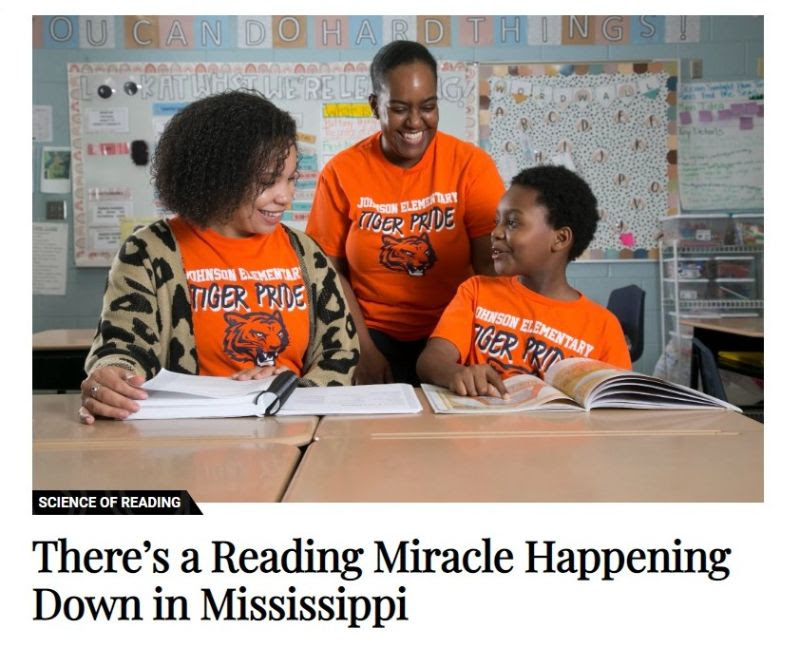
Another good story was produced by Holly Korbey for Ed Post. Her piece focuses on Mississippi, a state that has made strides in foundational skills instruction and is now trying to overhaul schools’ approach to comprehension.
Korbey’s piece ranges over several related issues, but she begins and ends with an elementary school in Jackson, a district that has adopted a knowledge-building curriculum called Wit & Wisdom.
“The part that has been really eye-opening and exciting for me is the knowledge piece,” Korbey quotes a school interventionist as saying. “What students need to be able to do is to deeply understand and discuss a complex text.”
Korbey describes kids doing “choral readings” of challenging text to build fluency and also slowing down to analyze it. A choral read of a book about Jacques Cousteau is part of a knowledge-building unit during which students “watched videos on shipwrecks, learned about divers and oceanographers, and tried to figure out the answer to questions like ‘why do scientists study the sea?’”
Journalists may feel they have their hands full with phonics, but these pieces show it is possible to also cover the importance of content-rich curriculum.
Journalists may feel they have their hands full with phonics, but these pieces show it is possible to also cover the importance of content-rich curriculum.
And the website of the Knowledge Matters Campaign offers a wealth of helpful resources from basic explainers to deep dives—along with videos of classrooms and detailed descriptions of six knowledge-building curricula. (I serve on the board of the Campaign’s parent organization.)
If reading coverage fails to highlight comprehension issues, I fear the progress now being made in decoding instruction will be reversed. In the past, phonics skeptics have pointed to the fact that some kids could decode complex text without understanding it to argue that phonics “doesn’t work.”
If that happens again, we may go back to a situation where children neither learn to decode nor acquire the knowledge that enables reading comprehension.
Previously from this author:
The media blind spot hiding a big problem in American classrooms
No, anti-CRT laws don’t actually outlaw lessons that might make students uncomfortable.
Previously on literacy coverage:
After ‘Sold a Story,’ what comes next?
The reckoning over reading.
Why reading went under the radar for so long – and what one reporter is aiming to do about it
ABOUT THE AUTHOR

Natalie Wexler
Natalie Wexler is a senior contributor on education at forbes.com and has published two books, one as a co-author, on education.