In this week’s newsletter: The fallout from the pandemic response keeps becoming clearer, including enrollment declines, student disengagement, and emotional distress. The New York Times and Boston Globe are both losing some of their most talented education reporters, while Gannett layoffs have hit at least one local education reporter. Star journalists share tips for colleagues who want to jump on what’s arguably become this year’s hottest topic: the effort to fix reading instruction. And student journalists in Colorado score a huge victory after suing their district.
GRAPPLING WITH LOSSES
The big story of the week, according to us
The big story of the week is the ever-growing fallout from the schools’ pandemic response and its impact on kids. Schools and districts continue to experience enrollment declines. Principals are experiencing hyper-partisanship. Teachers struggle to recover from months-long remote learning and other disruptions. And too many students have experienced loss of a parent — many more to drug abuse and gun violence than to COVID itself. A sampling of the coverage:
🔊 The science on remote schooling is now clear. Here’s who it hurt most. (Washington Post). See also New York Times
🔊 Pandemic-Related School Closures Fueled Enrollment Exodus (The 74). See also EdWeek
🔊 More Texans turn to home schooling after the pandemic showed them what learning outside of schools could be like (Texas Tribune)
🔊 ‘Hyper-Partisanship’ Is Making It A Lot Harder To Run Public Schools (LAist). See also Washington Post
🔊 Oregon schools see low enrollment, more diverse teachers and students (The Register-Guard)
🔊 Pa. school test scores still trail pre-pandemic levels (PennLive)
🔊 As New York City Schools Face a Crisis, Charter Schools Gain Students (New York Times)
🔊 Historic Rise in Child Bereavement as COVID, Drugs and Guns Claim Parents’ Lives (The 74)
Other big stories this week: The U.S. Department of Ed determined that Fairfax schools failed students with disabilities during the pandemic. Several schools in Georgia were victims of active shooter hoaxes, part of what appears to be a disturbing national trend. Political fallout from the November midterms continues to emerge, including Florida school boards dumping their superintendents and a San Francisco special education advocate who won a seat on the school board. And teens in Oakland and Berkeley won the right to vote in school board elections — but were then denied the vote.
📌 Welcome back! We took last week off so some stories in this edition go back two weeks, all the way to Nov. 21. 📌
UP CLOSE WITH TEACHER STRUGGLES, TRIUMPHS
The best education journalism of the week, according to us
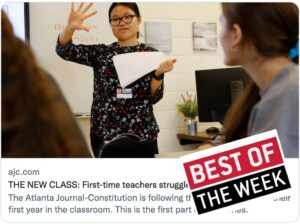
🏆 BEST: The best story of the week is First-time teachers struggle, triumph in metro Atlanta by Cassidy Alexander and Josh Reyes in the Atlanta Journal-Constitution. The first in a new series following three teachers during their first year teaching, this story zooms in and takes readers straight into the classroom and teachers’ firsthand experiences. The three teachers Alexander and Reyes profile are brutally honest about the toll of their jobs. But they don’t want to quit. Kudos to Alexander and Reyes for their nuanced firsthand reporting, which may remind you of Eli Saslow’s profile of a new teacher in the Washington Post. We can’t wait to see the rest of the series.
🏆 RUNNER-UP: This week’s runner-up is Boston schools lost 15,000 Black students in the past 20 years. Where did they go, and will they ever return? by Jenna Russell and Christopher Huffaker in the Boston Globe. While enrollment in Boston Public Schools has been in decline for years, Russell and Huffaker focus on the Black student population that has seen the largest changes — and talk to parents about their individual reasons for leaving Boston schools. The glacial pace of reform, the lack of control over which school their child goes to, and the proliferation of other options are some of the reasons parents offered. “We’re leaving because, at some point, enough is enough,” said one parent. The Globe is great at accountability stories combining data and feature reporting, and this one doesn’t disappoint. Districts should pay attention to what’s happening — and reporters should, too. Boston isn’t the only district going through this kind of transition.
BONUS:
🏆 At Washington State Special Education Schools, Years of Abuse Complaints and Lack of Academics (Seattle Times/ProPublica)
🏆 Once underperforming, East Boston High School made gains through the pandemic. (Boston Globe)
🏆 Amid teacher shortages, SC can’t afford to lose any more Black male educators (Post and Courier)
🏆 National charter school enrollment flat after early pandemic gains, according to report (Chalkbeat)
🏆 LAUSD’s stunning reading score on NAEP: Illusion, real or something in between? (EdSource)
🏆 Here’s how these Colorado students learn about the state’s deadliest day (Chalkbeat Colorado)
🏆 When the ‘gifted’ kids aren’t all right (Deseret News)
WHAT’S NEXT AFTER ‘SOLD A STORY’?
New from The Grade
In this week’s new piece from The Grade, reporters who’ve produced blockbuster stories about efforts to fix school reading programs share tips and strategies for other journalists that might want to explore what’s shaped up to be 2022’s biggest education topic: the reckoning over ineffective reading programs.
Focus your story on individuals who are going through “transformational experiences,” advises EdNC’s Rupen Fofario. “Take time to read about the research… so you can write about it simply,” says APM Reports’ Emily Hanford.
SERVING HOMELESS STUDENTS
Promising innovations & signs of progress
💡 A Washington school district is helping homeless students graduate by employing staff whose job is to guide them to the finish line. (Seattle Times)
💡 A sprawling rural community college district in California has built what’s now one of largest dual-enrollment programs in the state, second only to the district that covers LA. (EdSource)
💡 High schoolers in Los Angeles are setting more ambitious post-graduation goals after taking college-level courses offered through a New York nonprofit. (LA Times)
💡 As part of a comprehensive 2020 plan, school districts in Maryland are now offering free preschool for low-income families, raising teacher pay, and making room for apprenticeships and advanced coursework. (The 74)
💡 Alabama hopes to develop future educators by paying student interns to lead classrooms in short-staffed districts. (AL.com)
Follow me at @alexanderrusso for thought-provoking commentary all day, every day.

PEOPLE, JOBS
Who’s doing what, going where
Above, left to right: The New York Times’ Dana Goldstein and Vimal Patel.
🔥 Departures: In a major shift, the New York Times’s veteran national education reporter Dana Goldstein is leaving the education beat for a new beat focused on “how Americans are living today.” Meanwhile, Vimal Patel is moving to the education desk to report on free speech issues.
🔥 More departures: After more than two decades at the Boston Globe including a recent stint on the education team, Jenna Russell is leaving to join the New York Times as the New England bureau chief. (Another former education reporter at the Globe, Meghan Irons, is also leaving the paper to start teaching journalism at Boston University.)
🔥 Job moves: Former New York Post ed reporter Cayla Bamberger has joined the New York Daily News as an education and youth issues reporter. Em Espey is Bethesda Beat’s new education reporter. Jackie Orchard is the new KPCC community colleges reporter. Beth Wallis is the new education reporter at StateImpact OK. Congrats to all!
🔥 Layoffs: Columbus Dispatch education reporter Michael Lee says he’s part of the latest wave of Gannett layoffs. Give him a wave or send him job tips. And let us know if there are other education reporters going through layoffs, Gannett or otherwise.
🔥 Job openings: The San Antonio Report is hiring an education reporter. WAMU is hiring an education reporter. Chalkbeat Philadelphia is looking for a bureau chief. EducationWeek is hiring an assistant managing editor for policy and politics. Check previous editions of this newsletter for more jobs that may still be open.
🔥 A newsroom that cares: Even the hardest-hearted reader might be unable to resist journalist Susan Gonzalez’s Twitter thread about Chalkbeat, in which she describes how well the nonprofit outlet has treated her as she’s gone through personal and professional challenges. It’s the best fundraising appeal I’ve seen in a while.

PODCASTS, RESOURCES
What’s happening and new research
Above: If you’re a fan of School Colors and live in New York, join them for a rare in-person event about the podcast Dec. 15 at the Queens Public Library. Hosts Mark Winston Griffith and Max Freedman will be joined by NYC DOE Chancellor David Banks, and Chalkbeat New York’s Reema Amin will moderate.
⏰ Podcasts & webinars: WNYC rebroadcast DJ Cashmere’s APM Reports audio documentary about race and reckoning at a Chicago charter school he used to work for. Anya Kamenetz and The 74’s Kevin Mahnken were on a Progressive Policy Institute panel talking about the school choice election wave on Tuesday. You can watch the replay here. EdWeek’s Daarel Burnette II and Andrew Ujifusa talked about the transition from reporter to editor for EWA Radio. And congrats to Emily Hanford’s Sold a Story podcast, which was listed by Podchaser as one of 30 podcasts to discover in December!
⏰ Research & resources: AEI has a new report tying the steepest enrollment declines to districts with the most remote instruction in the pandemic. Education Next has a similar report. EdWeek has a new resource that reporters and editors could use when writing about school closure procedures. And in her latest newsletter, Poynter’s Kristen Hare rounded up several style guides from different journalism associations to help keep you up to date.
THE KICKER
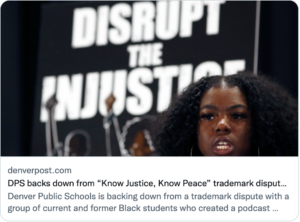
“This is a very beautiful story of the students not letting somebody trample on them.”
That’s the lawyer for a group of current and former Denver students who won their fight to keep the trademark of their podcast “Know Justice, No Peace,” which the district had allegedly tried to steal.
That’s all, folks. Thanks for reading!
Reply to this email to send us questions, comments or tips. Know someone else who should be reading Best of the Week? Send them this link to sign up.
Using Feedly or FlipBoard or any other kind of news reader? You can subscribe to The Grade’s “feed” by plugging in this web address: http://www.kappanonline.org/category/the-grade/feed/.
Read more about The Grade here. You can read all the back issues of The Grade’s newsletter, Best of the Week, here.
By Alexander Russo with additional writing from Colleen Connolly.
ABOUT THE AUTHOR

The Grade
Launched in 2015, The Grade is a journalist-run effort to encourage high-quality coverage of K-12 education issues.