Finding unexpected examples, providing first-hand observations, and giving national context are all key to success, according to this veteran education journalist.
By Kate Rix
Any journalist who has covered education for more than 24 hours will be well aware of the many seemingly intractable problems school districts face: lack of funding, family poverty, achievement gaps, poor teacher pay.
The list goes on and on.
For a lot of the problems on that list, there is rarely good news to report, either locally or on a national scale.
But I get curious once in a while about these so-called “intractable” problems.
Could it be that, in the absence of a perfect solution, we deprive our readers of messy but promising experiments taking place in many places?
Could it be that we journalists miss opportunities to write about real progress?
Over two decades of writing about public education, my general experience has been that there’s never a lack of bad news.
But aside from covering those issues — which of course we must do — we journalists can also mine them for glimmers of innovation.
If nearly every district is struggling with many of the same issues, then a lot of talented and caring people are coming up with possible solutions. Some of them are bound to bear fruit.
These stories — the ones about progress — are just as important as the ones about what is broken.
Progress is real and exploring it may provide much-needed momentum for others to embark on their own innovation.
These stories — the ones about progress — are just as important as the ones about what is broken.
To give others a better sense of how I approach this kind of reporting, here’s an example of a story I wrote recently about a district in Phoenix where they’ve found ways to bolster the numbers of Black teachers.
The story idea started as I was thinking about missed opportunities to highlight innovation last August, while reporting about a program in Oakland, California, that focuses on young Black boys and men.
One of the program’s pillars is that Black boys and young men need Black male role models as teachers, coaches, and mentors.
There’s a lot of research to back this up. Black kids who have a Black teacher by the third grade are more likely to go to college.
And yet, there aren’t a lot of places where Black and Latino kids are exposed to teachers who look like them.
If having teachers that look like them is so good for kids, who is doing a good job of hiring and retaining teachers of color? Where is progress being made to align teacher workforce ethnicity with student population ethnicity?
Where is progress being made to align teacher workforce ethnicity with student population ethnicity?
This question would lead me far away from Oakland and into the realm of efforts to retain teachers of color.
First, I did a search for “teacher diversity progress” and found a study that identified Highline Public Schools, outside of Seattle, as a leader in hiring and retaining teachers of color to align with its very diverse student body.
After interviewing district officials, who are indeed working hard to diversify their teacher workforce, I came away thinking, ‘everybody knows Seattle is an innovative place. There’s got to be a better example of progress on this issue, someplace less predictable than the home of Amazon and Starbucks.’
Another search revealed an article about Arizona, a state where the teacher workforce is significantly less diverse than students. Buried deep in the article was a reference to Phoenix Union High School District — an exception to the rule — where nearly half of teachers were not white.
I visited Phoenix and spoke with the superintendent, teachers, and school principals about how they have been able to retain teachers of color. Their approach is very intentional, it turned out, and has already produced results.
Over the past two years, the district has hired six teachers from among its non-teaching staff, including a Black bus driver who recently earned his teaching credentials and now teaches history.
In bright red Republican Arizona, this one district was doing more than most to attract and retain teachers that looked like its Black, Latino, and Native American students.
In bright red Republican Arizona, this one district was doing more than most to attract and retain teachers that looked like its Black, Latino, and Native American students.
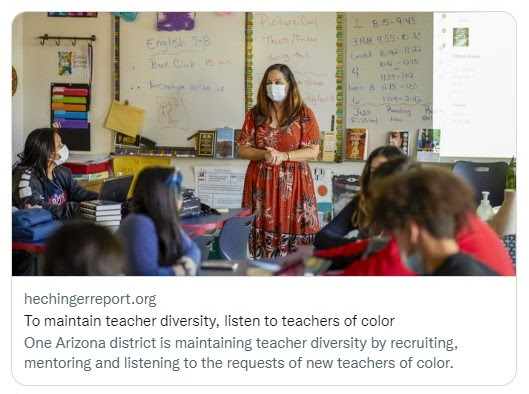
Above: In Phoenix Union School District, hiring panels are diverse, non-traditional candidates are welcome, and more than half of the district’s administrators are people of color. Roughly 40 percent of the district’s teachers are Black, Hispanic, Asian, or Native American.
Sound too good to be true? Already looking for problems? I get it.
Here’s how I wrote a story about innovation and progress — but avoided creating a puff piece:
I focused on the evidence, not the district’s aspirations.
Veteran teachers told me that the district has kept them happy in their jobs by inviting them to collaborate and create their own courses.
Latino teachers developed a literature course for seniors focused on Chicano writers.
Black teachers did the same, with a focus on Black authors.
I focused on first-hand observations rather than district quotes.
I kept quotes from district leaders to a minimum, focusing instead on what I saw and heard for myself.
In the lobby of the administration building there were photographs of the superintendent’s executive team. I counted (and confirmed) that most were people of color and included that detail in my story.
I spoke with parents who described how important it was to them that their kids (of color) had teachers of color, including Black teachers who arranged tours of historically Black colleges and universities every year.
I provided national and research context.
I placed Phoenix in a broader landscape of districts and nonprofits facing the challenges of making teaching a viable and sustainable career for people of color.
The story I wrote also refers to plenty of research about how students fare in classrooms where their teachers look like them, as well as how white students respond to diverse teachers.
I felt that the higher level the view I could take on Phoenix’s work, the less I risked simplifying the story. I also didn’t want to present this one district’s progress as a solution. Nothing is that simple.
I got into the weeds of what problems the district was trying to fix, how they were trying to fix them and some things they learned along the way.
By doing these things, I avoiding writing a fluffy piece and I produced a play-by-play that another district might learn from
I produced a play-by-play that another district might learn from.
To be sure, it’s easier for me, writing for a national trade outlet, to do this than it might be for a beat reporter.
I can drop in and look at a big initiative like the one in Phoenix, while a local reporter is responsible for all the bleak news that comes out of school board meetings.
A local reporter would probably be accused of writing a puff piece if they focused positive attention on the district they cover.
But that’s too bad.
We shouldn’t fear sharing promising stories with our readers, as long as we’re not fawning over the programs and people we describe — and as long as we have the data and stick to what we know, measuring progress against intentions.
I think the journalistic obstacles are surmountable. Local education news teams can balance their accountability coverage with stories about progress (when there really is some) by embedding their more positive stories with context and outside commentary.
If readers see that you’ve done your homework — that you know what real progress looks like — they’ll trust you.

Above: The author
This isn’t the first or only time I’ve taken this approach to a story. Another example is this piece about how Dallas is desegregating its schools with an enrollment formula that pulls from the richest and poorest parts of town.
But I’d love to hear what other education journalists think about all of this.
I’m no expert, but I have had experience writing hard-hitting stories that show how some districts are trying to do better.
Writing about these examples doesn’t mean giving districts an A for effort. It’s about sharing ideas that may hold promise elsewhere and help more kids down the road.
Kate Rix is a freelance journalist based in Oakland. You can follow her at @mskaterix.
Previously from The Grade
The case for covering promising innovations and preliminary successes
Making education news more useful (Greg Toppo)
The promise and peril of “solutions” journalism
5 bad habits education journalists need to break
Negative COVID coverage and prolonged school shutdowns
Education journalism is stuck. What’s holding it back?
ABOUT THE AUTHOR

The Grade
Launched in 2015, The Grade is a journalist-run effort to encourage high-quality coverage of K-12 education issues.