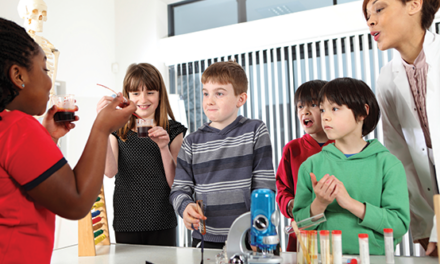
Middle school students learned from college student tutors about their African history and culture while building literacy skills in a cooperative environment.
Most people do not have fond memories of middle school. It is a time of transition and uncertainty for young people; they are leaving elementary school, are not quite teenagers, and are starting to go through puberty. Scientists consider the middle school years “a ‘sensitive period’ for social and emotional learning, when the brain is primed to learn from social cues” (Field, 2021). According to the National Academy of Sciences, middle schoolers’ brains are going through an enormous growth period, one in which they are paying most of their attention to their social world (Field, 2021). The findings suggest that middle schoolers need something very different from their schools and their teachers than what they receive.
The problem of middle schools missing the mark with students is not new. Prior to desegregation, it was not uncommon for school districts to house early learning through 8th grade in the same building. As enrollments increased, after the Brown v. Board of Education decision, junior highs emerged, covering grades 7 to 9. The modern middle school model of grades 6 to 8 became widespread in the 1970s. Since its inception, Paul S. George (2009) explains, no one “really seemed to know what a middle school was supposed to be.”
In their influential 1968 work, The Emergent Middle School, William Alexander and Emmit Williams “proposed that the middle school build its programs on a core curriculum, guidance programs, exploratory education and vocational and home arts . . . excluding competitive sports and subject matter orientation” (Manning, 2000). The idea was that middle school should address needs specific to young adolescents. Unfortunately, many middle schools did not follow this model and instead were structured like mini-high schools, where students move between classes when the bell rings with little time devoted to the social and emotional learning that is integral to the holistic development of adolescents. According to the Collaborative for Academic, Social, and Emotional Learning (Elbertson et al., 2009), schools traditionally focus on academic instruction, but adolescents thrive when they feel emotional connections to their teachers and peers. What middle schoolers need is an environment that gives them choice and agency and that builds on their interest in peer connections to create cooperative learning environments.
We centered our model on middle schoolers’ needs to connect with their peers and adults, to build relationships, and to have social and emotional support.
The social isolation of the pandemic created an even greater need for peer-to-peer connections. But, while schools recognized the mental health issues produced by the pandemic, they still put energy into “the great catch up” by focusing on academic learning (St. George et al., 2021). There have been some efforts to increase opportunities for social-emotional learning, especially as middle school teachers have observed their students exhibiting behavior on returning to school that they associated more with elementary school students (Belsha, 2021). But by and large, schools have not radically reimagined themselves.
Learning through culture and connection
We are two college professors, one Black at a historically Black university and one white at a predominantly white institution. Given the massive changes within schools at the height of the pandemic, we thought this was an ideal time and opportunity to create new models for learning. However, we were aware of concerns about learning loss and decided that we could use the need to boost literacy skills while attending to students’ emotional needs as a space for reimagining.
What resulted was a near-peer tutoring and mentoring model for literacy instruction that paired our college students with middle school students. Instead of focusing on improved test performance, we centered our model on middle schoolers’ needs to connect with their peers and adults, to build relationships, and to have social and emotional support. Additionally, we wanted cultural identity to be a key part of the experience, because young adolescents are exploring who they are in the world. We created a model for literacy learning that drew upon the tenets of cultural responsiveness and was specifically grounded in African identity. We launched the program in Baltimore City Schools, which has a student enrollment that’s more than 80% Black.
Decades of research confirm the benefits of culturally responsive teaching, which emphasizes the need to validate young people’s identities while they are learning (Alim, Paris, & Wong, 2020; Gay, 2010; Ladson-Billings, 1995, 2008). Our program drew on a framework from Hawaiian scholars, which suggests teachers of literacy should:
Promote literacy learning and build cultural identity: (a) literacy in the indigenous and dominant languages; (b) community connections; (c) a shared vision that encompasses cultural knowledge, academic proficiency, and community service; (d) authentic assessment; and (e) teaching grounded in cultural knowledge and aimed at higher level thinking and advocacy. (Keehne et al., 2018)
To this framework, we added the notion of Afrocentricity, which Molefi Asante (1991) describes as:
a frame of reference wherein phenomena are viewed from the perspective of the African person. The Afrocentric approach seeks in every situation the appropriate centrality of the African person. In education, this means that teachers provide students the opportunity to study the world and its people, concepts, and history from an African worldview.
A community built on sharing
We recruited college student tutors from our respective campus networks before the 2021-22 school year began. We ended up with four skilled tutors who worked with 15 middle schoolers selected by their teachers. Tutors worked with students twice a week during the school day for the entire year, drawing on skills acquired from their own English classes and employing modeling strategies we introduced. Tutees were pulled from their daily English language arts class. They were divided into three groups based on the literacy test scores provided by the school. One group met toward the end of their class time, and the other met at the start of their class. The third group was pulled from a self-contained class during their in-class reading time. Tutoring sessions were originally designed for 30-45 minutes of engagement, however, time constraints reduced the engagement time to 20-30 minutes per session.
Each session was a lesson in African heritage as well as language learning. They had geography lessons on Africa, read African folk tales, and learned African-centered ideas like the seven principles of Kwanzaa. Slowly, the tutors and middle schoolers connected with each other. They made jokes; learned about each other’s lives; and built on a common set of references from American pop culture, their own personal experiences, and the African-centered ideas in the lessons. The students we worked with did not have a great deal of knowledge about Africa or their African heritage. They were not even aware that some staff members at their school were born in Africa. This new learning captured these middle schoolers’ interest, and they were eager for more.
We trained the tutors, all of whom were Black, in the concepts of cultural responsiveness and Afrocentrism. Moreover, the tutors validated the African American English (AAE) students used and discussed Standard American English (SAE) to build on their understanding of both versions of the language. During sessions and on assignments, tutors and students often engaged in code-meshing, which is when students use more than one language or dialect in a single composition (Behizadeh, 2017; Canagarajah, 2013; Young et al., 2014). Code-meshing differs from code-switching (Wheeler & Swords, 2006) in that code-switching generally entails using one language for one audience and then switching to a different language for another audience. In code-meshing, a student might incorporate AAE in a persuasive essay that is primarily in SAE or use SAE in a narrative that is primarily in AAE, instead of choosing either AAE or SAE for the entire composition.
A more engaging approach
Often, the middle schoolers would mention that they did not want to go back to their regular classes. When we examined the English class’s curriculum, we found they were reading a series of novels and completing computer-based reading comprehension exercises. There was little room for culturally responsive practice or building community around the readings.
One teacher told us that this was only her second year of teaching, and she was not sure how to make the curriculum more responsive. Another more-experienced teacher was able to tailor the curriculum to the students, but there was only so much wiggle room. The administrator in charge of curriculum and professional development explained that the school was primarily concerned with improving literacy skills, which were measured exclusively by test scores. It was not lost on us that the teachers were white, teaching an exclusively Black student population. The cultural divide, although addressed in some professional development training sessions, was obvious.
In interviews, the middle schoolers reported that their tutoring time was a relaxed space where stories and jokes were told, and tutors said they could see the full personalities of the middle schoolers.
This lack of responsiveness in the school’s curriculum was evident in the tutoring program. The middle schoolers we worked with found their regular English language arts classes boring. They told us that the tutors made learning fun and were patient with them. “They would stay on a topic and made sure we all learned it before we moved on,” one student explained. Additionally, tutors worked with the middle schoolers in groups, and the students often helped each other too. This did not happen in their classrooms, where teachers stuck to their pacing calendars. Moreover, teachers did not engage students in close reading of texts. We found in working with middle schoolers that tutors needed to break down sentences and paragraphs and to reread texts. This was enormously helpful in building students’ understanding.
The tutors also spent time on basic language arts skills. Having been out of school during the pandemic, the middle school students needed a refresher on parts of speech and vocabulary. There was little time for review in their classrooms, so the tutors’ efforts were invaluable. They taught parts of speech through games, which helped the middle schoolers remember the content. Using vocabulary drawn from African folk tales, they worked in teams, competed with each other, and played hand games, which built on their natural interest in play and peer-to-peer engagement. They matched their new vocabulary in SAE with more familiar words in AAE, validating both languages and supporting their development in both as well.
In each session, middle schoolers got to free-write, practice handwriting, and draw. We found that middle schoolers liked old-school paper and pencil, much as they liked reading actual books and text on paper. The tutors asked the middle schoolers to write about their neighborhoods, families, favorite foods, holidays, vacations, and what they liked to do when not in school. This provided an opportunity for students to share who they were with the tutors. The tutors also shared their lives with the middle schoolers. In interviews, the middle schoolers reported that their tutoring time was a relaxed space where stories and jokes were told, and tutors said they could see the full personalities of the middle schoolers.
The future of this model
At the end of the school year, the administration told us that, although they really liked what we were doing, we would not be invited back the following year. The school had decided to hire teaching assistants who could be at the school full time and help the students in their classrooms with the work they were assigned. Their hope was that more intensive support would move the needle more dramatically on state tests.
We still have hope for reimagining how middle schoolers grow their literacy skills, but a few conditions need to be met for culturally responsive programs like ours to succeed. First, schools need to get comfortable veering from the script of test score accountability. They need to be OK with taking risks and accept the possibility of “creative failures.” Although culturally responsive and sustaining practices have considerable research support, implementing these practices “is likely to involve many mistakes” (Puzio et al., 2017, p. 231).
Second, we need to let students learn from one another in peer groups and at their own pace. We found this to be appealing to middle schoolers because of their developmental need to have agency and connect with their peers.
Third, middle schoolers value connecting with near-peers or adults who are willing to get to know them. Tutors and middle schoolers reported that one major factor contributing to the program’s success was the relational connection. They were excited to spend time with their tutors and brought with them a willingness to learn, which contributed to their growth.
Finally, centering culture was essential. Middle schoolers had a window and a mirror in the tutoring program. The middle schoolers were able to see themselves and have their language validated while also learning about standard English, which is key to navigating the public school world.
We hope that middle schools can take these lessons and reimagine the possibilities for their students.
References
Alim, H.S., Paris, D., & Wong, C.P. (2020). Culturally sustaining pedagogy: A critical framework for centering communities. In N. Nasir, C.D. Lee, R. Pea, & M. McKinney de Royston (Eds.), Handbook of the cultural foundations of learning (pp. 261-276). Routledge.
Asante, M.K. (1991). The Afrocentric idea in education. Journal of Negro Education, 60, 170-180.
Behizadeh, N. (2017). “Everybody have their own ways of talking”: Designing writing instruction that honors linguistic diversity. Voices from the Middle, 24 (3), 56-62.
Belsha, K. (2021, September 27). Stress and short tempers: Schools struggle with behavior as students return. Chalkbeat.
Canagarajah, A.S. (2013). Negotiating translingual literacy: An enactment. Research in the Teaching of English 40 (1), 40-67.
Elbertson, N., Brackett, M., & Weissberg, R. (2009). School-based social and emotional learning (SEL) programming: Current perspectives. In A. Hargreaves, A. Lieberman, M. Fullan, & D. Hopkins (Eds.), Second international handbook of educational change (pp. 1,017-1,032). SpringerLink.
Field, K. (2021). Middle school’s moment: What the science tells us about improving the middle grades. And why now’s the perfect time to overhaul the way we educate early adolescents. Hechinger Report.
Gay, G. (2010). Culturally responsive teaching. Multicultural Education Series. Teachers College Press.
George, P.S. (2009). Special series: Part 1: Renewing the middle school: The early success of middle school education. Middle School Journal, 41 (1), 4-9.
Keehne, C.N., Sarsona, M.W., Kawakami, A.J., & Au, K.H. (2018). Culturally responsive instruction and literacy learning. Journal of Literacy Research, 50 (2), 141-166.
Ladson-Billings, G. (1995). Toward a theory of culturally relevant pedagogy. American Educational Research Journal, 32 (3), 465-491.
Ladson-Billings, G. (2008). “Yes, but how do we do it?”: Practicing culturally relevant pedagogy. In W. Ayers, G. Ladson-Billings, G. Michie, & P.A. Noguera (Eds.), City kids, city schools: More reports from the front row (pp. 162-177). The New Press.
Manning, M.L. (2000). A brief history of the middle school. The Clearing House: A Journal of Educational Strategies, Issues and Ideas, 73 (4), 192.
Puzio, K., Newcomer, S., Pratt, K., McNeely, K., Jacobs, M., & Hooker, S. (2017). Creative failures in culturally sustaining pedagogy. Language Arts, 94 (4), 223-233.
St. George, D., Strauss, V., Meckler, L., Heim, J. & Natanson, H. (2021, March 15). How the pandemic is reshaping education. The Washington Post.
Wheeler, R.S. & Swords, R. (2006). Code-switching: Teaching Standard English in urban classrooms. National Council of Teachers of English.
Young, V.A., & Barrett, R., Young-Rivera, Y., & Lovejoy, K.B. (2014). Other people’s English: Code-meshing, code-switching, and African American literacy. Parlor Press LLC.
This article appears in the October 2022 issue of Kappan, Vol. 104, No. 2, pp. 17-21.

ABOUT THE AUTHORS

Jessica T. Shiller
Jessica T. Shiller is a professor of education at the College of Education at Towson University, Towson, MD.
Inte’a DeShields
Inte’a DeShields is an assistant professor in the Department of English and Language Arts at Morgan State University, Baltimore, MD.