How to write about hot-button issues like teaching kids to read — and ways to advance a story that’s already been told.
By Alexander Russo
Social media lit up late last week when Inside the Massive Effort to Change the Way Kids Are Taught to Read first showed up online.
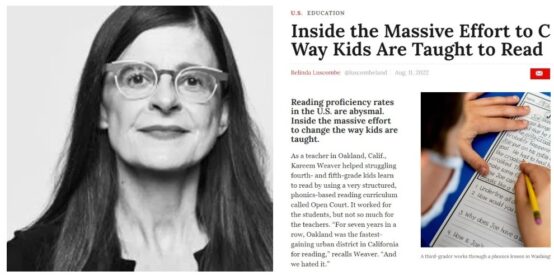
The 3,500-word TIME magazine story by Belinda Luscombe encapsulated the long, frustrating story of how reading instruction evolved in U.S. classrooms and recent efforts to reconsider those practices in light of dismal results.
Luscombe had written a previous piece about parents of dyslexic children advocating for improved services and results. And in a recent phone interview she revealed that her very first job in journalism was as an education reporter at the Daily Telegraph in Australia. She also comes from a family of teachers and originally trained to be one. “That is actually how I got into journalism,” she told me.
However, she did not come to this story with a long history writing about education issues. And the narrative she set out to tell was one that many readers might have heard before, through the work of APM Reports’ Emily Hanford or others.
Nonetheless, Luscombe’s retelling has generated an enormous response from readers — thanks, Luscombe believes, to all the help she received from experts and practitioners, as well as powerful insights from former teacher Kareem Weaver:
“For seven years in a row, Oakland was the fastest-gaining urban district in California for reading,” recalls Weaver. “And we hated it.”
It’s also worth noting that Luscombe found a way to tell a dramatic story without creating a superficial narrative of evildoers and altruists — or suggesting that a miraculous solution is just around the corner. The story is also very well written, full of sharp observations and a gripping opener.
In the following interview, Luscombe shares some of the backstory behind the reporting and writing of the piece, explains how she added to a narrative Hanford and others had already covered, and gives some hard-won advice about how to write compelling and constructive stories about hot-button education issues.
“Always be more curious than furious,” says Luscombe. “If you see what you consider to be an injustice, your blood rises…But it is important to stay curious. Why is this happening?”
Always be more curious than furious. If you see what you consider to be an injustice, your blood rises… But it is important to stay curious. Why is this happening?
This interview has been edited and condensed.
How did this story come to be in the first place?
Belinda Luscombe: My editor came to me and said, I’d really like you to look into a reading story and I began to read up on what was happening. I realized there was probably a pretty good story there, although at some point I said to her, ‘look, APM Report’s Emily Hanford has done this story before.’ But they [the editors] were like, ‘we think there’s still an audience,’ and that seems to have been true.
How much concrete influence do you think Hanford’s work has had?
BL: Short answer: lots, at least within the education community. I don’t think I spoke to a person who didn’t mention it. Everybody also pointed out that she had the receipts, as the kids say.
How has the reception been so far?
BL: Actually I thought it would sink like a rock, but in fact I think that’s not what has happened. I don’t know how I feel about this, but it has sort of got tagged as a political story as well. I guess because of Kareem’s words, and I did say in my story that it has somehow got caught up in the sort of divisions that America is finding itself in.
And for some reason that’s not been clear to me — and did not seem clear to people like Louisa Moats and all these others — the phonics team seems to have been associated with a sort of more conservative political position, and that has added some juice to the fire of it getting a lot more attention. It’s been one of the best performing stories on our site for a few days.

Above: Graphic from the TIME story explaining some of the differences between balanced literacy and phonics.
What do you feel like you added or updated that you felt like was original or moved the story forward?
BL: I thought that the order in which I told it in, which was that dyslexic parents were very much the canaries in the coal mine and they were the ones who sort of began the ball rolling in a lot of state houses, and that this would not really have taken off without their work, I thought that was an insight. If you read every one of Emily’s stories, you see it there, but you know, not everybody’s reading all five.
And then I don’t think Emily got into the political side as much, and obviously she did not know about the NAACP involvement — although maybe her more recent stuff has done a little bit more on the civil rights aspects of it. But I don’t think she ever mentioned the NAACP petition. So, I guess I if I added anything — which I would not necessarily say I did, because Hanford’s stories were solid — I think it’s just a wider reach, or a different reach. And then maybe a little bit more about the sort of non-educational reasons that it happened.
Are there any other new developments in your piece — or changed dynamics to the debate in 2022?
BL: The other thing, I guess that has happened since her piece, is there’s this new book, Shifting the Balance, whose authors are trying to find a middle ground and having a lot of commercial success by doing that. They’re saying, ‘it’s not that much of a shift, let’s move it just a little bit this way,’ rather than seeing this is a revolution in which there are two camps, one of which we have to crucify: ‘I won’t accept anything less than the crucifixion of Fountas and Pinnell and Calkins! Hang them from the gibbets,’ sort of thing.
Honestly, it would surprise me that people got into teaching or got into curriculum to not teach people to read. Like, why would you? I don’t think we should start from the position that people set out to do harm to these kids. Of course not.
But in America right now, it’s quite difficult to have evolution. It’s much more an era of revolution. So, every change that you want to make has to be made with a lot of finger-pointing.
I don’t think we should start from the position that people set out to do harm to these kids… But in America right now, it’s quite difficult to have evolution.
Were there any particular challenges to reporting and assembling this story?
BL: I did feel quite overwhelmed at times because I’m not a specialist in this. And so to sort of understand it all … phew. Luckily TIME is somewhere that will still give you a little time, so the story’s been underway for months. And then, of course, I am super lucky and privileged that most people will return my calls.
So there’s a lot of people who I didn’t quote — Louisa Moats and Daniel Willingham and a whole bunch of people — who talked to me, who did not get credited. But they really helped me sort through what was going on because it’s daunting. And I do see my role, as someone who has been in journalism a long time, to actually try to make stories as reader-friendly as possible.
Do you feel your piece is fair to balanced literacy, whose adherents believed — and may still believe — that they were doing the right thing for kids?
BL: I contacted Heinemann and asked for interviews with Lucy Calkins and Irene Fountas and Gay Su Pinnell. They declined. I read through all the statements that they had released and tried to sum up their arguments to the best of my ability. I contacted some academics who had published studies that discounted the Science of Reading findings to hear what they had to say. And I think the inclusion of the Shifting the Balance authors who were formerly balanced literacy advocates gave an insight into the Balanced Reading point of view. We worked ridiculously hard at the graphic we included, running it by all sorts of people to try to make sure we were being fair. I find you often can’t see the unfairness of things until afterwards, so I may discover it was not enough. I think my mother still believes in whole language, and she seemed to think it fair, which, even with the built-in mother-bias, I took as a good sign.
How did you make the story accessible to non-education readers?
BL: I think what you have to do is you have to really force the people you’re talking to away from the language that they want to use. You see this in every profession. Everybody I talk to has a jargon that they use, and you have to either ask them to sort of explain it differently, or you have to say it back to them in a way that you think would be more reader friendly. Or you just say, ‘could you unpack what that really means?’ So it’s painstaking. The difficulty is clarity versus precision. There are people who would probably split hairs and say, ‘what you said is not really phonics,’ and I would say back to them, ‘it is phonics as people understand it.’
I think what you have to do is you have to really force the people you’re talking to away from the language that they want to use.
Who’s your audience for a story like this?
BL: I try to write for the most intelligent young mother in Milwaukee. She’s reading, she wants to be abreast of things but she’s busy and can’t pay attention to everything. So how can you speak to that person?
Do you have any favorite moments from the piece?
BL: It’s too soon to ask me that question because I’m still in that ‘I hate everything about my own writing’ period. But I really thought Kareem spoke incredibly well of the challenges that he’s facing. And I think he’s a very interesting and dedicated human. I love the thing he said at the end. I mean there’s a lot of people who were like appalled that they could have hurt somebody by teaching them the wrong way.
At the end where he said that he really laments thinking that children didn’t learn to read because they were too damaged or their parents weren’t reading to them, as a parent that sort of struck home.
My kids went to progressive schools and they didn’t read very well and still don’t read very well. At the time, I was like, ‘I guess they’re just not readers,’ and now I think, ‘Why did I not have more faith in my own children?’
Was there anything gripping or important that got left on the cutting room floor?
BL: I interviewed this great woman called Mary Dahlgren, and she said that after her first year of teaching and trying to help sixth graders learn to read, she started to get her real estate license, because she felt like such a bad teacher. Now she’s a literacy specialist; I interviewed her while she was doing some work among first nations people in Oklahoma. She got cut because a magazine page is ruthless and only fits what it fits.

Above: Luscombe and the TIME story she wrote.
What advice for fellow journalists would you give?
BL: The first thing is obviously the old journalistic saying, which is ‘if your mother says she loves you check it out.’ If Kareem told me he was working with the OUSD and told me this great stuff, then I have to call the OUSD and make sure he’s not making it up, even though he’s a fantastic source and I really want to include him. I want to make sure he’s not misunderstanding or overselling, you know, so I have to call them.
The second thing I think is really key at this moment is to always be more curious than furious. If you see what you consider to be an injustice — and a lot of journalists get into journalism to find injustice — your blood rises. But it is important to stay curious. Why is this happening? The world is not necessarily ‘bad guys’ and ‘good guys.’ It’s almost disappointingly rare that you can find one, a genuine bad guy — and especially in something like education.
The last thing is to be a miniaturist. Every word counts. Every metaphor counts. Work at finding the best one, so you can keep the piece short. If you’re not rewriting, are you really writing?
Previously from The Grade
How to report on whether district reading programs are any good (Colleen Connolly)
Cracking the code on reading instruction stories (Holly Korbey)
Why reading went under the radar for so long – and what one reporter is aiming to do about it
The lamentable rise of ‘conflict’ journalism
ABOUT THE AUTHOR
Alexander Russo
Alexander Russo is founder and editor of The Grade, an award-winning effort to help improve media coverage of education issues. He’s also a Spencer Education Journalism Fellowship winner and a book author. You can reach him at @alexanderrusso.
Visit their website at: https://the-grade.org/