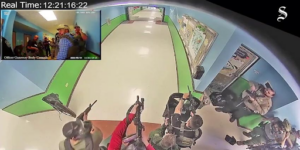
In this week’s newsletter: The Austin American-Statesman released a shocking video showing the police response inside Robb Elementary in Uvalde. Vulnerable kids continue to bear the brunt of pandemic education disruption, despite increased awareness of their plight. Two stories explore the extent to which schools and parents should be responsible when tragedies occur. A handful of education reporters announced their decisions to change jobs. And Abbott Elementary received a LOT of Emmy love.
VULNERABLE STUDENTS
The big story of the week, according to us:
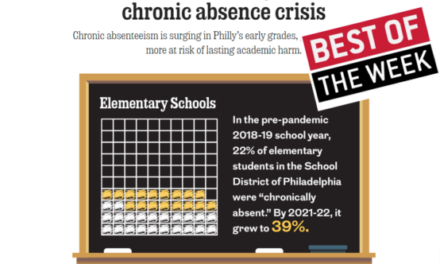
The big story of the week is the continuing plight of vulnerable students. It’s no secret that the decisions schools made during the pandemic hit them hardest. But even as kids are back in school, vulnerable students continue to suffer the consequences — and it may take years or a lifetime to catch up:
🔊 The pandemic set back big Latino gains in education. How to get them back on track? (NBC News) See also AP.
🔊 New Study: Black, Special Ed Students Punished at Greater Rate Through Pandemic (The 74)
🔊 Covid learning loss has been a global disaster (The Economist)
🔊 Denver bilingual programs face a threat: not enough students (Chalkbeat Colorado)
🔊 Youth under Michigan foster care claim they did not receive ‘real’ education (NBC News)
🔊 Report: Thousands fewer CT children in child care since COVID (CT Mirror)
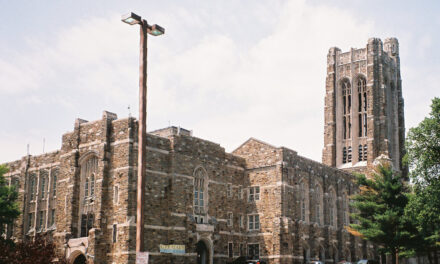
Other big stories this week: The parents of students who were killed in Uvalde continue to demand answers from officials about what happened inside the school (Texas Tribune, New York Times). Meanwhile, the Austin American-Statesman released a video from inside Robb Elementary and an explanation of why they did so. The release and the reaction received coverage from the Washington Post, Texas Tribune, and Houston Chronicle.
Also: In the wake of enrollment declines and the need to invest in student recovery from the pandemic, districts are adjusting their budgets and facing scrutiny for how they are allocating dollars (Chalkbeat Philadelphia, Philadelphia Inquirer, State House News Service, Wisconsin Public Radio, Vox). And though it seems like summer has just begun, some schools are already wary of what the next school year will bring as new COVID variants emerge and teacher shortages continue (NBC Bay Area, Chicago Tribune).

PREVENTING TRAGEDIES
The best education journalism of the week, according to us:
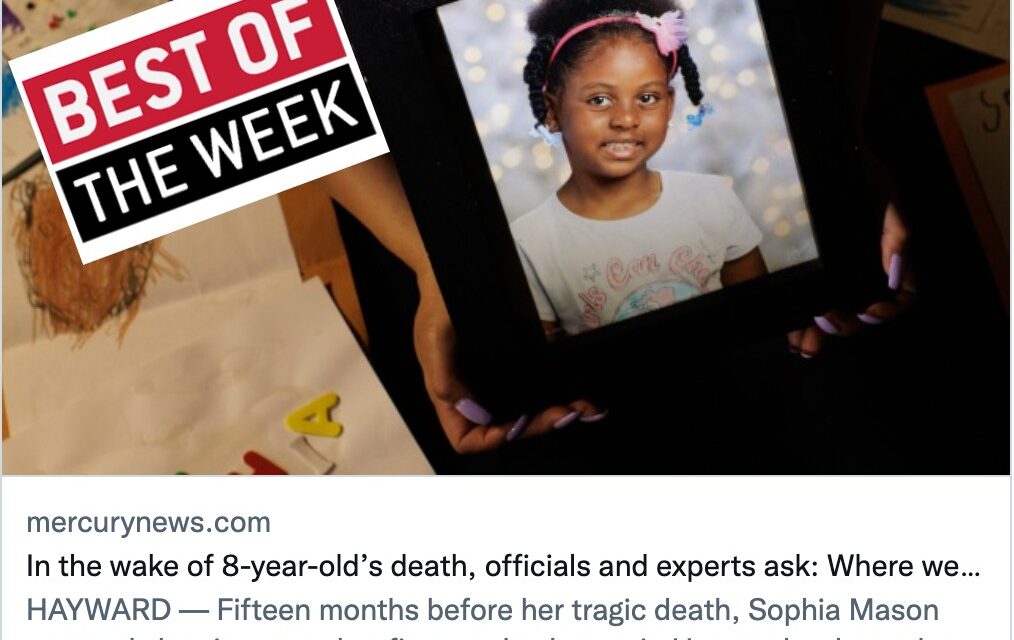
🏆 BEST: The best story of the week is In the wake of 8-year-old’s death, officials and experts ask: Where were Hayward schools? by Maggie Angst in the California-based Mercury News. It tells the tragic story of Bay Area student Sophia Mason, who stopped showing up to school and was eventually found dead 15 months later. Based on Angst’s reporting, the school district failed to follow its own policies on truancy and never followed up on concerns brought by the child’s relatives who tried to get the school involved. How many other kids are still missing from enrollment records with no followup from schools? The tragic outcome of this story is rare, but it is still incredibly important for reporters to dig a little deeper. We’ve heard a lot about the students who have seemingly disappeared from schools in the pandemic, but this story stands out because it holds schools to account for their role in keeping track of students and reporting them if they are chronically absent. More reporters should do the same.
🏆 RUNNER-UP: This week’s runner-up is When Parents Report a Child to Avert a Shooting by Tawnell D. Hobbs and Sara Randazzo in the Wall Street Journal. Following every school shooting are questions about whether it could have been prevented. What were the signs that parents, teachers, and counselors refused to see or failed to report? In this story, Hobbs and Randazzo give readers a rare glimpse into the decision making of parents who did report their children. For one family, a mother reporting her son resulted in a felony charge for the teen and some backlash from other relatives who thought his mother shouldn’t have involved the police. The story is emotional, vivid, and intimate, featuring candid comments from both the mother and the son (who now refers to his obsession with school shootings as a passing interest). The story is hard to read but worthwhile for anyone trying to better understand these tragedies and work to prevent the next one. What a great piece of journalism.
BONUS STORIES:
🏆 Minnesota’s Somali American Teacher of the Year is leaving the classroom. What happened? (Sahan Journal)
🏆 This Eagle County summer camp helps keep kids engaged and school-ready (Colorado Public Radio)
🏆 Identifying with their pain, a teacher made a club for students who’ve lost a parent (NPR)
🏆 Black, Latino Teachers Collecting $835 Million in Discrimination Lawsuit (Wall Street Journal)
🏆 How have Massachusetts school districts spent their $2.5 billion in federal COVID funds? Mostly, they still haven’t. (Boston Globe)
🏆 ‘I Felt Trapped’: Sexual Abuse of Teens in the Military’s J.R.O.T.C. Program (New York Times)
🏆 “Critical race theory” is being weaponised. What’s the fuss about? (Economist)

DE-CATASTROPHIZING THE NEWS
New commentary from The Grade
Journalism has come to be dominated by hyper-negative coverage — full of chilling quotes, frightening anecdotes, and ominous language. The education beat is arguably the worst offender.
But increasing numbers of people (and a handful of journalists) have come to avoid this distressing, repetitive, and alienating approach. And some outlets and teams — including various education labs, the Christian Science Monitor, and KPCC’s College Pathways — are already providing readers with the hope, agency, and dignity that Amanda Ripley called for in a recent Washington Post op-ed.
In this week’s new column, I explain how the education beat could help save journalism from its alienating approach of focusing on the worst-case scenarios and most frightening anecdotes — along with a list of recent examples that show how to do it better. “Real life is hard, and we need to know about it,” writes Ripley, who has shown amazing leadership. “But we deserve a fuller picture of the problems — and the solutions.”
Big thanks to CJR, the COVID Policy Update, and Fox for including last week’s interview with former NPR reporter Anya Kamenetz.
Follow me at @alexanderrusso for thought-provoking commentary on education journalism all day, every day.

PEOPLE, JOBS, AWARDS
Who’s doing what, going where
Above, clockwise from upper left: Journalists on the move including Perry Stein (Washington Post), Debbie Truong (LA Times), Bianca Vázquez Toness (AP), and Meghan Mangrum (TBD).
🔥 Career moves: The Washington Post’s Perry Stein is leaving the beat to join the paper’s national desk to report on the Justice Department. Along with Anya Kamenetz, Stein is the second veteran education reporter to leave the beat in the past two weeks. Education reporter Bianca Vázquez Toness announced on Thursday that she’s leaving the Boston Globe and joining the newly expanded AP education team. Debbie Truong is leaving WAMU to report on higher ed for the L.A. Times. Meghan Mangrum is leaving The Tennessean but promises she’s not leaving the beat.
🔥 Also: Patrick Wall has officially joined Chalkbeat’s national team and penned his first national story. Former Indy Star city government reporter Amelia Pak-Harvey is Chalkbeat Indiana’s newest reporter. Voice of San Diego has tapped Jakob McWhinney to replace Will Huntsberry, who is now a senior investigative reporter. It appears the Hartford Courant’s Seamus McAvoy has moved on, according to his Twitter bio. Good luck and congrats to all!
🔥 ICYMI: The Wall Street Journal’s Tawnell D. Hobbs talked about her story on the parents who call the police if their child talks about school shootings on This Morning with Gordon Deal. Education Week’s Alyson Klein moderated a panel yesterday on learning acceleration featuring Deputy Secretary of Education Cindy Marten. Former NPR education reporter Anya Kamenetz spoke about her book “The Stolen Year” at the National Association of Secondary School Principals Summit.
🔥 Job openings: The Dallas Morning News is hiring an engagement reporter for their Education Lab. The Boston Globe is hiring a replacement for Vázquez Toness on their Great Divide team. No word yet on when or whether the Hartford Courant, Tennessean, and WAMU will replace departing reporters. We’re told the Post will put out a job announcement next week and that no decision has been made yet about replacing Kamenetz at NPR.
🔥 Awards & recognition: ProPublica’s Nicole Carr won the July Sidney Award from the Sidney Hillman Foundation for her story on how white parents chased a Black educator out of town. And congrats to former education reporters Kenya Hunter and Mackenzie Wilkes who have been accepted to the Data Institute, a collaboration by ProPublica, the Ida B. Wells Society for Investigative Reporting, and OpenNews.
🔥 The Atlanta Journal-Constitution’s new education editor Eric Stirgus tells us he’ll focus the team’s reporting on school safety, student loan debt, how race is taught in schools, mental health, teacher retention, and student academic performance. “Our goal is to cover the conversation over CRT more aggressively,” he added, “and find ways to improve the coverage of our districts.”
PODCASTS, POLLS, & NEW RESOURCES
Above: A still from the video the Austin American-Statesman published from inside Robb Elementary.
⏰ Podcasts: School Colors came out with a bonus episode last week on how COVID changed everything in a Queens school district. The episode was also shared on NPR’s Throughline podcast. WBUR On Point broadcast an episode on lessons from America’s brief experiment with universal free school meals. And the education-focused Have You Heard podcast dove into the controversy over a proposed mental health center at a Connecticut school — inspired by reporting from the CT Mirror’s Ginny Monk.
⏰ New ventures: Vox has launched a weekly parenting newsletter called Extra Curricula, and Chalkbeat has just announced a new advice column After the Bell, which aims to give teachers “validation, support, and actionable advice.”
⏰ Resources: New research from Attendance Works dives into the students missing from classrooms and the state policies and practices in those places. A report from the OECD, UNESCO, UNICEF, and the World Bank “shows no relationship between the extent of school closures and COVID-19 infection rates across countries.”
⏰ Poll results: A New York Times/Siena College poll revealed that “only 4% of voters combined said education, crime, or immigration was the most important issue facing the country.” A new poll for the American Federation of Teachers shows Democrats have lost ground on education and suggests they should fight back on CRT and book-banning while emphasizing basics of schooling as their core value.
THE KICKER

In case you’ve been hiding under a rock somewhere, the breakout hit TV show Abbott Elementary about a group of Philadelphia teachers received numerous Emmy nominations this week. Catch up this weekend!
That’s all, folks. Thanks for reading!
Reply to this email to send us questions, comments or tips. Know someone else who should be reading Best of the Week? Send them this link to sign up.
Using Feedly or FlipBoard or any other kind of news reader? You can subscribe to The Grade’s “feed” by plugging in this web address: http://www.kappanonline.org/category/the-grade/feed/.
Read more about The Grade here. You can read all the back issues of The Grade’s newsletter, Best of the Week, here.
By Alexander Russo with additional writing from Colleen Connolly.
ABOUT THE AUTHOR

Alexander Russo
Alexander Russo is founder and editor of The Grade, an award-winning effort to help improve media coverage of education issues. He’s also a Spencer Education Journalism Fellowship winner and a book author. You can reach him at @alexanderrusso.
Visit their website at: https://the-grade.org/